Inburgering Listening Hacks: Catch Fast Speech Keywords
When you sit down for the Dutch civic integration exam (inburgeringsexamen), the listening section (Luisteren) often triggers the greatest anxiety....
Read more
This article was written by AI and published by StroopTaal.
AI can get things wrong. For anything official, check the source it points to.
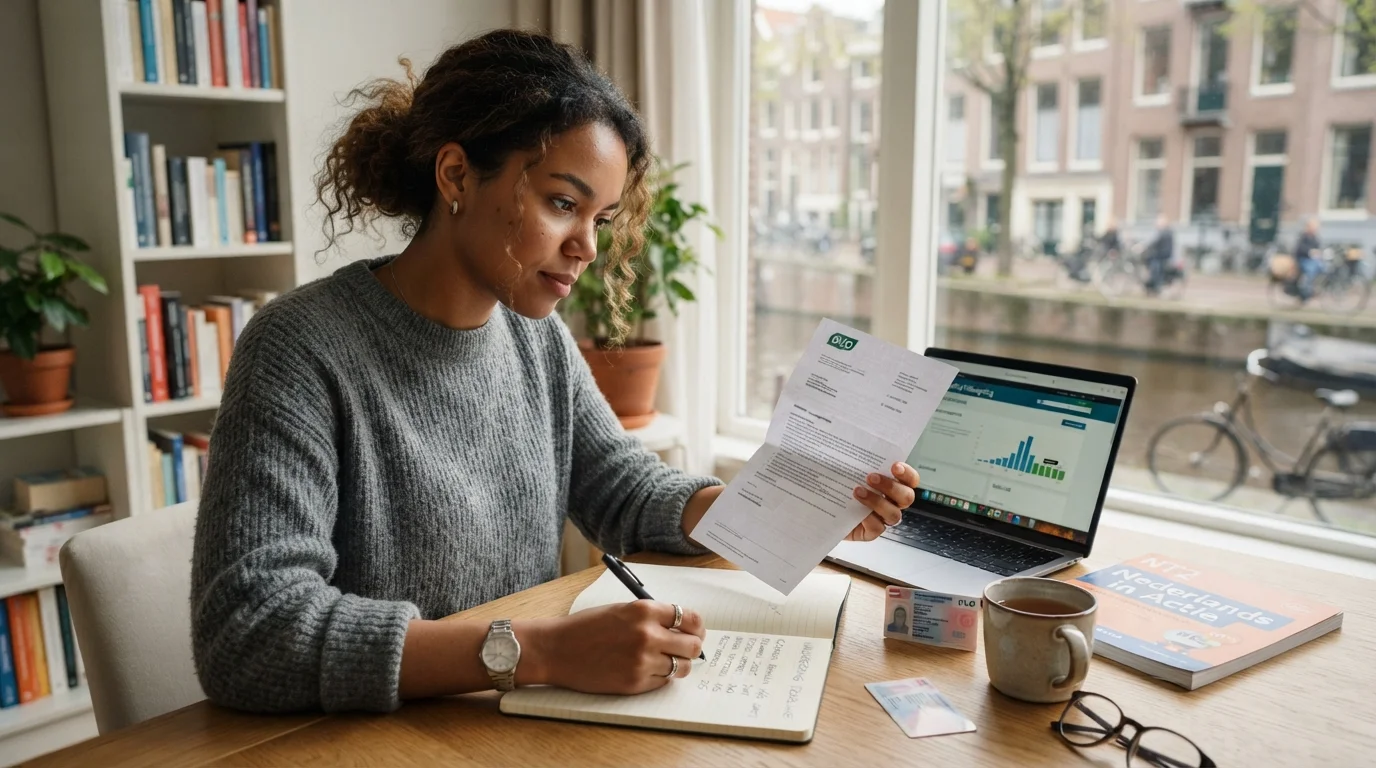
AI-generated image

Preparing for the Dutch civic integration exam (inburgeringsexamen) can feel daunting, especially as candidates transition to the higher B1 level. Among the four core language skills tested by DUO, the writing exam (Schrijven) requires both practical communicative competence and strict grammatical precision. One of the most common prompt types you will encounter is writing an email seeking information (een e-mail om informatie vragen).
Whether you need to ask a local community centre about room rental, inquire about a sports club membership, or request details about an evening training course, the exam board expects a structured, polite, and cohesive response. In this comprehensive guide, we will break down the exact anatomy of a high-scoring B1 inquiry email, provide reusable Dutch sentence templates, examine full model answers, and show you how to avoid typical pitfalls that cost candidates valuable points.
At the B1 level under the Common European Framework of Reference (CEFR), your writing must demonstrate independence. Unlike the shorter, rudimentary notes expected at A2, B1 tasks require you to connect ideas smoothly, use nuanced conjunctions, vary your vocabulary, and sustain a consistent level of politeness. If you are still weighing the differences between the two standards, our guide on the difference between A2 and B1 integration exams offers a helpful breakdown of expectations.
The writing test is administered on a computer at an official exam location. You typically complete four distinct writing assignments within a 40-minute window. When you receive an email prompt asking for information, the official examiners evaluate your work against several strict criteria:
Official exam guidelines can be reviewed on the DUO Inburgeren website, where you can verify official exam scheduling and procedures.
To score high marks consistently, memorize a clear four-step layout. This structural framework keeps your writing logical and prevents you from forgetting critical prompt requirements under exam pressure.
Your opening sets the tone immediately. Check the prompt carefully to see if a recipient name is provided.
Geachte heer/mevrouw,Geachte heer Jansen, / Geachte mevrouw De Vries,Beste heer Jansen, / Beste meneer Jansen,Beste Sophie, / Hallo Pieter,Punctuation rule: Always place a comma after the salutation. In Dutch, the sentence that follows begins on a new line with a capital letter.
Never jump into your questions without establishing context. Explain where you found the information and why you are reaching out. This demonstrates B1 fluency.
Ik schrijf deze e-mail omdat ik geïnteresseerd ben in... (I am writing this email because I am interested in...)Naar aanleiding van uw advertentie op de website wil ik graag... (Following your advertisement on the website, I would like to...)Ik heb gelezen dat u binnenkort een cursus organiseert over... (I read that you are organizing a course soon on...)Via een kennis hoorde ik over uw organisatie, en ik wil graag wat meer informatie ontvangen. (Through an acquaintance, I heard about your organization, and I would like to receive more information.)This is where you answer each bullet point in the assignment. At the A2 level, learners often write three separate short questions: Wat kost het? Wanneer begint het? Waar is het? At B1, this is insufficient. You should introduce questions using complex structures, indirect queries, and clear transition words.
Ten eerste zou ik graag willen weten wat de kosten van de cursus zijn. (Firstly, I would like to know what the costs of the course are.)Daarnaast vraag ik me af of het mogelijk is om... (In addition, I wonder whether it is possible to...)Bovendien wil ik weten op welke dagen de lessen plaatsvinden, omdat ik op dinsdagavond moet werken. (Moreover, I want to know which days the classes take place, because I have to work on Tuesday evenings.)Ten slotte zou ik willen vragen of er een korting is voor studenten. (Finally, I would like to ask if there is a discount for students.)Conclude your email politely by stating what you expect next, followed by an appropriate sign-off.
Ik zie uw reactie met belangstelling tegemoet. (I look forward to your response.)Alvast hartelijk dank voor uw moeite en uw antwoord. (Thank you very much in advance for your effort and answer.)Zou u mij de informatie per e-mail kunnen toesturen? (Could you send me the information by email?)Sign-offs to use:
Met vriendelijke groet, (followed by your first and last name)Hartelijke groeten, / Groetjes, (followed by your first name)The defining marker of B1 writing is the ability to construct embedded or indirect questions. An indirect question softens a direct demand and requires subordinate clause word order (where the conjugated verbs move to the end of the clause).
| Direct Question (A2 style) | Indirect Question (B1 style) | Grammar Note |
|---|---|---|
| Hoeveel kost het abonnement? | Kunt u mij vertellen hoeveel het abonnement kost? | Verb kost shifts to the end of the clause. |
| Is er parkeergelegenheid? | Ik wil graag weten of er parkeergelegenheid is. | Use of (whether/if); verb is goes to the end. |
| Wanneer begint het evenement? | Zou u mij kunnen laten weten wanneer het evenement begint? | Polite modal zou... kunnen + subordinate verb at end. |
Combining indirect questions with strong vocabulary creates the variety examiners look for. If you want to expand the terms you use across the writing exam, explore our guide on building your Dutch exam vocabulary.
Let us look at two authentic practice prompts typical of the Inburgering B1 writing exam, along with high-scoring sample texts.
Prompt:
U heeft een advertentie gezien voor een avondcursus Spaans voor beginners bij een talenschool. U wilt deelnemen, maar u heeft nog een paar vragen. Schrijf een e-mail naar de talenschool waarin u:
Model Answer (B1 Level):
Geachte heer, mevrouw,
Naar aanleiding van uw advertentie op internet schrijf ik deze e-mail. Mijn naam is Alex Chen en ik zou graag willen deelnemen aan de cursus Spaans voor beginners. Volgende zomer ga ik namelijk voor mijn werk naar Spanje verhuizen, waardoor ik de taal graag zo snel mogelijk wil leren.
Voordat ik me definitief inschrijf, heb ik echter nog een aantal praktische vragen. Ten eerste zou ik graag willen weten op welke data en tijdstippen de lessen precies plaatsvinden. Omdat ik overdag werk, hoop ik dat de lessen na 18:30 uur beginnen.
Daarnaast wil ik graag weten hoeveel de volledige cursus kost. Kunt u mij vertellen of de boeken en het online lesmateriaal al bij deze prijs zijn inbegrepen, of dat ik die apart moet aanschaffen?
Ten slotte vraag ik me af tot welke datum ik mij uiterlijk kan aanmelden voor deze cursus.
Alvast hartelijk dank voor uw tijd en moeite. Ik zie uw antwoord met belangstelling tegemoet.
Met vriendelijke groet,
Alex Chen
Why this passes with flying colours:
Prompt:
U organiseert een verjaardagsfeest voor uw partner en wilt een zaaltje huren in het buurthuis. Schrijf een e-mail naar de beheerder van het buurthuis waarin u:
Model Answer (B1 Level):
Beste meneer De Wit,
Ik stuur u dit bericht omdat ik op zoek ben naar een geschikte locatie voor een verjaardagsfeest. Op zaterdag 14 november viert mijn partner zijn veertigste verjaardag, en we zouden dit feest graag in het buurthuis willen vieren.
Om te bepalen of de ruimte geschikt is, wil ik u graag een paar vragen stellen. Allereerst zou ik willen weten voor hoeveel personen de zaal geschikt is. Wij verwachten namelijk ongeveer veertig gasten.
Verder vraag ik me af wat de regels zijn met betrekking tot catering. Is het toegestaan om zelf hapjes en drankjes mee te brengen, of zijn we verplicht om gebruik te maken van de bar in het buurthuis?
Tot slot wil ik graag weten of er een muziekinstallatie in de zaal aanwezig is die wij kunnen gebruiken tijdens het feest.
Ik hoop spoedig iets van u te horen. Bij voorbaat dank voor uw hulp.
Met vriendelijke groet,
Elena Rossi
Even advanced speakers make avoidable errors when writing under exam conditions. Keep these common traps in mind:
In standard main clauses starting with an adverb or time phrase, Dutch requires inversion: the verb comes before the subject. For instance, write Daarnaast wil ik weten... instead of Daarnaast ik wil weten....
In English, "you" works everywhere. In Dutch, switching between u and je is a significant stylistic error. If you start with Geachte heer/mevrouw, stick strictly to u, uw, and u heeft. If the email is addressed to a friend with Beste [Voornaam], stay with je, jouw, and je hebt throughout.
When asking a yes/no question indirectly, learners frequently translate literally from their native tongue. In Dutch, you must use of (whether/if):
Ik wil weten als er parkeerplaatsen zijn. (Using als here is an English carryover error).Ik wil weten of er parkeerplaatsen zijn.Examiners check off the prompts bullet by bullet. If you write a beautifully worded email that only addresses three of four requested points, your maximum score for task fulfillment is automatically capped. Before finishing, read through each bullet in the exam prompt and locate where you addressed it in your draft.
With only 40 minutes for four short tasks, you must manage your time efficiently. Allocate roughly 8 to 10 minutes per prompt, leaving the final 60 to 90 seconds of each task for a fast, disciplined review:
Met vriendelijke groet,?Consistent, targeted practice is key to developing natural sentence flow and mastering Dutch word order. While reading sample answers builds familiarity, actively typing complete texts under time constraints helps eliminate hesitation on exam day. For the speaking component, similar principles apply—structured responses make all the difference, as covered in our guide on Inburgering B1 speaking exam practice.
If you are looking for structured digital practice, StroopTaal offers dedicated exam practice for the inburgering exam at A2 and B1, covering reading, writing, listening, speaking, and KNM. You practice each section individually against an exam timer. With StroopTaal Premium, the app grades your writing tasks with AI, keeps track of your results, and provides a readiness score for each part of the test. In addition, its Sentence Check feature identifies grammar and sentence structure mistakes in the sentences you type, explaining the rules behind each correction so you can spot and fix errors before your official exam date.
Before you enter the test centre, keep this quick summary in mind:
With structured preparation and regular writing practice, writing a clear, professional inquiry email will become second nature on your path to completing the civic integration exam.
Share this article:
When you sit down for the Dutch civic integration exam (inburgeringsexamen), the listening section (Luisteren) often triggers the greatest anxiety....
Read moreMoving to the Netherlands comes with a long list of bureaucratic rites of passage: registering at the gemeente, setting up your DigiD, and opening a...
Read morePreparing for the Dutch civic integration exam (inburgeringsexamen) can feel like a dual challenge: you are not just learning a language, you are...
Read more