
30 Essential KNM Exam Terms: Dutch Society and Politics
Preparing for the Dutch civic integration exam (inburgeringsexamen) can feel like a dual challenge: you are not just learning a language, you are...
Read more
This article was written by AI and published by StroopTaal.
AI can get things wrong. For anything official, check the source it points to.
AI-generated image
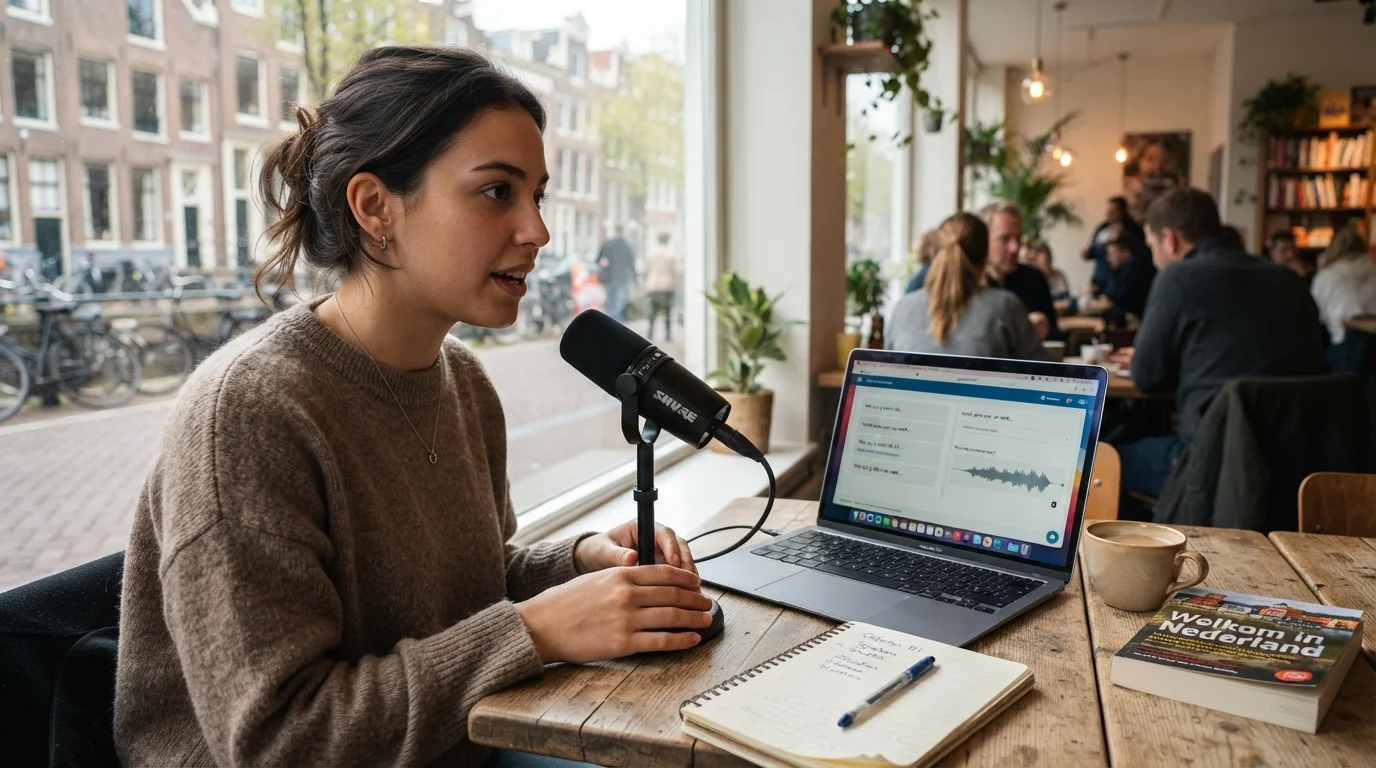
Preparing for the Dutch civic integration exam (inburgeringsexamen) can feel intimidating, particularly when stepping up to the CEFR B1 level. Unlike the entry-level A2 assessment, the B1 speaking exam (Spreken) expects candidates to express nuanced opinions, compare alternatives, explain causes and effects, and navigate both professional and social situations in the Netherlands. If you are scheduling your testing date or ramping up your autumn study plan, focusing on practical speaking prompts will give your preparation the structure it needs.
Whether you are trying to decide whether to take the A2 vs B1 Dutch integration exam or you are already locked into the B1 trajectory under the modern integration framework, targeted practice is key. In this comprehensive guide, we unpack the structure of the Inburgering B1 Speaking exam, provide thematic practice prompts, examine high-scoring answer structures, and show you how to train effectively on your own.
The B1 speaking test is administered digitally at official test centres run by the Education Executive Agency (DUO). You sit at a computer terminal equipped with a headset and microphone. You do not speak to a human examiner across a table; instead, prompts appear on screen, and your audio responses are recorded and later evaluated by certified raters.
The test evaluates two primary styles of oral communication:
To achieve a passing mark at B1, assessors do not expect flawless, native accentuation. However, they strictly look for:
Many candidates who passed A2 easily assume B1 requires only a slightly larger vocabulary. In reality, the communicative demand changes fundamentally:
At A2, short, descriptive sentences suffice. If asked about your commute, an acceptable A2 response might be: "Ik ga met de trein naar mijn werk. Dat vind ik fijn, want het is snel. Soms heeft de trein vertraging."
At B1, raters expect elaboration, nuanced viewpoint construction, and hypotheticals. A comparable B1 response requires depth: "Ik reis meestal met het openbaar vervoer naar kantoor, hoewel de treinen tijdens de spits vaak overvol zijn. Aan de ene kant bespaart reizen met de trein mij parkeerkosten in het centrum. Aan de andere kant ervaar ik regelmatig vertragingen door herfstbladeren op het spoor, waardoor ik soms te laat kom voor overleggen. Daarom overweeg ik om vaker thuis te werken."
Notice the deliberate structural shifts: subordinate conjunctions (hoewel, waardoor), contrasting markers (aan de ene kant... aan de andere kant), and causal connectors (daarom).
October marks the start of the colder Dutch autumn, bringing seasonal workplace shifts, educational terms, and community discussions to the forefront. These authentic prompts reflect the exact register, social themes, and communicative dilemmas common in the B1 speaking exam.
Prompt A: Remote Work vs. Office Presence
Context: Uw leidinggevende wil dat alle medewerkers vanaf november weer vier dagen per week naar kantoor komen om de teamgeest te versterken. U werkt liever twee dagen thuis en twee dagen op kantoor.
Opdracht: Geef uw mening over dit voorstel. Leg uit waarom u liever deels thuiswerkt. Noem minimaal twee voordelen van thuiswerken en één nadeel van elke dag op kantoor zijn. Geef een alternatieve oplossing.
Prompt B: Training Request
Context: U merkt dat uw team overstapt op een nieuw softwareprogramma. U wilt graag een cursus volgen om uw vaardigheden te verbeteren.
Opdracht: Laat in een bericht aan uw manager weten waarom deze cursus belangrijk is voor uw dagelijkse werkzaamheden. Vertel wanneer u de cursus wilt volgen en hoe uw taken worden opgevangen terwijl u afwezig bent.
Prompt C: Energy Conservation and Sustainable Living
Context: De herfst is begonnen en de energieprijzen stijgen. De bewonerscommissie van uw appartementencomplex stelt voor om de centrale verwarming overdag een graad lager te zetten om kosten te besparen.
Opdracht: Wat vindt u van dit idee? Bent u voor of tegen? Geef twee argumenten voor uw standpunt. Vertel ook welke maatregelen u zelf in uw eigen woning neemt om energie te besparen.
Prompt D: Neighborhood Activity Organization
Context: Uw buurtvereniging wil in het najaar een bijeenkomst organiseren om nieuwe buurtbewoners te verwelkomen en samen de straat schoon te maken.
Opdracht: Vertel of u mee wilt helpen. Waarom wel of niet? Welke activiteiten stelt u voor om de sfeer te verbeteren? Geef minstens één concreet voorbeeld uit uw eigen ervaring.
Prompt E: Healthy Lifestyle and Children's Sports
Context: De gemeente overweegt om naschoolse sportactiviteiten gratis te maken voor alle kinderen, maar dit betekent dat er bezuinigd moet worden op culturele uitjes zoals museumbezoeken.
Opdracht: Vergelijk beide opties. Welke optie vindt u belangrijker voor de ontwikkeling van kinderen? Onderbouw uw mening met duidelijke argumenten en trek een conclusie.
Prompt F: Doctor Visit Dilemma
Context: U belt de huisartsenpraktijk omdat u al twee weken aanhoudende vermoeidheidsklachten heeft. De assistent stelt voor dat u nog een week afwacht.
Opdracht: Reageer beleefd maar duidelijk op de assistent. Leg uit waarom u nu een afspraak wilt en welke impact de klachten hebben op uw dagelijks leven en werk.
When the recording light turns red, panic can lead to disjointed sentences. Having a mental template ensures that you deliver a structured response that meets the examiner's rubric every single time. Similar to how you approach structuring clear, logical answers in the writing exam, speaking benefits from an orderly framework: the OREC model.
State your position clearly in the opening sentence without ambiguity.
Provide the underlying explanation using complex conjunctions that trigger inversion or subclauses.
Ground your argument in a concrete scenario or weigh an alternative perspective.
Summarize your perspective and provide an actionable conclusion.
Many candidates with conversational fluency still fail the B1 speaking component due to recurring test-taking errors. Keep these potential stumbling blocks in mind:
In conversational English, word order stays largely constant. In Dutch, subordinate conjunctions such as omdat, hoewel, toen, and zodat push the conjugated verb to the very end of the clause. Mixing this up is the most frequent grammatical penalty at B1.
Incorrect: *Ik wil een cursus volgen omdat ik wil mijn Nederlands verbeteren.
Correct: Ik wil een cursus volgen omdat ik mijn Nederlands wil verbeteren.
In the official DUO exam, candidate recordings cannot be paused or restarted. If you freeze or make a slip of the tongue, do not stop speaking. Correct yourself naturally and continue: "Wat ik eigenlijk bedoel is..." (What I actually mean is...) or "Laat ik het anders formuleren..." (Let me phrase that differently...). The scoring rubric rewards self-correction when executed smoothly.
At A2, a 15-second answer is often sufficient. At B1, if the prompt gives you one minute to speak and you stop after 18 seconds, you will not have demonstrated the linguistic range required for a passing grade. Aim to fill at least 75% to 80% of the allotted recording window with coherent, relevant Dutch.
Practising speaking when living a busy routine can be challenging, particularly if your daily work environment is in English or your Dutch friends switch to English whenever you hesitate. While human conversation practice is invaluable, structured, daily repetition is what cements grammatical confidence.
This is where specialized tools help bridge the gap. The language learning app StroopTaal is designed specifically around the Dutch of daily life, work, and the integration exams in the Netherlands. For speaking practice, StroopTaal offers Taalmaatje, an AI conversation partner (clearly identified as software before you begin). With Taalmaatje, you can call and speak Dutch out loud about practical everyday situations, including simulated doctor visits or job interviews, and review the full transcript afterward. To refine clarity, the app's pronunciation practice feature scores your spoken words and sentences and provides targeted advice on what to improve.
Furthermore, StroopTaal includes dedicated Inburgering exam practice at the B1 level. You can practise each section of the exam—including speaking, reading, writing, listening, and KNM—individually under timed conditions. The app grades your speaking and writing with AI, logs your history, and provides a readiness score for each component, helping you gauge your preparation before registering for your exam via Mijn Inburgering.
Performing well under artificial test conditions requires mental preparation. The environment inside an official DUO computer room can feel unusual:
Achieving a passing score on the Inburgering B1 Speaking exam does not require theatrical eloquence or a native Dutch accent. It requires reliable control of sentence structure, the ability to link ideas logically, and consistent practice answering realistic prompts under time constraints. Spend time each week formulating arguments, recording your thoughts, and polishing your pronunciation. By breaking down prompts into clear opinions, reasons, and conclusions, you can approach your exam date with confidence and poise.
Share this article:
Preparing for the Dutch civic integration exam (inburgeringsexamen) can feel like a dual challenge: you are not just learning a language, you are...
Read moreFor expats, international professionals, and newcomers making the Netherlands their long-term home, the Dutch civic integration exam...
Read moreMoving to the Netherlands and embarking on your civic integration journey (inburgering) is an exciting milestone, but the financial reality can...
Read more