Master Inburgering Dutch Vocabulary: A Guide for Busy Adults
Balancing a demanding career, administrative responsibilities, and family life in the Netherlands leaves little room for extensive language study....
Read more
This article was written by AI and published by StroopTaal.
AI can get things wrong. For anything official, check the source it points to.
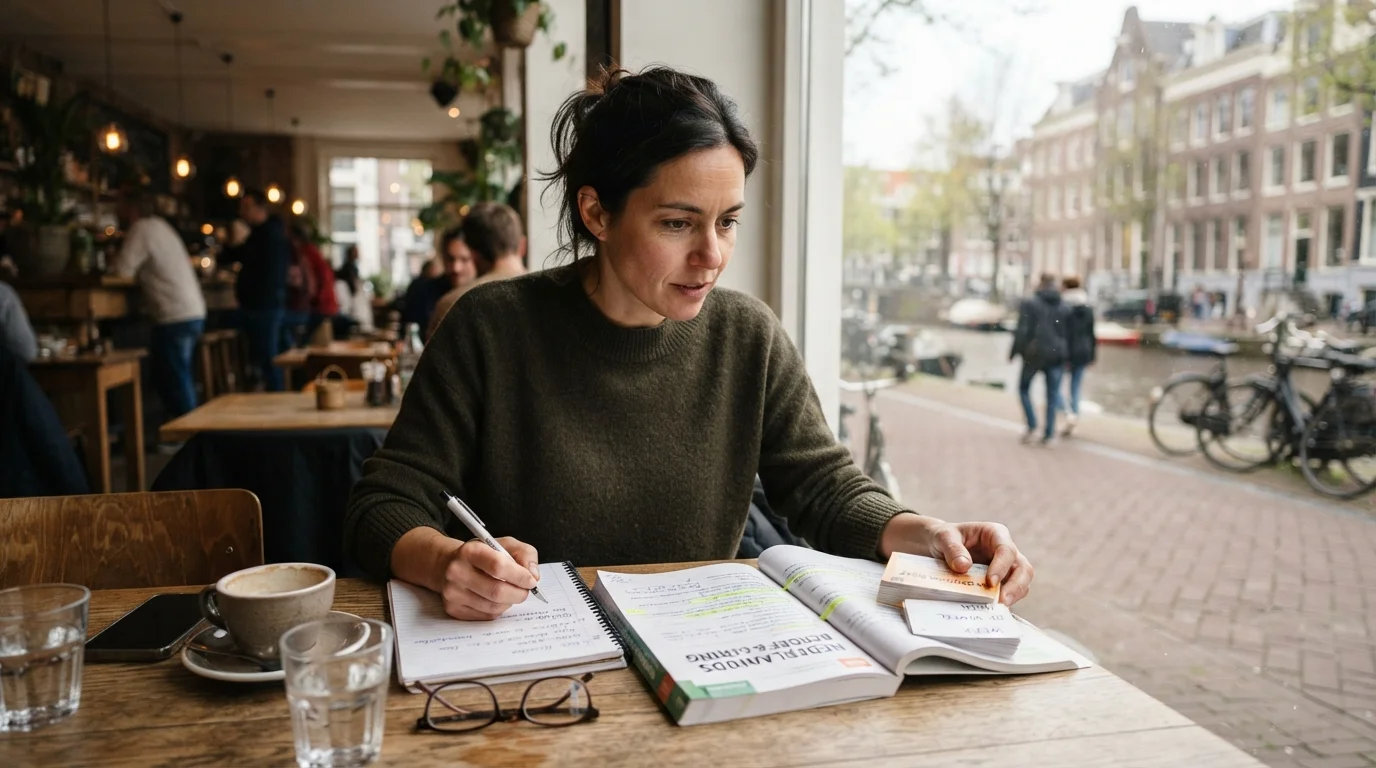
AI-generated image

When you sit down for the Dutch civic integration exam (inburgeringsexamen), the listening section (Luisteren) often triggers the greatest anxiety. You put on your headphones, click play, and instead of the measured, textbook Dutch you have been studying, you are hit with a rapid stream of syllables that seem to melt into one another. Words connect, unstressed endings disappear, and before you have registered the speaker's first sentence, the audio dialogue is already moving to the next point.
This experience is universal among expats and language learners. Spoken Dutch in daily life—and in official exams—relies heavily on rhythm, vowel reduction, and consonant assimilation. When preparing for the exam, whether you are choosing between the A2 and B1 exam or navigating the requirements set out by the Dutch Education Executive Agency (DUO), understanding how to dissect this rapid speech is crucial.
In this guide, we break down why fast Dutch sounds so elusive, how native speech patterns alter familiar words, and actionable hacks you can use during the exam to isolate key words, filter out distractions, and confidently select the correct answers.
To decode fast Dutch, you first need to understand the mechanics of Dutch phonetics. Native Dutch speakers do not pronounce each word in isolation. Instead, they optimize their speech for efficiency, creating sound patterns that can mislead your ear if you are only used to reading printed texts.
In standard Dutch spoken in the Netherlands, the final letter -n of infinitives and plural nouns is almost universally silent in everyday speech. Words like werken (to work), maken (to make), and boeken (books) sound like werke, make, and boeke. If you are listening for an audible -n to identify a plural noun or a verb form, your brain will hesitate while the recording continues to play.
Dutch is a stress-timed language. This means stressed syllables receive full acoustic weight, while unstressed syllables are reduced to a quick, neutral schwa sound (like the 'a' in 'about'). Personal pronouns frequently shift to their weak forms:
A phrase written as "Wat heb je gisteren gedaan?" rarely sounds like four discrete words. In natural, fast speech, it often sounds like "Waddebje gistere gedaan?". If you try to parse each word individually, you will quickly experience mental fatigue.
When the final consonant of one word meets the initial vowel or consonant of the next, Dutch speakers blend them. For instance, in het becomes in 't (sounding like int), and op de frequently blends into oppe. Recognizing these common audio contractions prevents you from mistaking blended small words for unfamiliar vocabulary.
The listening exam administered under the Dutch integration system tests your practical comprehension in everyday Dutch situations. The audio clips are designed to mimic genuine interactions in the Netherlands, as outlined in official civic integration policies on government.nl.
Typically, the exam contains audio clips paired with multiple-choice questions. You will hear scenarios such as:
The exam does not test your ability to transcribe every single syllable. It evaluates whether you can extract the primary message, locate a specific detail (like a time, price, or location), and recognize a speaker's intention. To excel, you need a strategy tailored around this format.
Rather than trying to listen passively to everything, use these four active strategies to train your ears and target the words that determine the correct answer.
Before the audio starts, you are given a short window to read the question prompt and the possible answers. Never waste this time. You are not just reading; you are creating mental radar traps.
Dutch exam designers love distractors. A speaker will often mention option A, only to clarify or correct themselves moments later, making option B the correct answer. You can spot these conversational shifts by tuning your ear to discourse markers.
Whenever you hear any of the following pivot words, pay immediate attention—the critical information usually follows right after:
Because Dutch reduces unstressed syllables, native speakers naturally place heavier volume, higher pitch, and longer duration on content words—specifically nouns, main verbs, and key adjectives. Function words (prepositions, articles, auxiliary verbs) are pronounced rapidly and softly.
If an announcement sounds like a whirlwind, ignore the soft murmurs and anchor your attention exclusively to the louder, stressed beats:
"Dames en heren, door een storing rijden er geen treinen tussen Utrecht en Amersfoort."
Even if you missed the connecting words, catching storing (technical fault), geen treinen (no trains), and the two city names gives you everything required to answer what is happening.
A classic exam scenario involves two people agreeing or disagreeing. One speaker suggests an idea, and the second speaker begins with a polite acknowledgment, such as "Ja, dat klopt, maar..." or "Ja, leuk idee, alleen...".
Inexperienced test-takers hear "Ja", immediately check the box for the first option, and stop listening. Always wait until the second speaker finishes their full thought before deciding on your answer.
Executing these hacks during the exam requires structured practice before test day. Listening comprehension is a physical skill that develops as your brain creates neural templates for fast Dutch sounds.
Dictation forces your brain to bridge the gap between written orthography and spoken phonetics. Listen to a short audio clip (10 to 15 seconds) at normal speed. Attempt to write down precisely what you hear. When you review your transcription against the original text, look closely at where your transcription failed. Did you miss a small preposition? Did you fail to separate a separable verb? Regular dictation directly trains your ear to dissect blended speech.
If you are looking for audio resources to build into your schedule, exploring targeted listening exam practice audio will help you get accustomed to the formal pacing used in test environments.
Relying solely on simplified audio can leave you unprepared for the variety of accents, background noise, and speech tempos on the exam. It helps to practice with real-world scenarios—such as automated telephone menus, doctor's appointments, and train delays.
In the StroopTaal app, listening practice is built around realistic situations. You can work through listening scenes that feature real-world settings like phone calls, announcements, and counter conversations. You answer questions on what you heard, save new vocabulary to review later, and even practice dictation exercises where you write down the exact words spoken. With accompanying transcripts that follow the audio word by word, you can tap on any unfamiliar term to immediately inspect its meaning and see how it fits into the rhythm of the sentence.
As your test date approaches—especially if you are keeping track of recent updates like the Inburgering B1 exam changes—you need to test your keyword-spotting skills under actual exam conditions.
StroopTaal includes dedicated exam practice for both the A2 and B1 inburgering exams (as well as Staatsexamen NT2 Programma I and II). You can practice the listening section on its own with a timer, matching the single-component format of the official test. The app tracks your results and provides an exam readiness score, helping you see where your listening comprehension stands before you enter the official test center.
Before you sit down for your exam, keep these principles front of mind:
Listening to fast Dutch can feel overwhelming at first, but native speech follows consistent phonetic rules. By learning how speakers reduce sounds, anticipating common distractors, and focusing on content words, you can demystify the audio stream and approach your inburgering listening exam with calm confidence.
Share this article:
Balancing a demanding career, administrative responsibilities, and family life in the Netherlands leaves little room for extensive language study....
Read morePreparing for the Dutch civic integration exam (inburgeringsexamen) can feel daunting, especially as candidates transition to the higher B1 level....
Read moreMoving to the Netherlands comes with a long list of bureaucratic rites of passage: registering at the gemeente, setting up your DigiD, and opening a...
Read more