How to Avoid Housing Scams in the Dutch Rental Market
Finding a home in the Netherlands can feel like a race. Affordable rooms and apartments disappear within minutes, landlords may ask for documents...
Read more
This article was written by AI and published by StroopTaal.
AI can get things wrong. For anything official, check the source it points to.
AI-generated image

In Dutch, wo means “where” and is used to ask about a location, place, or position. You will hear it constantly in everyday conversations: Wo woon je? means “Where do you live?”, while Wo is het station? means “Where is the station?” Learning wo is essential for anyone studying Dutch, moving to the Netherlands, or preparing for a Dutch integration exam.
Although the word is short, Dutch learners often need to understand several related forms, including waar, waarheen, and waarvandaan. This guide explains exactly how to use wo, when to choose another question word, how Dutch word order works, and how to sound more natural in real conversations.
Wo is an informal or conversational form of waar, the standard Dutch word for “where.” In spoken Dutch, people commonly say wo, especially in phrases such as Wo ben je? and Wo ga je heen? In careful writing, formal communication, and many textbooks, waar is usually preferred.
Some Dutch speakers use waar in all situations, while others use wo naturally in casual speech. Neither should confuse you: they have the same basic meaning. If you are writing an official letter, completing an exam, or speaking in a formal situation, waar is the safest choice.
The difference between wo and waar is mainly about register and pronunciation. Waar is the complete, standard form. Wo is shorter and more relaxed. It is similar to the difference between a formal and conversational expression in English, although Dutch speakers may switch between the two without giving it much thought.
Choose waar in official documents, formal emails, job applications, presentations, and exam writing. For example:
In casual speech, wo sounds natural and friendly:
As a learner, it is useful to recognize both forms. You do not need to avoid wo, but learning waar first gives you a reliable form for every context.
Most Dutch questions with wo follow the same basic structure: question word + verb + subject + remaining information. This is different from a normal Dutch statement, where the subject usually comes before the verb.
The verb comes before the subject in a direct question. This is called inversion. Once you understand this pattern, you can create many useful questions.
Pay attention to the verb. Dutch uses different verbs for different types of location. Use staan for objects that are upright, liggen for objects that are lying down, and zitten for people or objects that are sitting or fixed in a particular place.
In the past tense, the question word still comes first, followed by the auxiliary verb, subject, and past participle:
Remember that Dutch often uses hebben or zijn as an auxiliary verb. Movement and change of state frequently use zijn, as in Waar is hij gebleven? meaning “Where did he stay behind?” or “Where has he gone?”
English uses “where” in several situations, but Dutch often makes the meaning more precise by adding a second word. The most important forms are waar for location, waarheen or waar naartoe for direction, and waarvandaan or waar vandaan for origin.
Use wo or waar when someone or something is already in a place:
When you want to know where someone is going, Dutch can use waarheen or the more conversational waar naartoe. In everyday speech, many people simply use waar with a movement verb, and the context makes the meaning clear.
Wo ga je? can be understood, but Waar ga je naartoe? sounds more complete when you specifically mean a destination. If you are navigating Dutch public transport, you will also hear questions such as Waar moet ik uitstappen? meaning “Where do I need to get off?” For practical travel vocabulary, our guide to using public transport and setting up an OV-chipkaart can help you connect these questions to real-life situations.
Use waarvandaan or waar vandaan to ask where someone or something comes from:
The most common introduction question is Waar kom je vandaan? It asks about origin or nationality, not necessarily your current address. To ask where someone lives now, say Waar woon je?
Knowing a few complete phrases is more useful than memorizing wo in isolation. The following questions can help you at work, in shops, at school, at the doctor, and when dealing with public services.
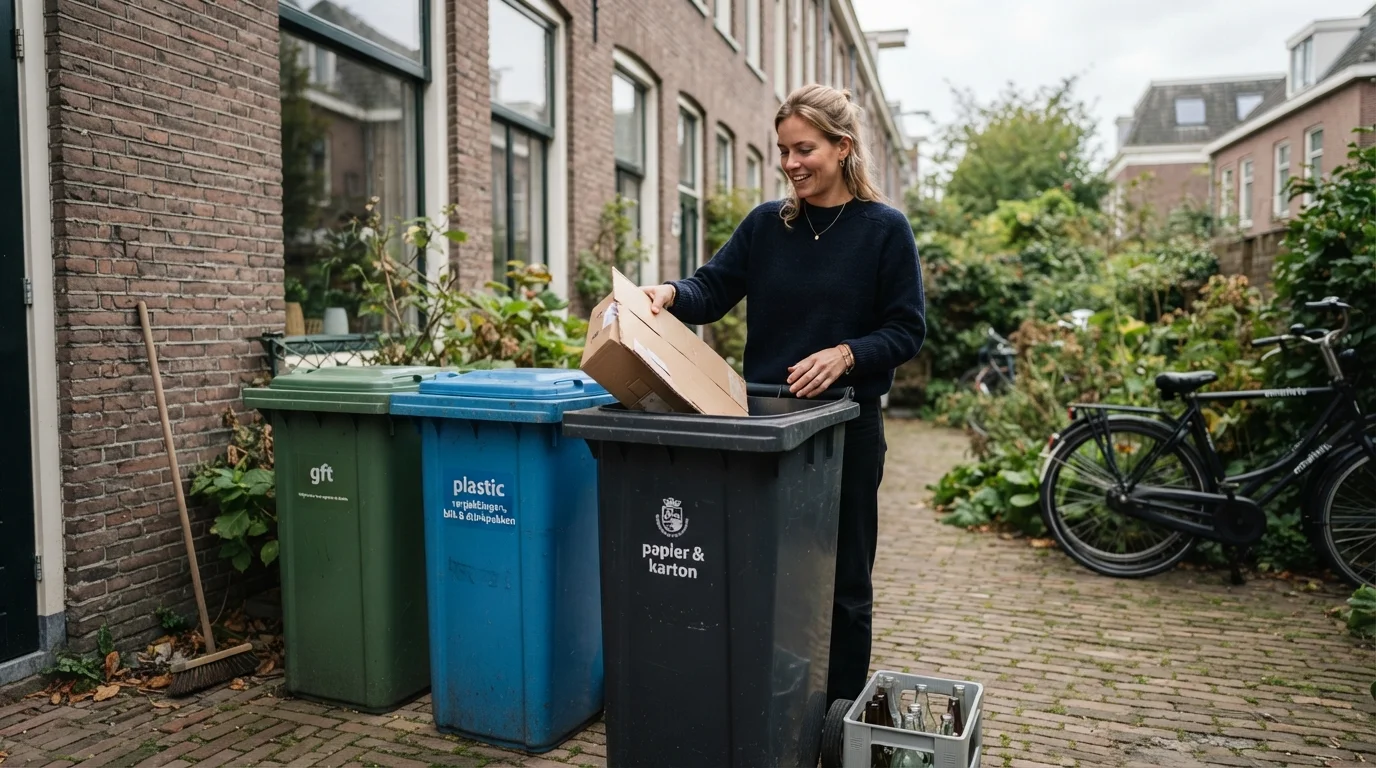
Waste collection rules differ between municipalities, so a question such as Wo moet dit plastic heen? can be genuinely useful. You can learn more practical vocabulary in this Dutch garbage and waste guide for expats.
In the last example, be careful with pronunciation and spacing when you speak. Written Dutch uses lokaal twaalf, meaning “room twelve.”
New residents often need to ask location questions while arranging healthcare, housing, municipal registration, or government services. If you are still learning how online Dutch instructions work, this guide to using the DigiD app as a new resident provides useful context and vocabulary.
A common mistake is saying Wo je woont? as a direct question. The correct form is Wo woon je? In a main question, the conjugated verb comes before the subject.
The verb wonen changes according to the subject:
Because the question has inversion, jij after the verb takes the form without -t: Wo woon je? However, with u, the verb keeps its formal ending: Waar woont u?
Waar woon je? asks for your current residence. Waar kom je vandaan? asks about your origin. These questions may lead to very different answers, so choose the phrase carefully.
Native speakers will understand wo, but waar is more appropriate in formal writing. In an integration exam, use the standard form unless the exercise specifically tests informal spoken Dutch.
Wo is pronounced approximately like the English sound in “who,” although Dutch pronunciation is not identical. The vowel is rounded, and the sound may be short in rapid speech. Waar has a longer vowel and a distinct Dutch w sound.
Do not worry if native speakers seem to swallow the word. In a sentence such as Wo woon je eigenlijk?, the words may run together. Train your ear by listening for the question word, then identifying the verb that follows it. This is more effective than trying to translate every sound individually.
Practice aloud with pairs such as:
StroopTaal can support this routine with real-life AI conversation practice and pronunciation feedback, so you can repeat location questions until the word order and pronunciation feel automatic.
Start with places you actually visit. Write ten questions about your daily routine, answer them in Dutch, and then say both the question and answer aloud.
For example:
Use spaced repetition to review these phrases over several days rather than studying them once. A personalized learning plan can help you combine vocabulary, grammar, listening, and speaking practice at the right level, from beginner A0 through advanced C1.
Location questions are important for integration because they appear in everyday situations covered by the Inburgeringsexamen. You may need to understand directions, describe your home, talk about work or school, or ask where a public service is located.
Focus on these exam-friendly patterns:
Notice that waar is generally the best choice for formal exam answers. For official information about civic integration requirements and procedures, consult the Dutch government information on civic integration. Requirements can change, so always check current official guidance.
| Dutch | English | Use |
|---|---|---|
| Wo? | Where? | Informal speech |
| Waar? | Where? | Standard and formal Dutch |
| Waar woon je? | Where do you live? | Current residence |
| Waar kom je vandaan? | Where are you from? | Origin |
| Waar ga je naartoe? | Where are you going? | Destination |
| Waar moet ik zijn? | Where do I need to be? | Finding the correct place |
Wo means “where” in Dutch and is the informal spoken form of waar. Use it to ask about a location, remember Dutch question word order, and distinguish it from expressions about origin or direction. In formal writing and integration exams, waar is usually the better choice.
The fastest way to remember this word is to use it in meaningful situations: ask where the bus stop is, where a colleague lives, where an appointment takes place, or where you need to go next. Add a few phrases to your daily review routine, practice them aloud, and listen for them in real Dutch conversations. With consistent practice, wo and waar will quickly become automatic parts of your Dutch.
Ready to put this into practice? Build a short daily speaking routine with location questions, and use StroopTaal to rehearse practical dialogues, review vocabulary with spaced repetition, and receive immediate pronunciation feedback.
Share this article:
Finding a home in the Netherlands can feel like a race. Affordable rooms and apartments disappear within minutes, landlords may ask for documents...
Read moreMoving to the Netherlands often means learning a new vocabulary for everyday life: gemeente, belastingaanslag, afvalstoffenheffing, and rioolheffing....
Read moreMoving to the Netherlands with children can feel exciting, but enrolling your child in a Dutch primary school in August requires planning. You may...
Read more