Best Mobile Phone Providers for Expats in Netherlands 2026
Staying Connected: The Expat's Guide to Dutch Mobile Providers in 2026 Welcome to the Netherlands! Whether you have relocated for a thriving career...
Read more
This article was drafted by AI and edited by a person before it was published.
AI can get things wrong. For anything official, check the source it points to.
AI-generated image
Welcome to the Netherlands! You have successfully navigated the highly competitive housing market, mastered the art of biking through the rain while holding groceries, and finally settled into your new Dutch home. But just when you think you have everything under control, you receive an email or a physical letter from a company like Vattenfall, Eneco, or Waternet. It is time to deal with your Dutch utility bills.
For many expats, international students, and newcomers, understanding utility bills in the Netherlands can feel like trying to read an ancient, encrypted language. Not only is the terminology entirely in Dutch, but the way the country structures its billing system—using estimated monthly advances and annual settlements—is fundamentally different from how utilities are managed in many other parts of the world.
Whether you are preparing for your inburgering exam or simply trying to avoid overpaying on your monthly expenses, understanding your energy and water costs is essential. In this comprehensive guide, we will break down exactly how Dutch utility bills work, explain the notorious "GWL," demystify the taxes involved, and give you the vocabulary you need to manage your household finances like a true local.
Managing utilities in the Netherlands typically costs a single expat between €150 and €250 per month for gas, electricity, and drinking water, though this varies significantly based on insulation, energy label, and household size. Setting up your household utilities involves contracting three core pillars: energy (gas and electricity), mains drinking water, and regional water/waste charges. Beyond these basic services, you will also receive annual levies from your municipality for waste collection, which you can learn about in our detailed guide to Dutch municipal taxes and afvalstoffenheffing.
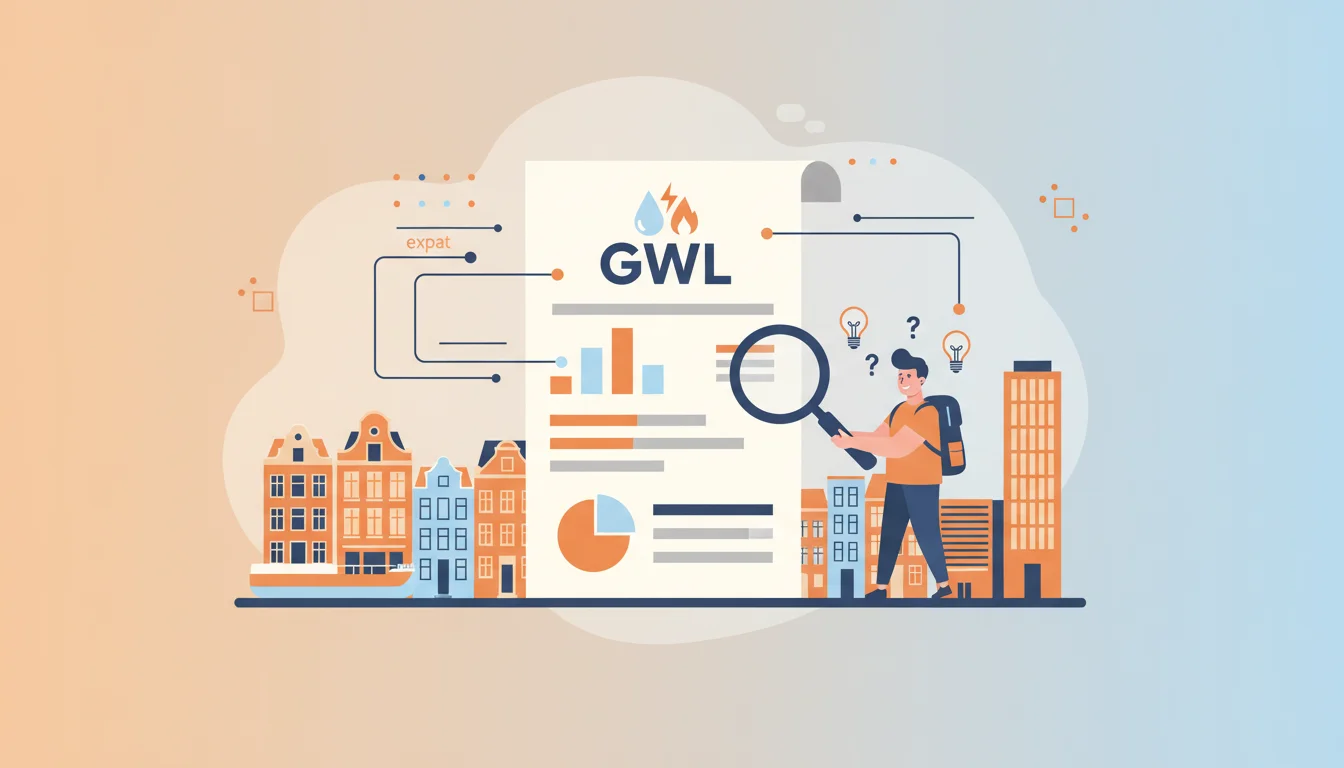
If you have been browsing rental listings on websites like Funda or Pararius, you have undoubtedly come across the acronym GWL. This stands for Gas, Water, en Licht (Gas, Water, and Light). In the Netherlands, "licht" is the colloquial term used for electricity.
When renting an apartment or house, you will typically encounter two types of rental agreements regarding GWL:
If you are renting "exclusief," keeping your utility costs manageable is crucial, especially if you are on a tight budget and looking into applying for housing allowance (huurtoeslag). Let's dive into how these exclusive utility contracts actually work.
Gas and electricity in the Netherlands are provided through a deregulated retail energy market where consumers freely choose their commercial energy supplier while an assigned regional grid manager maintains the physical network. In Dutch homes, natural gas is measured in cubic meters (m³) and used primarily for central heating and hot water, while electricity is billed in kilowatt-hours (kWh). Depending on your risk tolerance, you can choose among three primary contract structures: fixed-rate contracts (locking in kWh and m³ prices for 1 to 3 years), variable contracts (where rates adjust twice annually on January 1 and July 1), or dynamic contracts (where prices fluctuate hourly for electricity and daily for gas based on wholesale spot prices).
The Dutch energy market is privatized, meaning you have the freedom to choose your energy supplier (energieleverancier). Popular providers include Vattenfall, Eneco, Essent, and Greenchoice. However, the energy bill you receive from them is actually a combination of three different components. Understanding these components is the key to understanding your costs.
This is the actual cost of the gas and electricity you consume. It is the only part of the bill where your choice of energy provider makes a difference. The supply costs are divided into:
When choosing a provider, you can opt for a vast contract (fixed rates for 1-3 years), a variabel contract (rates change twice a year), or a dynamisch contract (rates change daily or hourly based on market prices).
While you can choose your energy supplier, you cannot choose your grid operator (netbeheerder). The grid operator is responsible for maintaining the physical cables and pipes that deliver energy to your home. The operator assigned to you depends entirely on your postal code (e.g., Liander, Enexis, or Stedin).
You do not pay the grid operator directly. Instead, your chosen energy supplier collects the netbeheerkosten on your monthly bill and passes the money on to the grid operator. These are fixed annual costs that do not change based on your consumption.
A significant portion of your Dutch energy bill goes directly to the government. The Netherlands heavily taxes energy consumption to encourage sustainability and reduce carbon emissions. You will pay Energiebelasting (Energy Tax) on every unit of gas and electricity you use, plus 21% BTW (VAT) on the entire bill.
However, there is some good news. Because the government considers a basic amount of energy to be a fundamental human right, they offer a standard tax refund per household connection, known as the Vermindering Energiebelasting. This fixed discount is automatically deducted from your bill by your provider. You can read more about the Dutch government's policy on energy taxes on their official portal.
The best way to compare local gas utility rates and plans in the Netherlands is to run your postal code and estimated consumption through certified independent comparison platforms like Gaslicht.com, Independer, or Pricewise. These platforms scan current market tariffs across all licensed Dutch suppliers and automatically calculate welcome discounts (welkomstkortingen) or cashback promotions that are not advertised on providers' direct websites. When comparing plans, evaluate the cost per m³ of gas alongside the fixed standing charges (vastrecht)—if you live in an energy-efficient apartment with low gas consumption, high fixed charges can easily outweigh a marginally lower per-unit rate.
Utilities arrangements for internationals in Leiden require setting up an energy contract with any national supplier, registering for water exclusively through Dunea, and preparing for water board levies from Hoogheemraadschap van Rijnland. Leiden's local gas and electricity grid is operated by Liander, meaning network management is standardized regardless of which retailer you select. When moving to Leiden, ensure you register your move with both Dunea and Gemeente Leiden within five days of receiving your keys; you can reference our walkthrough on moving within the Netherlands and reporting your address change to stay on track.
Unlike gas and electricity, the water market in the Netherlands is not privatized. You cannot choose your water provider; it is strictly determined by where you live. For example, if you live in Amsterdam, you must use Waternet. If you live in Rotterdam, you use Evides.
Water billing in the Netherlands is unique because it is split into two entirely different categories, which are often billed separately:
This is the bill for the physical tap water you consume for drinking, showering, washing clothes, and flushing the toilet. Dutch tap water is among the highest quality in the world, and surprisingly, it is relatively cheap. You pay a fixed standing charge (vastrecht) plus a fee per cubic meter (1,000 liters) of water used.
This is the bill that catches most expats completely off guard. Because roughly a third of the Netherlands lies below sea level, the country relies on regional water boards (Waterschappen) to maintain dikes, manage water levels, and prevent the country from flooding. They also purify wastewater.
You will receive an annual tax bill from your regional water board. This bill typically includes:
To view and pay your local water taxes online, you will need a secure government login. If you haven't done this yet, check out our guide on setting up your DigiD, which is essential for managing Dutch municipal and tax affairs.
Perhaps the most confusing aspect of Dutch utility bills is the payment structure. You do not pay for exactly what you use each month. Instead, you pay an estimated monthly advance, known as a voorschotbedrag or termijnbedrag.
When you sign up for an energy contract, the provider estimates your annual usage based on the historical data of your address and the size of your household. They calculate the total expected cost for the year and divide it by 12. You pay this fixed amount every month.
Why do they do this? To protect you from massive financial shocks. During the freezing Dutch winters, your gas usage for heating will skyrocket. In the summer, it will be minimal. By averaging the costs, you pay the same manageable amount in January as you do in July.
At the end of your 12-month contract cycle, you will receive the jaarafrekening (annual statement). This is the moment of truth. The energy company compares your total monthly advances against the actual energy you consumed during the year.
Pro Tip: If you move into a poorly insulated apartment and the previous tenant rarely used the heater, your initial monthly estimate might be dangerously low. You can log into your provider's app to manually increase your voorschot to avoid a nasty surprise bill at the end of the year.
To help you navigate your contracts, customer portals, and inburgering exams, here is a glossary of crucial Dutch utility terms:
Learning these terms doesn't have to be a headache. With StroopTaal's vocabulary building feature utilizing spaced repetition, you can master these essential Dutch financial and housing terms in no time, ensuring you never sign a contract you don't understand.
Setting up your GWL should be done as soon as you have the keys to your new home. Here is a practical roadmap:
The very first thing you should do when you walk into your new apartment is locate the meter cupboard (meterkast), usually found in the hallway near the front door. Take clear photos of the gas, electricity, and water meters. You will need these numbers to start your new contracts and to ensure you aren't paying for the previous tenant's usage.
Before some utility companies will finalize your contract, they may verify that you are legally registered at the address. Make sure you prioritize registering at the local municipality (gemeente) to get your BSN.
Do not just accept the energy provider the previous tenant used. Use Dutch comparison websites (vergelijkingssites) like Independer, Gaslicht.com, or Pricewise. You input your postal code, house type, and estimated usage, and the site will show you the cheapest available contracts.
Look up which water company services your postal code and go to their website. There is usually a specific button for "Verhuizen" (Moving). Fill in your new address, your move-in date, and the water meter reading you photographed.
Almost all utility companies in the Netherlands require you to pay via Automatische Incasso (direct debit). You will need to provide your Dutch or European IBAN, and the company will automatically deduct the voorschot around the same day each month.
If you ever encounter an issue, such as an unexpectedly high bill, you might need to contact customer service. Calling a Dutch helpdesk can be intimidating for language learners. Fortunately, if you need to call your provider to dispute a bill or adjust your voorschot, StroopTaal's real-life Dutch conversation practice with AI can help you rehearse the exact dialogue beforehand, boosting your confidence and ensuring you get your point across clearly.
Dealing with Dutch utility bills might seem overwhelming at first glance, but once you understand the system of the voorschot, the difference between supply and network costs, and the separate water board taxes, it becomes a predictable and manageable part of expat life in the Netherlands.
Always remember to check your meter readings, compare energy providers annually to find the best deals, and never ignore a letter from the Waterschap! By mastering the vocabulary and concepts outlined in this guide, you are one step closer to living like a true Dutch local.
Want to feel more confident handling your Dutch life administration? Download the StroopTaal app today to start practicing real-life scenarios, from calling the energy company to chatting with your new neighbors. With AI-powered personalized learning plans, mastering Dutch has never been more practical or engaging!
Share this article:
Staying Connected: The Expat's Guide to Dutch Mobile Providers in 2026 Welcome to the Netherlands! Whether you have relocated for a thriving career...
Read moreNavigating the Dutch Roads: The Expat's Golden Ticket Moving to the Netherlands often means embracing the world-famous cycling culture. However, as...
Read moreIntroduction: Navigating the Dutch Waste Labyrinth Welcome to the Netherlands! You have successfully navigated the housing market, bought your first...
Read more