How to Get a Dutch Driver's License: The 30% Ruling Exchange Rule
Navigating the Dutch Roads: The Expat's Golden Ticket Moving to the Netherlands often means embracing the world-famous cycling culture. However, as...
Read more
This article was drafted by AI and edited by a person before it was published.
AI can get things wrong. For anything official, check the source it points to.
AI-generated image
Welcome to the Netherlands! You have successfully navigated the housing market, bought your first bicycle, and survived the directness of your new neighbors. But just when you thought you had settled in, you are faced with a row of mysterious, brightly colored underground bins. Welcome to the world of afvalscheiding (waste separation).
For many expats and international students, Dutch garbage disposal rules can feel like a complex puzzle. The Netherlands is a densely populated country with ambitious environmental goals, meaning waste management is highly regulated, strictly enforced, and constantly evolving. As we move into 2026, the Dutch government has implemented even stricter recycling targets to achieve a fully circular economy by 2050.
Whether you are throwing away a greasy pizza box, an empty milk carton, or a broken chair, putting it in the wrong bin can result in hefty fines. In this comprehensive guide, we will break down everything you need to know about Dutch garbage disposal rules, understanding afvalscheiding, and how to recycle like a true local in 2026.
The Netherlands trash system is a decentralized, circular waste management model operated by local municipalities (gemeenten) that prioritizes high-rate source separation, deposit returns, and energy recovery over traditional landfills. In practice, individual city councils determine whether waste is separated by residents before pickup (bronscheiding) or separated by automated machinery at regional processing facilities (nascheiding).
Each municipality partners with a regional sanitation authority (such as Avalex, ROVA, or Cure) and publishes a digital waste calendar via the Afvalwijzer app. Depending on your address, household waste is either collected on designated curb days or dropped off at neighborhood collection points. If you are moving within the Netherlands and reporting your address change, checking your new municipality's waste calendar is an essential first step.
The Dutch approach to waste is rooted in sustainability and efficiency. Land is scarce in the Netherlands, so traditional landfills are virtually nonexistent. Instead, the country relies on advanced recycling facilities and waste-to-energy incinerators.
In 2026, the rules around afvalscheiding have become more stringent. The national government has mandated that municipalities drastically reduce the amount of restafval (residual waste) produced per resident. To encourage this, many cities have adopted a "Diftar" (gedifferentieerde tarieven) system, where you pay per garbage bag or per time you open the underground residual waste bin. By separating your trash properly, you not only help the environment but also save money.
For official national guidelines on environmental policies, you can always consult the Dutch Government's environment portal.
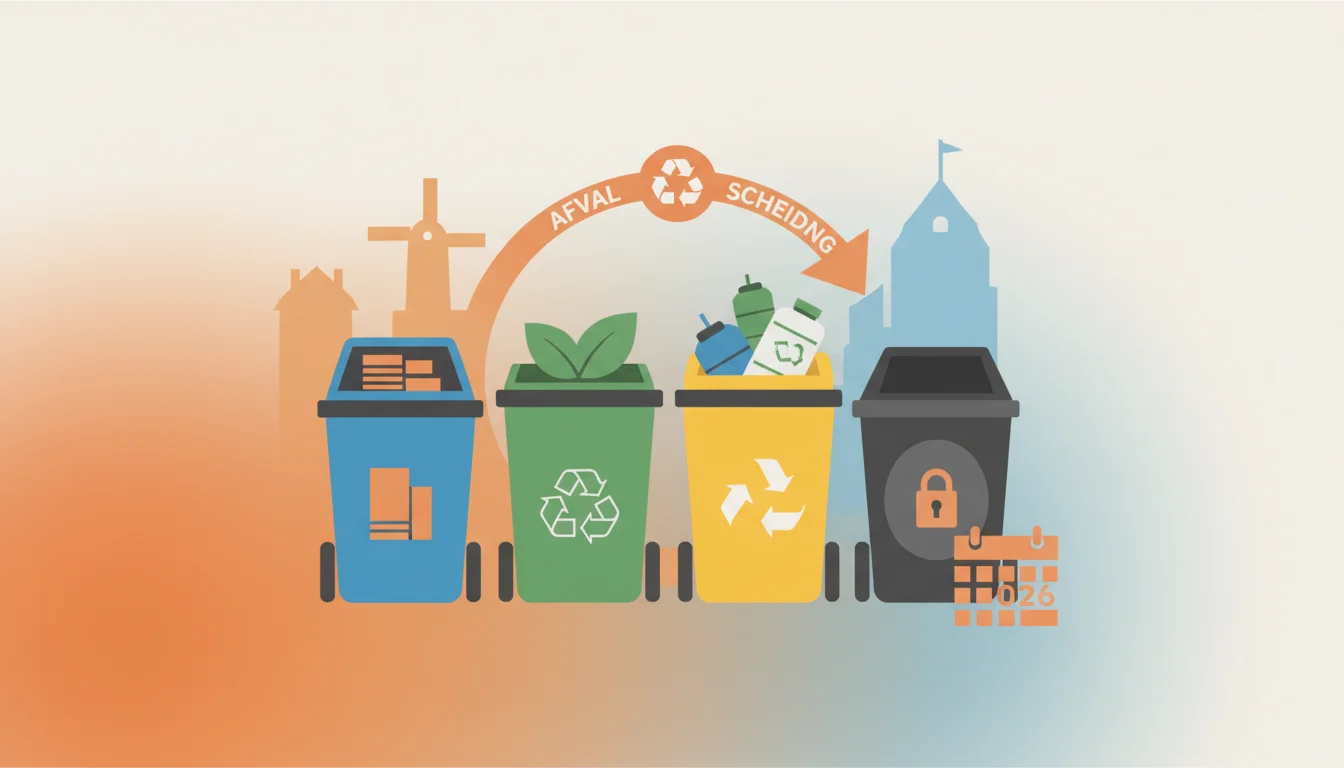
Garbage bins in the Netherlands are categorized into curbside wheelie bins (known as kliko's) for low-rise suburban housing and electronic underground containers (ondergrondse containers) for high-density urban areas. While color schemes can vary slightly by council, standard Dutch wheelie bins follow a uniform national color-coding framework:
Depending on whether you live in a bustling city center like Amsterdam or a suburban house with a garden, your waste collection method will vary. You might have individual wheelie bins (kliko's) or shared underground containers (ondergrondse containers). Regardless of the container type, the categories remain the same.
Restafval is the waste that cannot be recycled. Because the goal is to minimize this category, disposing of restafval is often the most restricted and expensive part of the process.
The term restafval literally translates from Dutch to "residual waste" or "leftover trash," referring specifically to all non-hazardous household waste that cannot be separated, composted, or recycled into secondary raw materials. Because incinerating residual waste incurs heavy carbon taxes, Dutch policy aims to keep restafval volumes as close to zero as possible.
GFT stands for Vegetables, Fruit, and Garden waste. In 2026, municipalities are cracking down on organic waste ending up in the general trash, as GFT is highly valuable for creating compost and biogas.
PMD is one of the most common bins you will use. It stands for Plastic packaging, Metal (cans), and Drink cartons. Some municipalities use an "after-separation" machine at the waste plant, meaning you might throw PMD in with restafval, but most cities require you to separate it at home.
The Dutch recycle a massive amount of paper. However, paper recycling is easily contaminated by food residue.
Glass recycling bins (glasbakken) are usually found near supermarkets. They are often color-coded: wit (white/clear), groen (green), and bruin (brown).
If you live in an apartment or a city center, you will likely need an afvalpas (waste pass) to open the underground restafval containers. This electronic card is linked to your home address.
When you move into a new place, the previous tenant should leave the afvalpas behind. If it's missing, you must request a new one from your municipality (gemeente), which often costs around €15 to €20. Keep in mind that before you can request a new pass or arrange municipal services, you must complete your registration at the local municipality to get your BSN.
Pro Tip: Never force a garbage bag into a jammed underground bin, and never leave your trash bag next to the bin. This is considered illegal dumping (bijplaatsing) and is heavily fined.
For lawful Nederland disposal of garbage, residents must sort household refuse at the source into assigned streams, use municipality-approved garbage bags or chip-enabled kliko bins, and dispose of bags inside underground drop chutes or on set curb collection dates before 07:30 AM. Failure to observe these local sanitation bylaws (Algemene Plaatselijke Verordening or APV) results in rapid enforcement action by municipal inspectors.
To avoid compliance issues across different Dutch regions, always follow these core operational steps:
The Netherlands has a robust deposit return system called statiegeld. You pay a small deposit when buying certain drinks, which you get back when you return the empty containers to a reverse vending machine (emballageautomaat) at the supermarket.
When you do your weekly grocery run at your favorite Dutch supermarket, simply bring your empty bottles. The machine will print a receipt that you can deduct from your grocery bill or donate to charity. Do not crush cans or bottles, as the machine needs to read the barcode to verify the statiegeld logo!
What do you do with an old mattress, a broken television, or leftover paint? These items cannot go into standard bins.
For large items, you have two options. You can bring them yourself to the municipal waste recycling center (milieustraat or afvalpunt), which usually requires showing your ID or afvalpas. Alternatively, you can make an appointment online for the municipality to pick it up from your curb. Note: Never put bulky waste on the street without a confirmed appointment.
If the items are still usable, consider bringing them to a Kringloopwinkel (thrift store) or offering them for free on platforms like Marktplaats or local Facebook groups.
Batteries, lightbulbs, paint, motor oil, and strong cleaning chemicals must be disposed of safely. Supermarkets and hardware stores often have special drop-off boxes for batteries and lightbulbs (look for the Wecycle bins). Other KCA must be taken to the milieustraat. For detailed environmental guidelines on KCA, visit Milieu Centraal.
Waste management isn't free. Every household in the Netherlands must pay an annual municipal waste tax known as afvalstoffenheffing. The amount varies by municipality and household size (single-person households pay less than multi-person households).
You will receive the bill for this tax in the first quarter of the year. For a full breakdown of how this levy is calculated and who qualifies for exemptions, read our detailed guide to Dutch municipal taxes and afvalstoffenheffing explained. If your income is very low, you may be eligible to apply for a waiver (kwijtschelding).
Navigating Dutch websites and reading signs on bins requires some basic vocabulary. Here are the essential words you need to know:
Learning the specific vocabulary for daily life tasks can feel daunting for expats. With the StroopTaal app, you can easily master practical terms like these! Our app features vocabulary building with spaced repetition and interactive dialogue games for practical scenarios. You can even practice a real-life Dutch conversation with our AI about asking a neighbor which bin to use, complete with instant pronunciation feedback.
The Dutch are pragmatic, but rules are rules. Municipal law enforcement officers (BOAs) actively patrol neighborhoods and will literally open illegally dumped trash bags to find mail with a name and address on it. If they trace the bag back to you, expect a fine ranging from €100 to €400.
Avoid these common pitfalls:
Mastering afvalscheiding is a rite of passage for anyone moving to the Netherlands. While the rules for 2026 might seem strict, they are a vital part of keeping the country clean, green, and sustainable. By familiarizing yourself with the different bins, utilizing the statiegeld system, and respecting the collection schedules, you will integrate into Dutch society seamlessly (and avoid unnecessary fines!).
Understanding waste disposal and local customs is actually a crucial part of Dutch civic integration. If you are preparing for your exams, the StroopTaal app offers comprehensive Inburgering exam preparation alongside our cultural lessons about Dutch life and customs. From mastering the De/Het articles of your recycling bins to building a daily learning streak, StroopTaal makes learning Dutch engaging, practical, and highly effective. Download StroopTaal today and start speaking Dutch with confidence!
Share this article:
Navigating the Dutch Roads: The Expat's Golden Ticket Moving to the Netherlands often means embracing the world-famous cycling culture. However, as...
Read moreWelcome to the Netherlands: Bicycles, Windmills, and... Bureaucracy Congratulations! You have finally made the move to the Netherlands. You have...
Read moreIntroduction: Navigating Dutch Housing Costs Moving to the Netherlands is an exciting adventure filled with stroopwafels, bicycles, and picturesque...
Read more