Halloween vs Sint-Maarten: Dutch Autumn Etiquette Guide
Picture this scenario: it is the evening of 31 October. You have stocked your hallway with giant bags of candy, carved an intricate jack-o'-lantern...
Read more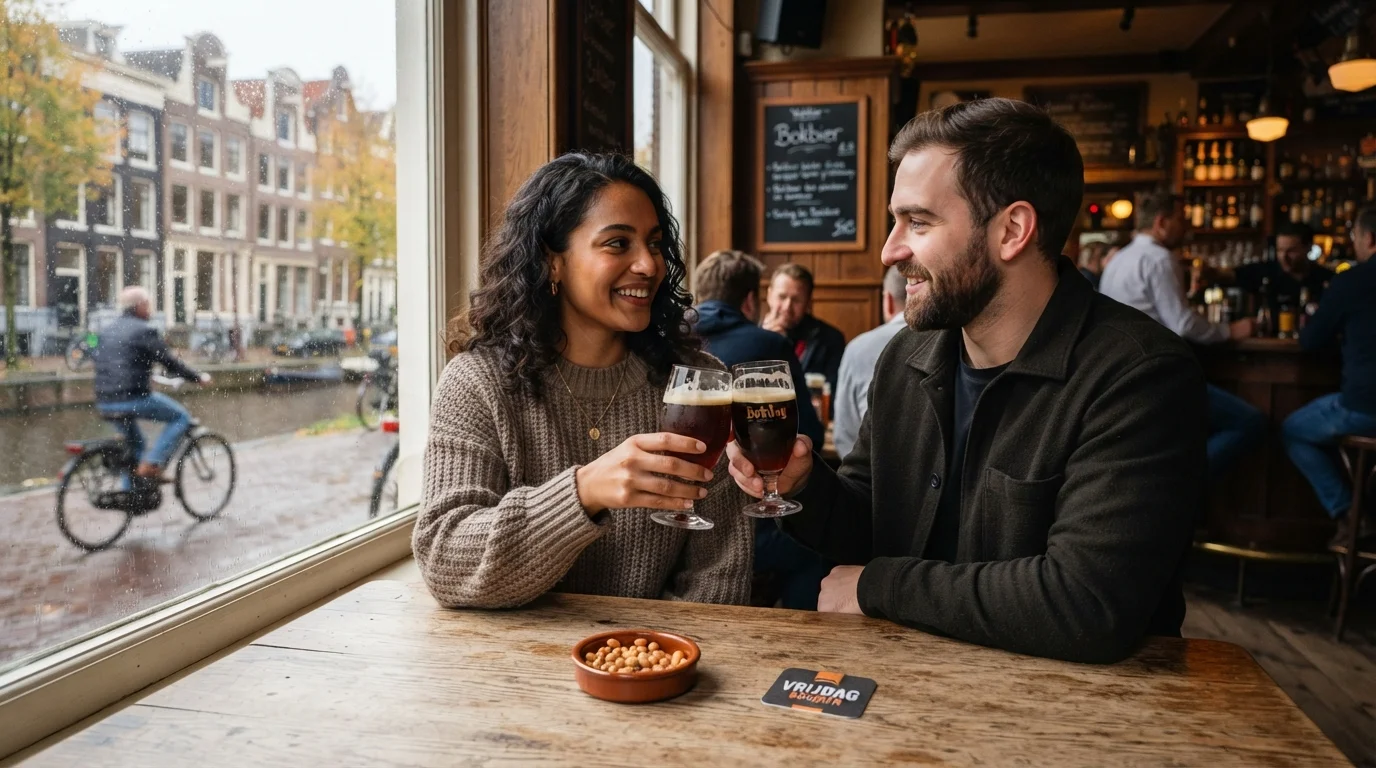
As October arrives in the Netherlands, the countryside transforms into a mosaic of amber and crimson, the wind off the North Sea takes on a crisp bite, and raindrops begin to patter reliably against cafe windowpanes. But inside the country's historic bruine kroegen (traditional brown cafes), an unmistakable warmth emerges. Chalkboards suddenly appear outside pubs in Amsterdam, Utrecht, Groningen, and quiet provincial villages alike, bearing four welcoming words: "Het bokbier is er weer!" (The bock beer is back!).
For newcomers, expats, and Dutch language learners, encountering bokbier season is often one of the first authentic cultural markers of autumn. It is far more than just a seasonal beverage; bokbier marks an annual communal ritual deeply intertwined with Dutch history, culinary heritage, and the quintessential concept of autumn warmth. In this guide, we dive into the rich history of Dutch bokbier, its peculiar goat-themed folklore, the rituals of pub crawls and festivals, and the essential Dutch phrases you need to order your first glass with confidence.
To understand bokbier, one must first look across the eastern border to northern Germany. The style originated in the 14th century in the Hanseatic brewing town of Einbeck. Beers from Einbeck enjoyed renown across northern Europe for their rich maltiness, high gravity, and longer shelf life. When Bavarian brewers in Munich sought to replicate this prized style in the 17th century, their southern dialect transformed the name Einbecker Bier into Ainpöckisch, then shortened it to Oanbock, and ultimately to Bock.
In standard German, as in Dutch, Bock or bok happens to mean a male goat (a billy goat). The linguistic mix-up proved irresistible to marketing minds and beer enthusiasts. Over the centuries, brewers embraced the pun, featuring sturdy mountain goats, horned heraldry, and playful caprine illustrations on labels, taps, and coasters. For a deeper look at the beer's European roots, the historical overview of Bock beer history sheds light on how this regional specialty spread across the continent.
In the Netherlands, herfstbok (autumn bock) evolved into a distinct seasonal category. While traditional German bocks are bottom-fermented lagers, Dutch brewers brew both bottom-fermented and top-fermented (ale-style) bokbieren. A classic Dutch autumn bokbier is typically characterized by:
Historically, brewing was tightly bound to seasonal agricultural cycles. In the era before mechanical refrigeration, brewing large batches during hot summer months carried a high risk of bacterial spoilage. Brewers worked vigorously in late winter and early spring, crafting richer, stronger beers that could rest and mature in cool cellars over the summer months. By October, when the fresh barley and hops were harvested, these cellared kegs were tapped to celebrate the changing season.
The modern Dutch obsession with bokbier owes much to a 19th-century revival. In the late 1800s, major Dutch commercial breweries such as Royal Grolsch and Heineken reintroduced seasonal bocks. In the late 20th century, consumer interest exploded further thanks to beer appreciation societies such as PINT (Promotie Informatie Traditioneel Bier). PINT organized the country's first national Bokbier Festival in Amsterdam in 1978, which quickly grew into one of the largest seasonal tasting gatherings in Europe.
Today, virtually every independent microbrewery in the Netherlands crafts its own seasonal interpretation. Alongside traditional dark bocks, you will now discover wood-aged bocks, smoked bocks (rookbok), double bocks (dubbelbok), and modern non-alcoholic varieties (alcoholvrij bokbier). October is not simply a time when beer is served; it is a time when the brewing calendar dictates the social rhythm of towns and cities.
You cannot truly appreciate bokbier without experiencing the space where it is most lovingly consumed: the bruine kroeg. Named after their tobacco-stained wood paneling, antique brass fixtures, dimly lit interior sconces, and cozy Persian rugs draped across wooden tables, brown cafes serve as neighborhood living rooms across the Netherlands.
When autumn winds rattle the leaded glass windows, locals seek refuge indoors, settling into a booth to enjoy a heavy goblet of seasonal draft beer alongside hot savory snacks. This experience represents the physical embodiment of understanding Dutch gezelligheid in autumn. The atmosphere balances quiet relaxation, informal conversation, and a communal celebration of seasonal comfort.
Bokbier is also a wonderful culinary partner to classic seasonal fare. Because of its sweet, malt-heavy profile, it cuts through rich meats and earthy root vegetables effortlessly. Traditional pairings include:
If you live in or visit the Netherlands during October, you will undoubtedly hear colleagues or neighbors mention going on a bokkentocht (or bokkenwandeling / bokkenfietstocht). This tradition combines the Dutch love of cycling, fresh air, and social drinking into a structured community event.
A typical bokkentocht involves visiting four to six participating neighborhood pubs on a Saturday or Sunday afternoon. At each stop, participants receive a tasting glass of a distinct bokbier, usually accompanied by an appropriately paired seasonal bite (such as wild game stew or mature cheese). Patrons receive a physical stamp card (stempelkaart) that is stamped at every stop. Those who complete the circuit collect a small memento, often a commemorative tasting glass or pin.
Participating in a bokkentocht is an outstanding way for expats and newcomers to practice conversational Dutch outside formal classroom environments. Because the events are lively, unhurried, and social, strike up casual conversations about the flavors, the weather, and your favorite local stops.
Ordering a beer in Dutch is straightforward, but knowing the nuances of seasonal pub language helps you feel right at home. Here are practical terms and real-world phrases you can put into practice immediately:
When stepping up to the bar or speaking to the server (bediening), keep it polite and natural:
Patron: "Goedemiddag! Heeft u al bokbier op de tap?"
(Good afternoon! Do you already have bokbier on tap?)
Server: "Jazeker! We hebben de lokale herfstbok van brouwerij 't IJ en een dubbelbok uit Haarlem."
(Certainly! We have the local autumn bock from 't IJ brewery and a double bock from Haarlem.)
Patron: "Doe mij maar die van 't IJ, alstublieft. En een portie oude kaas erbij."
(I'll have the one from 't IJ, please. And a portion of aged cheese to go with it.)
Developing confidence in everyday bar banter mirrors the practical skills needed to learn how to understand Dutch in real situations. Tuning your ear to background chatter, dialect nuances, and colloquial phrasing turns an ordinary afternoon at the cafe into an immersive language lesson.
To help you prepare for real-world encounters, the StroopTaal app features interactive listening scenes that place you in practical situations—such as ordering at a crowded counter or making informal plans. You can answer comprehension questions based on authentic audio, save new vocabulary to spaced-repetition flashcards, and use the AI conversation partner, Taalmaatje, to practice ordering food and drinks out loud before visiting your local brown pub.
For those preparing for the Dutch integration process (inburgeringsexamen), understanding traditions like bokbier offers direct insight into the Kennis van de Nederlandse Maatschappij (KNM) section of the exams. The KNM exam focuses heavily on daily life, community norms, work culture, and how people interact in social environments.
Dutch socializing often revolves around fixed calendar traditions, egalitarian social structures, and unwritten rules of hospitality. Joining colleagues for a vrijmibo (vrijdagmiddagborrel, Friday afternoon drink) to sample an autumn bokbier reflects how Dutch work cultures maintain flat hierarchies: managers, interns, and directors converse as equals over a shared beverage. Observing these customs helps newcomers navigate both professional and personal networks smoothly. If you are preparing for your exams, test your understanding of everyday social customs and civic institutions with our free KNM practice test.
October in the Netherlands may bring shorter daylight hours and unpredictable weather, but it also ushers in a beloved season of comfort, fellowship, and culinary tradition. Tapping into the story of bokbier is an invitation to step away from your desk, walk down to the nearest canal-side cafe, and participate in a seasonal ritual that Dutch communities have enjoyed for centuries.
Whether you prefer an afternoon bike ride during a local bokkentocht, a plate of warm bitterballen shared among friends, or simply sitting in a quiet corner with a book and a warming goblet, take the opportunity to practice your Dutch. Raise your glass, make eye contact, say "Proost!", and embrace the coziness of the Dutch autumn.
Rules, fees and dates change. Check the current version on the official pages before you act.
Share this article:
Picture this scenario: it is the evening of 31 October. You have stocked your hallway with giant bags of candy, carved an intricate jack-o'-lantern...
Read moreYou have just arrived at the office on a Thursday morning when a colleague asks if you are joining the team for drinks on Friday afternoon. Or...
Read moreIf you live or work in the Netherlands, you will inevitably notice a distinct rhythm to the month of October. The morning bicycle paths suddenly thin...
Read more