What Happens If You Miss Your Inburgering Exam Deadline? (2026 Rules)
Receiving that official blue-and-white letter from DUO (Dienst Uitvoering Onderwijs) marking your official integration deadline can spark genuine...
Read more
This article was drafted by AI and edited by a person before it was published.
AI can get things wrong. For anything official, check the source it points to.
AI-generated image
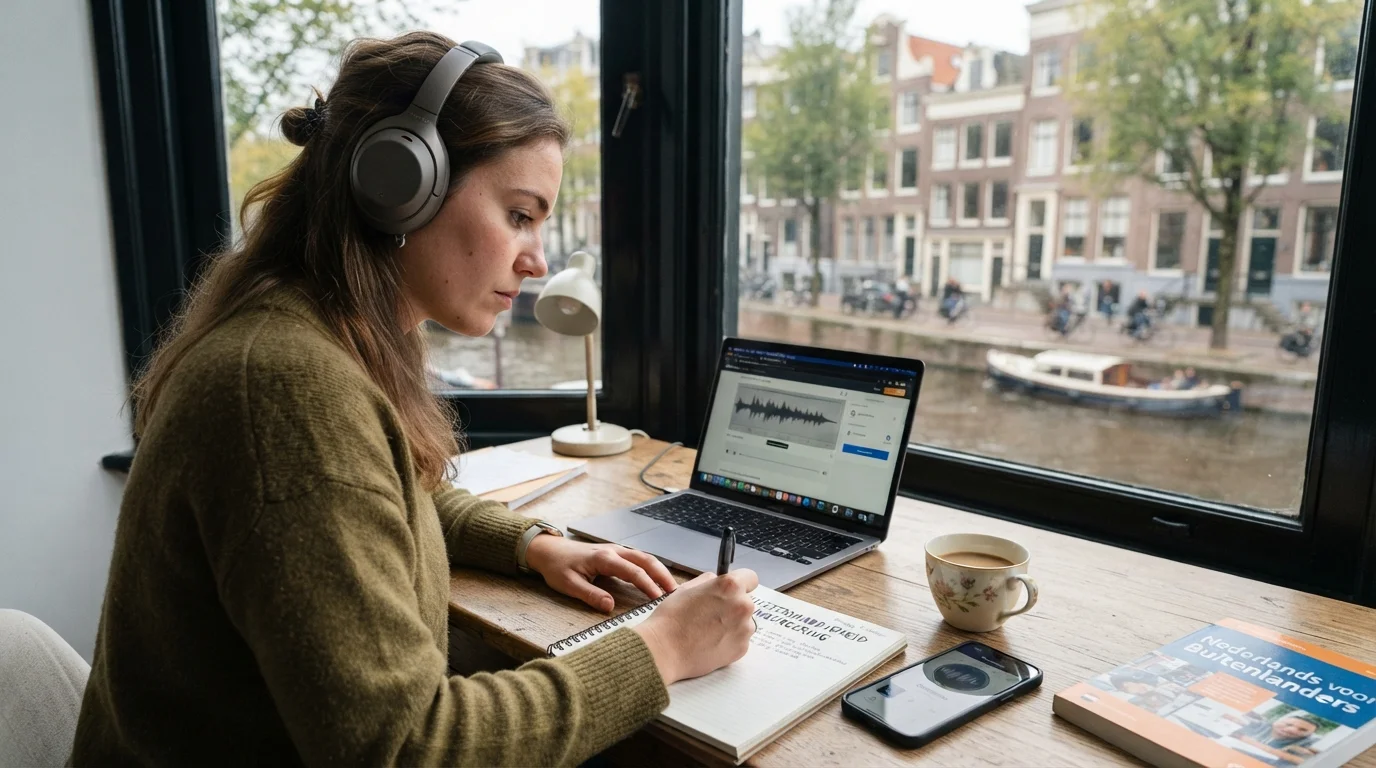
Preparing for the Dutch civic integration exam (inburgeringsexamen) can feel intimidating, but for many newcomers, the Listening component (Luisteren) stands out as the most nerve-wracking section. In real life, native Dutch speakers talk quickly, blend words together, and use subtle intonations that textbooks often fail to capture.
During the official DUO listening exam, you won't have the luxury of asking someone to repeat themselves or speak more slowly. You get a set number of audio recordings, a ticking clock, and multiple-choice questions designed to test your comprehension under pressure. To pass on your first attempt, you need targeted preparation using high-quality practice audio files and battle-tested listening strategies.
Whether you are preparing under the older regulations or aiming for a higher tier, understanding the distinction when choosing between the A2 and B1 integration levels is the first step. In this comprehensive guide, we will break down the exam format, reveal the best sources for practice audio files, and share actionable tips to help you ace your Inburgering listening exam.
The listening exam is entirely computerized and administered at official test centers managed by the Dienst Uitvoering Onderwijs (DUO). While the exact timing and difficulty depend on your required level (A2 or B1), the core mechanics remain consistent.
The exam does not just evaluate your broad understanding; it tests your ability to catch specific details, identify conversational context, and filter out deliberate distractors.
Consistent exposure to varied, authentic Dutch audio is the secret to building intuitive listening comprehension. Here are the most reliable and realistic audio resources available for your preparation:
The single most accurate resource is the official practice environment provided by DUO on the Inburgeren.nl portal. These mock exams use the exact same user interface, audio speed, voice actors, and question styles you will face on test day. Make sure to complete every official sample test at least twice: once to assess your baseline score and once under strict timed exam conditions.
Because DUO only provides a limited set of practice exams, you will need extra materials to build stamina. Working through additional curated audio clips will sharpen your ear for different Dutch regional accents and background noises. If you want structured practice tests that mirror recent exam cycles, explore our guide on the best mock exams for the Inburgering B1 listening test.
The Dutch public broadcaster NOS produces weekly news broadcasts specifically adapted for language learners (NOS Nieuws van de Week), as well as simplified news on YouTube and NPO Start. These segments feature professional broadcast audio spoken at a moderate, accessible pace with clear enunciation—ideal for transitioning from A2 to B1.
Podcasts allow you to turn dead time—such as your commute or chores—into valuable passive and active listening sessions. Some outstanding options include:
Listening is not purely passive; your listening comprehension skyrockets when you actively engage in spoken dialogue. The StroopTaal app offers interactive real-life Dutch conversation practice powered by AI, paired with pronunciation training and audio exercises. Hearing natural responses tailored to your skill level trains your brain to process conversational Dutch in real time rather than translating every sentence word-for-word.
Before the audio starts playing, you are given a short window of time. Use this window strategically. Never stare blankly at the screen—scan the question stem and the multiple-choice options immediately.
Exam creators love using misdirection. A speaker might state an initial plan, only to change their mind two seconds later using a contrast conjunction:
Example: "Ik wilde eigenlijk met de trein gaan om 14:00 uur, maar de fiets was toch sneller." (I actually wanted to go by train at 14:00, but the bike turned out to be faster.)
If you choose "trein" the moment you hear it, you will fall into the trap. Always listen through to the end of the sentence before committing to an answer.
In spoken Dutch, unstressed pronouns and articles are frequently shortened. Native speakers rarely say full, robotic words. Familiarize yourself with common spoken contractions:
Practicing with diverse audio clips ensures these spoken reductions do not confuse you during the test.
You cannot understand what you have never learned. The Inburgering exam focuses heavily on functional daily situations: calling in sick at work, scheduling a municipal appointment, buying train tickets, and discussing schooling for children. You can accelerate this process by reviewing essential Inburgering exam vocabulary on StroopTaal, which uses spaced repetition to ensure critical terms stick in your long-term memory.
If your exam is approaching, follow this structured weekly framework to steadily improve your listening comprehension:
| Timeline | Focus Area | Daily Action |
|---|---|---|
| Week 1 | Acoustic Familiarity | Listen to 15 mins of simplified Dutch podcasts daily. Transcribe 3 short sentences by ear. |
| Week 2 | Distractor Spotting | Practice dialogues with contrast words (maar, want, omdat). Complete 1 official DUO sample test. |
| Week 3 | Timed Mock Exams | Take full-length mock listening tests under strict timed conditions without pausing. Analyze all errors. |
| Week 4 | Speed & Confidence | Engage in interactive AI conversations on StroopTaal and listen to normal-speed Dutch radio bulletins. |
On the day of your test, small tactical decisions can make a significant difference in your final score:
Passing the Inburgering listening exam does not require you to understand every single Dutch idiom or colloquialism. It requires a calm, structured approach, an ear tuned to conversational cues, and consistent practice with high-yield audio files. By combining official DUO mock exams with daily active listening and smart digital tools like StroopTaal, you can walk into your test center calm and well prepared.
Share this article:
Receiving that official blue-and-white letter from DUO (Dienst Uitvoering Onderwijs) marking your official integration deadline can spark genuine...
Read moreFor many newcomers moving through the Dutch civic integration process, the Oriëntatie op de Nederlandse Arbeidsmarkt (ONA) exam feels like the most...
Read moreIf you are planning to settle down, apply for permanent residency, or become a Dutch citizen, you have almost certainly encountered the civic...
Read more