Tips for Passing the Inburgering Listening Exam: Best Practice Audio Files
Preparing for the Dutch civic integration exam (inburgeringsexamen) can feel intimidating, but for many newcomers, the Listening component...
Read more
This article was written by AI and published by StroopTaal.
AI can get things wrong. For anything official, check the source it points to.
AI-generated image
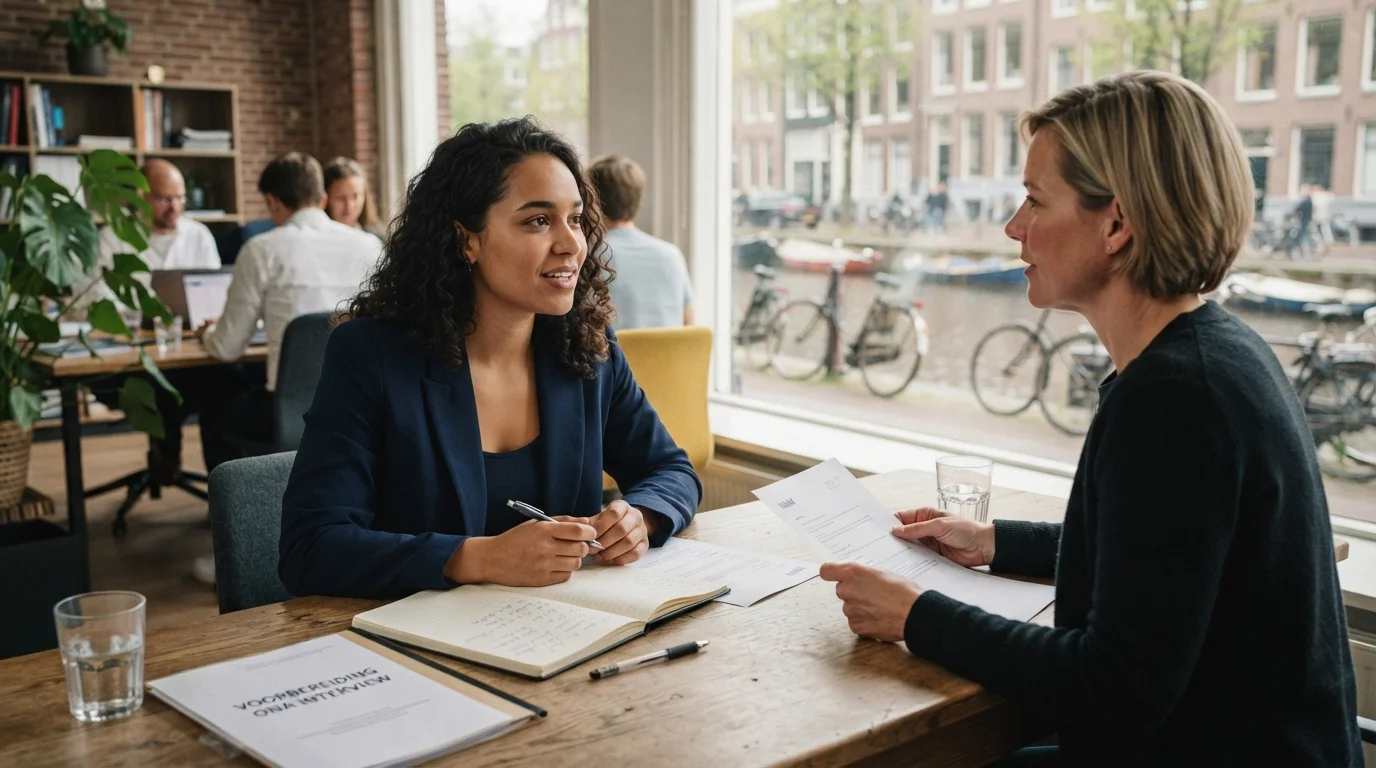
For many newcomers moving through the Dutch civic integration process, the Oriëntatie op de Nederlandse Arbeidsmarkt (ONA) exam feels like the most intimidating hurdle. Unlike multiple-choice tests on grammar or social knowledge, the ONA assessment puts your real-life career prospects and your ability to express professional ambitions in Dutch under a magnifying glass.
Whether you are pursuing employment in tech, healthcare, teaching, hospitality, or starting your own business in the Netherlands, the final ONA interview (het eindgesprek) is designed to evaluate one core premise: Do you have a realistic, well-researched plan to find work in the Dutch labor market?
In this comprehensive guide, we will break down the format of the ONA interview, analyze the most common questions you will face, provide practical model answers in Dutch, and share proven strategies to help you pass on your first attempt.
ONA stands for Oriëntatie op de Nederlandse Arbeidsmarkt (Orientation on the Dutch Labor Market). It is a mandatory component of the civic integration curriculum (under the Inburgeringswet 2013 and relevant transition paths) administered by the Dutch education executive agency, Dienst Uitvoering Onderwijs (DUO).
The ONA trajectory consists of two main parts:
If you are mapping out your full integration pathway, make sure to review the ultimate checklist for the Dutch civic integration exam to see how ONA fits alongside your reading, writing, speaking, and listening requirements.
Note on Exemptions: You may be exempt from the ONA interview if you have worked in the Netherlands for at least 6 months (working a minimum of 48 hours per month) within a continuous 12-month window, or if you completed the 64-hour ONA training course through an approved language institution. Always verify your current status after registering on Mijn Inburgering.
Knowing what happens on exam day removes unnecessary anxiety. Here is what to expect during your interview appointment at the DUO testing center:
Examiners structure their questions directly around the eight result cards you submitted. Below are the five most frequent lines of questioning, complete with breakdown analysis and Dutch model answers you can adapt to your own background.
Examiner Question: "Kunt u zich kort voorstellen en vertellen welk beroep u in Nederland wilt uitoefenen?" (Can you briefly introduce yourself and tell us what profession you want to pursue in the Netherlands?)
What the examiner wants to know: Can you summarize your professional profile succinctly in Dutch? Why did you pick this specific profession over other alternatives?
Model Answer (in Dutch):
"Natuurlijk. Mijn naam is Maria en ik kom uit Spanje. In mijn thuisland heb ik vijf jaar gewerkt als online marketeer. In Nederland wil ik graag aan de slag als Content Marketeer bij een internationaal bedrijf of een e-commerce bureau. Ik heb voor dit beroep gekozen omdat ik veel ervaring heb met social media en data-analyse, en er is in de Randstad veel vraag naar meertalige marketeers."
Examiner Question: "Welke opleiding of certificaten heeft u nodig voor dit beroep in Nederland? Moet uw buitenlandse diploma gewaardeerd worden?" (What education or certificates do you need for this job in the Netherlands? Does your foreign diploma need to be evaluated?)
What the examiner wants to know: Have you investigated whether your field is regulated (like nursing, law, or primary school teaching) or unregulated? Have you submitted your foreign credentials to IDW (Internationale Diplomawaardering)?
Model Answer (in Dutch):
"Voor mijn functie als webdeveloper is een hbo-niveau in Informatica gewenst, maar niet wettelijk verplicht. Ik heb mijn bacheloropleiding al laten waarderen door het IDW. Mijn diploma is gelijkwaardig aan een Nederlands hbo-bachelordiploma. Daarnaast leer ik nu Nederlands op B1-niveau, omdat veel bedrijven een goede beheersing van zowel het Nederlands als het Engels waarderen."
Examiner Question: "Welke competenties zijn belangrijk voor deze functie, en kunt u een voorbeeld geven waaruit blijkt dat u hierover beschikt?" (Which competencies are important for this role, and can you give an example showing you possess them?)
What the examiner wants to know: Can you link abstract soft skills (e.g., teamwork, stress resistance, precision) to concrete past achievements using the STARR method?
Model Answer (in Dutch):
"Twee belangrijke competenties voor een projectmanager zijn communicatie en planningsvaardigheid. In mijn vorige baan leidde ik een team van zes ontwikkelaars. We moesten een nieuw softwareproject opleveren binnen drie maanden. Door wekelijkse stand-ups te organiseren en taken duidelijk te verdelen, hebben we het project op tijd en binnen het budget afgerond."
Examiner Question: "Hoe zoekt u naar vacatures in Nederland en met wie heeft u genetwerkt tijdens uw voorbereiding?" (How do you search for job openings in the Netherlands, and who did you network with during your preparation?)
What the examiner wants to know: Did you actually make contact with working professionals in the Netherlands, or did you simply fill out hypothetical forms? They want specific names, platforms, and takeaways.
Model Answer (in Dutch):
"Ik zoek actief naar vacatures op LinkedIn, Indeed en via gespecialiseerde uitzendbureaus zoals Randstad en YoungCapital. Voor mijn netwerkopdracht heb ik een informatief gesprek gevoerd met de heer Jansen, een logistiek manager bij een distributiecentrum in Utrecht. Hij legde me uit dat kennis van SAP-software en een VCA-certificaat mijn kansen aanzienlijk vergroten. Dat advies neem ik mee in mijn stappenplan."
Examiner Question: "Wat zijn uw concrete stappen voor de komende zes tot twaalf maanden om deze baan te vinden?" (What are your concrete steps for the next 6 to 12 months to secure this job?)
What the examiner wants to know: Is your timeline realistic? If your Dutch is currently A1, claiming you will be a senior Dutch copywriter in three weeks will raise red flags. Be pragmatic.
Model Answer (in Dutch):
"Mijn stappenplan is als volgt: Eerst rond ik mijn inburgeringsexamens af om mijn B1-taalvaardigheid te bewijzen. Tegelijkertijd volg ik een online cursus Google Analytics om mijn vakkennis bij te spijkeren. Vanaf volgende maand stuur ik wekelijks minstens drie gerichte sollicitaties uit. Als tussenstap sta ik ook open voor een traineeship of vrijwilligerswerk om relevante Nederlandse werkervaring op te doen."
The biggest mistake candidates make is trying to memorize an exact script. If the examiner interrupts you or rephrases the question, a rigid script crumbles under pressure. Instead, review your resultaatkaarten until the key facts—company names, required certificates, job boards, contact persons—are second nature.
Your everyday conversational vocabulary might be great for ordering a coffee or chatting with neighbors, but the ONA interview requires workplace terminology: arbeidsvoorwaarden (working conditions), sollicitatiebrief (cover letter), bijscholing (additional training), and doorgroeimogelijkheden (career advancement opportunities). You can speed up your preparation by learning essential inburgering exam vocabulary using targeted spaced repetition.
Speaking anxiety is the number one reason candidates hesitate during the interview. To build reflexive confidence, practice answering open-ended career questions out loud. Using StroopTaal, you can engage in real-life Dutch conversation practice with AI and get instant feedback on your pronunciation and sentence construction, ensuring you speak clearly and confidently when sitting in front of DUO's examiners.
If you don't understand an examiner's question, do not guess or stay silent. Asking for clarification in good Dutch actually demonstrates strong communication skills! Keep these phrases ready:
Before heading to the DUO test location, verify this quick pre-exam checklist:
The ONA interview is not a trap designed to fail you. The examiners simply want to see that you have thought seriously about your future, researched the realistic requirements of the Dutch market, and can discuss your path forward in basic, coherent Dutch.
By preparing your portfolio answers thoroughly, polishing your professional terminology, and training your spoken Dutch with smart interactive tools like StroopTaal, you will turn the ONA interview into an empowering stepping stone toward your dream career in the Netherlands.
Share this article:
Preparing for the Dutch civic integration exam (inburgeringsexamen) can feel intimidating, but for many newcomers, the Listening component...
Read moreIf you are planning to settle down, apply for permanent residency, or become a Dutch citizen, you have almost certainly encountered the civic...
Read morePreparing for the Dutch civic integration exam (Inburgeringsexamen) can feel like standing at the base of a linguistic mountain. Whether you are...
Read more