
How to Find an Apartment in Amsterdam During the July Rental Peak
The Summer Rental Rush: Surviving Amsterdam's July Peak Amsterdam is a city of canals, historic charm, and unparalleled quality of life. It's no...
Read more
This article was drafted by AI and edited by a person before it was published.
AI can get things wrong. For anything official, check the source it points to.
AI-generated image
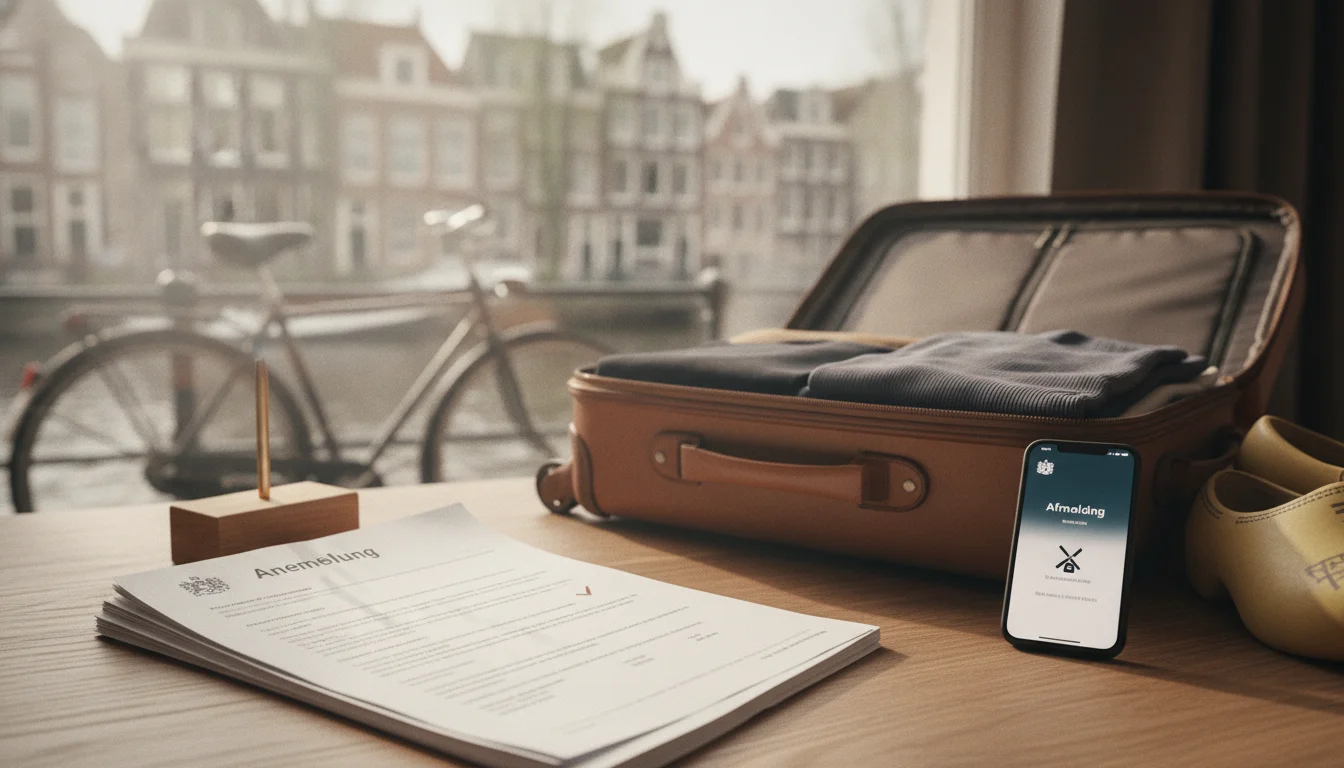
Moving to a new country is an adventure, but leaving one can be just as much of an administrative journey. If you have spent months or years enjoying the flat landscapes, efficient cycling infrastructure, and delicious stroopwafels of the Netherlands, saying goodbye is bound to be bittersweet. However, before you can board your flight or drive across the border, you must navigate the Dutch departure process—often colloquially referred to by expats as transitioning from Anmeldung (the German term for registration, often used interchangeably by European expats) to afmelding (the official Dutch term for deregistration, or uitschrijven).
The Dutch pride themselves on organization and bureaucracy. Just as there was a strict process to enter the country, there is an equally structured sequence of steps required to leave it legally and cleanly. Failing to complete these steps can result in unexpected tax bills, fines, or issues if you ever decide to return to the European Union. This comprehensive guide covers everything you need to know about deregistering, settling your taxes, cancelling utilities, and ensuring your departure from the Netherlands is completely hassle-free.
Whether you are an expat returning home, moving to a new country, or preparing for your integration exams by learning how the system works, here is your step-by-step checklist for leaving the Netherlands.
---The absolute first and most crucial step of your departure is deregistering from the Municipal Personal Records Database (Basisregistratie Personen or BRP). In Dutch, this process is called uitschrijven bij de gemeente.
If you are leaving the Netherlands for more than eight months within a one-year period, you are legally required to deregister. This applies whether you are a Dutch citizen, an EU expat, or a non-EU resident.
Once your deregistration is processed, the municipality will automatically notify other government bodies, including the tax authority (Belastingdienst) and social security. Your status will change from resident to non-resident. This status change directly impacts your Citizen Service Number (BSN). While your BSN remains uniquely yours forever, it will now be registered under the Registry of Non-Residents (Registratie Niet-Ingezetenen or RNI). If you need a refresher on how this number was generated in the first place, check out our guide on how to get a BSN number as an expat.
Tip: Ask your municipality for a written proof of deregistration (Uittreksel van uitschrijving). You may need this document to cancel your Dutch health insurance, mobile phone contracts, or to show authorities in your next destination.
---To deregister from a location in the Netherlands, you must submit an official departure notification to the municipality (gemeente) where your current residential address is registered, either online using DigiD, by post, or in person at the municipal civil affairs desk.
The exact steps depend on whether you are relocating to a different address within the country or leaving the Netherlands entirely. Understanding the administrative distinctions prevents unexpected tax assessments, fines, and status complications in the municipal records.
If you are moving from one Dutch property to another, you do not need to submit a separate deregistration form for your old location. Instead, you simply register your new address with the municipality where your new home is situated (or within your current municipality if moving locally). That registration automatically cancels your registration at the old location and updates your records in the municipal database (BRP). For background on how local records are structured, consult our Dutch BRP registration guide.
If you are leaving the country for at least eight months in a twelve-month period, you must complete an explicit international deregistration (emigratie doorgeven or uitschrijven wegens vertrek naar het buitenland). This formally detaches you from any physical address on Dutch soil.
Failing to deregister from your Dutch address can lead to severe legal and financial repercussions. If new tenants attempt to register at your old rental, the municipality will launch an address investigation (adresonderzoek). You can be fined up to €325 for failing to keep your address current. Moreover, regional tax authorities (such as water boards and municipal waste collectors) will continue billing the address under your name, and healthcare regulators (CAK) may impose steep penalties if you are still listed as an uninsured resident.
---Leaving the Netherlands midway through a calendar year means you will have a split tax year: part of the year you were a resident taxpayer, and part of the year you were a non-resident. To declare your income for this transition year, you must file a special tax return called the M-biljet (or M-Form).
The M-Form is notoriously long and, historically, had to be filled out on physical paper booklets sent by the Belastingdienst. Fortunately, in recent years, the Dutch tax office has made it possible to file the M-Form digitally via their online portal, provided you still have an active DigiD.
Because you only lived in the country for a portion of the year, you may actually be entitled to a significant tax refund, especially if your income was taxed at a high rate but your annual cumulative income was lower due to your departure. However, the form is entirely in Dutch. If your Dutch is still at an introductory level, you may want to hire a tax advisor (belastingadviseur) to assist you, or use language tools to translate the complex financial jargon.
If you have been receiving any government subsidies, such as healthcare allowance (zorgtoeslag), rent allowance (huurtoeslag), or child budget (kindgebonden budget), you must stop these payments immediately upon your departure. Because the municipality notifies the tax office of your deregistration, these should stop automatically, but it is highly recommended to log into Mijn Toeslagen and manually check. If you receive allowances for periods after your official departure date, you will be forced to pay them back later with interest.
---In the Netherlands, having basic health insurance (basisverzekering) is mandatory for all residents. The moment you deregister from the municipality and cease to be a resident, your obligation—and your right—to hold Dutch public health insurance ends.
You must actively contact your health insurance provider to cancel your policy. Do not assume it happens automatically. You will need to provide them with:
Your policy will be cancelled retroactively to your official departure date, and any overpaid premiums will be refunded to your bank account. For a deeper look at how the insurance system operates, you can review our comprehensive guide on cancelling your Dutch health insurance and managing your coverage transitions.
---Wrapping up your physical life in the Netherlands requires systematic cancellation of contracts. Dutch service providers strictly enforce notice periods, so planning ahead is vital.
Most rental contracts in the Netherlands require a notice period of at least one full calendar month (usually corresponding to your payment cycle). This means if you want to leave on August 31st, you must give written notice to your landlord no later than July 31st.
Schedule a pre-checkout inspection with your landlord to document the state of the property. Take photos of everything to ensure you receive your security deposit (borg) back. By Dutch law, landlords must return the deposit within an agreed timeframe (typically 30 to 60 days), minus any documented damages beyond normal wear and tear.
Contact your energy (gas/electricity) and water providers to notify them of your move. On your very last day in the property, take clear photos of your utility meters (meterstanden) and submit them online. Your providers will generate a final bill (eindrekening) based on these actual readings, which will either result in a final charge or a refund depending on your monthly prepayments.
Do you have a personal public transport card? If you have an active NS subscription (like Flex or monthly discounts), you must cancel it online. Simply throwing away the physical yellow card will not stop the monthly direct debits from your account. Make sure to complete this step to avoid unnecessary fees.
---A common dilemma for departing expats is whether they should close their Dutch bank account immediately. The short answer is: no, wait a few months.
You will likely receive final utility bills, tax refunds, or your rental deposit refund several weeks—or even months—after you have physically left the country. Keeping your Dutch bank account open makes these transactions significantly easier, as transferring money internationally or receiving refunds to non-EU accounts can incur high fees and administrative delays.
Before you close your account, ensure you have updated your contact details to your new foreign address. If you are curious about how to manage your banking options or minimize maintenance fees during this transition period, take a look at our analysis of closing your Dutch bank account and managing fees.
Your DigiD is your digital identity in the Netherlands. Even after you deregister, you will need your DigiD to log into the tax portal the following year to complete your M-Form. Before you leave, log into your DigiD account and ensure that:
If you reside in the Netherlands on a residence permit (e.g., highly skilled migrant, startup visa, or student visa), your residency rights are tied to your stay. Once you deregister from the municipality, the IND (Immigration and Naturalisation Service) will be notified.
You must physically return your residence card (verblijfsdocument) to the IND. Before you mail it, you must invalidate the card by cutting a corner off or punching a hole through the chip. You can then mail it to the IND headquarters in Hoofddorp. For specific instructions and mailing addresses, refer directly to the official IND website.
---Leaving the Netherlands doesn't mean you have to leave the Dutch language behind. Whether you want to maintain your language skills for future career opportunities, stay in touch with Dutch friends, or simply preserve the progress you worked so hard to achieve, regular practice is key.
This is where StroopTaal can help. Even from abroad, you can keep your language skills sharp using StroopTaal’s AI-powered personalized learning plans. With interactive dialogue games that simulate real-life scenarios, spaced repetition vocabulary builders, and instant pronunciation feedback, StroopTaal makes it incredibly easy to integrate Dutch practice into your new daily routine—no matter where in the world you move next.
---To make your transition as smooth as possible, use this quick-reference checklist:
Moving away is a major milestone, but with proper preparation, your administrative transition from the Netherlands will be a breeze. Veel succes with your next adventure, and remember: tot ziens is not a permanent goodbye!
Share this article:
The Summer Rental Rush: Surviving Amsterdam's July Peak Amsterdam is a city of canals, historic charm, and unparalleled quality of life. It's no...
Read moreWelcome to the Dutch Healthcare System: An Expat’s Introduction Moving to the Netherlands is an exciting adventure filled with scenic canal walks,...
Read moreMoving to a new country is a massive milestone, but doing so with a beloved furry companion adds an extra layer of complexity. The Netherlands is...
Read more