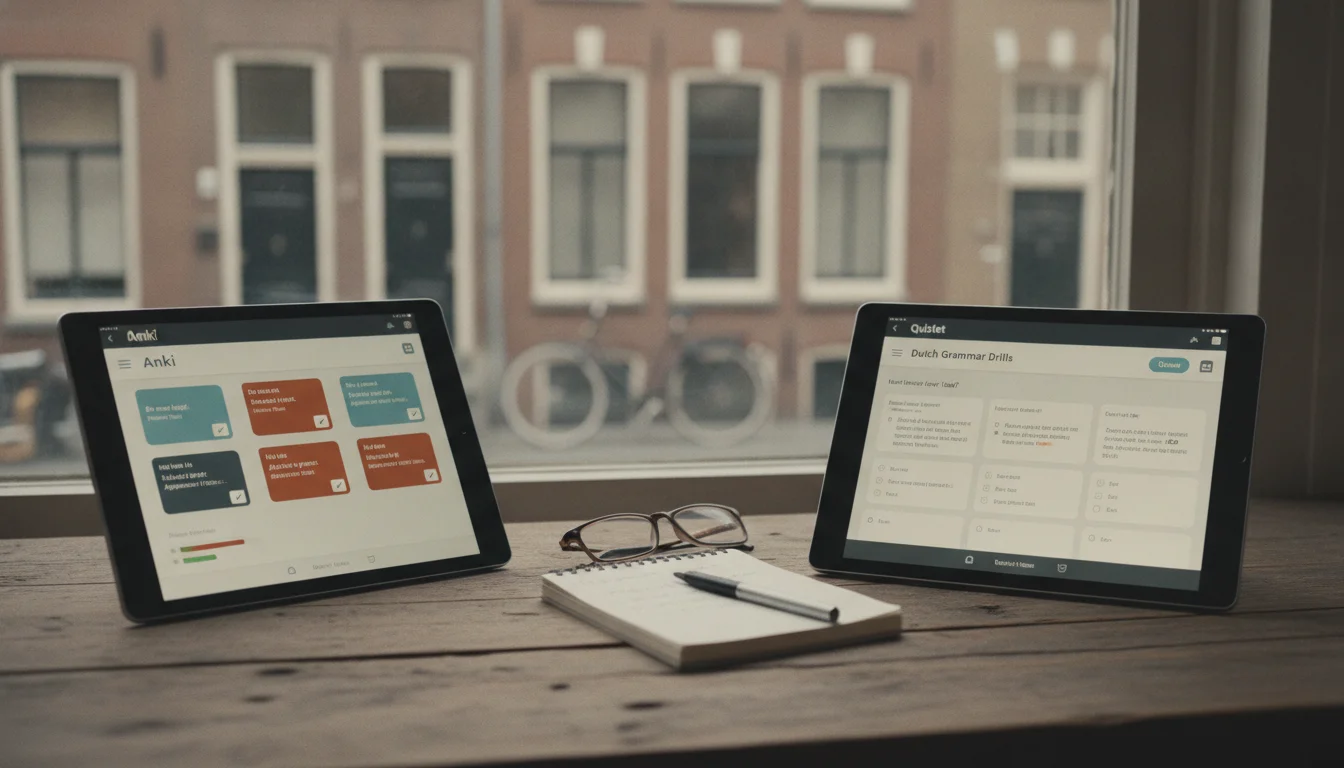
Anki vs Quizlet for Dutch Grammar: Which App Wins?
The Battle of the Flashcards: Mastering Dutch Grammar Learning Dutch can feel like a rollercoaster ride. One moment you are breezing through basic...
Read more
Whether you are an expat settling into the cozy streets of Utrecht, a professional aiming to level up your career in Amsterdam, or an ambitious learner preparing for the Dutch integration exams (Inburgeringsexamen), you have likely run into the same formidable wall: Dutch vocabulary. Dutch words can feel like a linguistic rollercoaster. Between complex compound nouns like arbeidsongeschiktheidsverzekering (occupational disability insurance) and subtle modal particles like wel, eens, and hè, memorizing Dutch vocabulary requires more than just passive reading.
Naturally, most language learners turn to their smartphones for help. Two titans dominate the mobile language-learning landscape: Duolingo and Memrise. Both apps promise to help you speak conversational Dutch by building your vocabulary, but they approach memory retention from entirely different psychological angles. One relies on heavy gamification and translation-in-context, while the other leans into systematic cognitive science and auditory immersion.
In this comprehensive guide, we will dive deep into the retention techniques of Duolingo vs Memrise for Dutch vocabulary. We will analyze the science of memory, explore how each app structures its lessons, and help you determine which platform will actually help you retain Dutch words when standing in front of a busy cashier at Albert Heijn. We will also look at how to supplement these tools with advanced AI learning systems like StroopTaal to achieve true fluency.
Before we compare the apps, we must understand how the human brain stores foreign words. When you learn a new Dutch word—for example, de sleutel (the key)—it first enters your short-term working memory. To move that word into your long-term memory, your brain must undergo a process called consolidation.
Cognitive science highlights two primary mechanisms that accelerate vocabulary consolidation:
How do Duolingo and Memrise leverage these scientific principles? Let us take a closer look at their individual methods.
Duolingo is famous for its green mascot, Duo the Owl, and its highly gamified user experience. But behind the streaks, leagues, and cartoon animations, how does Duolingo actually teach Dutch vocabulary?
Duolingo does not use a traditional flashcard-style Spaced Repetition System. Instead, it utilizes a proprietary machine learning algorithm called Half-Life Regression (HLR). This algorithm analyzes your historical performance on specific words and grammar structures to predict when you are likely to forget them. It then dynamically populates your daily lessons and personalized practice sessions with these "weak" words.
Unlike flashcard apps that present words in isolation, Duolingo almost always teaches Dutch vocabulary within sentences. You learn de hond (the dog) by translating sentences like "De hond eet een bot" (The dog eats a bone). This contextual approach helps you understand how Dutch words fit together grammatically, highlighting word order (V2 word order) and adjective endings (e.g., een groot huis vs. het grote huis).
Duolingo’s primary retention technique is psychological: keeping you coming back day after day. By using daily streaks, XP leaderboards, and immediate positive reinforcement, it builds a daily learning habit. For a deeper analysis of how these gamified mechanics stack up against other popular platforms, check out our comprehensive Babbel vs Duolingo vs StroopTaal comparison.
Memrise was founded by a Grand Master of Memory and a neuroscientist, which is reflected in its core philosophy. While Duolingo focuses on gamified translation, Memrise is built entirely around systematic memorization, sensory association, and real-world exposure.
Memrise uses a highly transparent, classic Spaced Repetition System (SRS). When you learn a new Dutch word, it is represented as a seed. As you review the word at mathematically optimized intervals, the seed sprouts into a flower. Once the flower is fully grown, the word is considered part of your long-term memory, and the review intervals stretch out to weeks or months. To understand the mechanics of this system, read our guide on spaced repetition systems (SRS) for Dutch.
One of Memrise’s unique features is the use of "Mems"—user-generated mnemonics, funny images, and word associations designed to anchor a new word in your mind. For example, to remember that bellen means "to call/ring," a Mem might show a picture of a telephone made of bell peppers. This visual and conceptual association makes abstract Dutch words instantly relatable.
Memrise addresses one of the biggest complaints about language apps: robotic text-to-speech voices. Its official Dutch courses feature thousands of short video clips of native Dutch speakers pronouncing words and phrases in everyday settings. This provides vital auditory context, helping you train your ears to recognize natural Dutch accents, fast speech, and colloquial pronunciations.
To determine which app is better for retaining Dutch vocabulary, let us compare their core cognitive techniques side-by-side.
| Retention Metric | Duolingo | Memrise |
|---|---|---|
| Spaced Repetition (SRS) | Implicit (Half-Life Regression), hidden behind lessons. | Explicit, highly structured, and visible progress (growing flowers). |
| Active Recall Strength | Low to Moderate (heavy reliance on word banks and multiple-choice). | High (frequent typing tests, spelling checks, and listening-to-type). |
| Mnemonic Support | None (relies entirely on repetitive exposure). | Excellent (user-curated visual and textual memory aids). |
| Contextual Depth | High (words are taught inside complete, if sometimes bizarre, sentences). | Moderate (focuses on isolated words and short idioms/phrases). |
| Auditory Processing | Synthesized computer voices (can sometimes sound unnatural). | Real native speaker video clips (excellent for real-world listening). |
While both Duolingo and Memrise offer powerful techniques for memorizing vocabulary, they both suffer from a fundamental limitation: they keep you in a controlled, artificial environment. In real life, speaking Dutch is not a multiple-choice game. When a neighbor says, "Lekker weertje, hè?" (Nice weather, isn't it?), your brain has to perform several complex operations simultaneously: interpret the spoken sounds, retrieve the correct vocabulary, apply Dutch grammar rules, formulate a response, and pronounce it with the correct Dutch accent.
This is where standard vocabulary apps fall short. They do not teach you how to apply your vocabulary dynamically in real-life conversations. If you want to move past basic memorization, you need to start expanding your Dutch vocabulary beyond basic flashcards and into active, conversational usage.
To truly master Dutch, you need a system that combines the structured retention of SRS with real-world conversational application. This is exactly why we built StroopTaal. StroopTaal is an AI-powered Dutch language learning app designed to take you from a passive vocabulary recognizer to an active, confident Dutch speaker.
StroopTaal enhances your learning journey by offering:
If your primary goal is rapid, efficient vocabulary acquisition and listening comprehension, Memrise is the clear winner. Its explicit Spaced Repetition System, combined with "Learn with Locals" video clips and mnemonic aids, makes it incredibly effective at cementing individual Dutch words and phrases into your long-term memory.
If your primary goal is building a daily learning habit and understanding basic sentence structures, Duolingo is a solid starting point. Its gamified lessons are highly accessible and keep you motivated during the early stages of your language-learning journey.
For the best results, we recommend a hybrid approach. Use Memrise to rapidly build a core bank of 1,000 to 2,000 Dutch words. Simultaneously, use StroopTaal to practice using those words in active conversations, master your pronunciation, and play interactive dialogue games that simulate real life in the Netherlands. By combining systematic vocabulary acquisition with active conversational practice, you will unlock true Dutch fluency faster than you ever thought possible.
Ready to take your Dutch vocabulary out of the flashcard app and into the real world? Download StroopTaal today and start practicing real-life Dutch conversations with instant AI feedback!
Share this article:
The Battle of the Flashcards: Mastering Dutch Grammar Learning Dutch can feel like a rollercoaster ride. One moment you are breezing through basic...
Read moreThe Expat's Dilemma: Why Perfect Grammar Isn't Enough You have spent hours memorizing vocabulary lists. You finally understand the difference between...
Read moreThe Evolution of Language Learning: From Textbooks to Algorithms Imagine landing at Schiphol Airport, your mind buzzing with excitement and a resolve...
Read more