AI-Powered Error Correction: Master Written Dutch Fast
Imagine this: You have spent twenty minutes carefully drafting an email to your Dutch landlord or colleague. You have checked your vocabulary list,...
Read more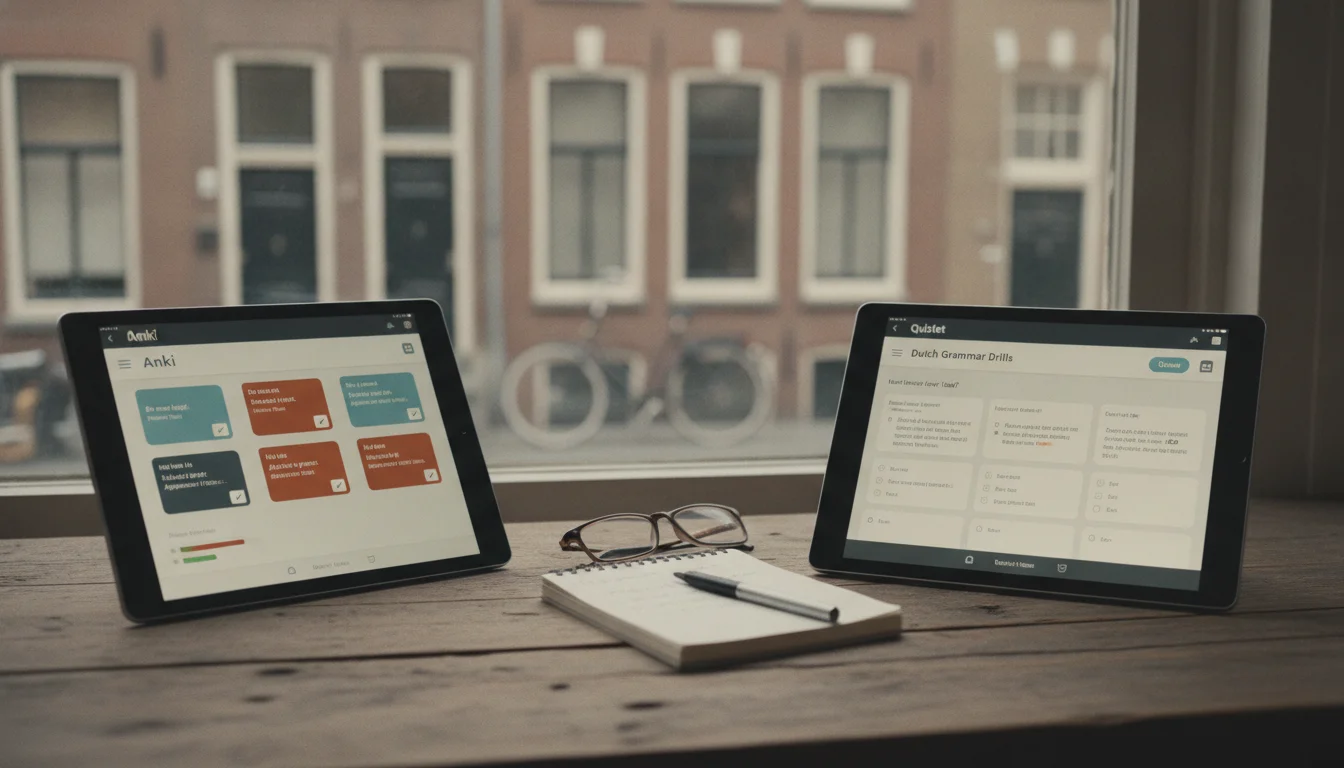
Learning Dutch can feel like a rollercoaster ride. One moment you are breezing through basic greetings, and the next, you are staring in utter confusion at a sentence where the verb has mysteriously migrated to the very end. Between the infamous de and het articles, the complex rules of word order (known as V2 structure), and the shifting forms of irregular verbs, mastering Dutch grammar rules requires a systematic approach.
Enter digital flashcards. For decades, language learners have relied on active recall and spaced repetition to commit difficult grammatical concepts to long-term memory. But when it comes to digital flashcard apps, two giants dominate the field: Anki and Quizlet. Both boast millions of users, yet they operate on entirely different philosophies.
In this comprehensive guide, we will break down the strengths and weaknesses of Anki and Quizlet specifically for learning Dutch grammar. Whether you are an expat trying to survive daily life in Amsterdam, or a dedicated student preparing for the Inburgeringsexamen (integration exam) as outlined by the Dutch government website, this comparison will help you choose the ultimate tool for your language-learning arsenal.
Before we pit Anki against Quizlet, it is crucial to understand why Dutch grammar is unique and why simple vocabulary-style memorization is not enough. Many language apps treat grammar as a secondary thought, assuming you will pick it up naturally. However, Dutch features several structural quirks that require conscious, targeted study:
To master these rules, you cannot just look at a Dutch word and its English translation. You need to actively construct sentences, recognize patterns, and test your recall. This is where choosing between spaced repetition for Dutch flashcards and more gamified platforms becomes a critical decision.
Anki (the Japanese word for "memorization") is a free, open-source flashcard program famous for its powerful Spaced Repetition System (SRS). Instead of reviewing the same cards every day, Anki uses a sophisticated algorithm to show you cards right at the moment you are about to forget them. If you answer correctly, the interval before you see that card again increases (from days to weeks, and eventually months).
Anki is highly customizable, making it incredibly powerful for complex grammatical structures. Here is how you can leverage Anki for Dutch:
While Anki is incredibly effective, it is not without its flaws. The user interface is famously utilitarian, resembling database software from the early 2000s. There is a steep learning curve to mastering card creation, syncing, and add-ons. For some learners, the lack of aesthetic appeal and gamification can lead to study fatigue, making it difficult to maintain a daily routine.
On the other side of the ring is Quizlet. Quizlet is a modern, polished, and highly intuitive platform designed with a focus on user experience. It turns your study decks into various games, practice tests, and interactive matching exercises.
Quizlet is built for rapid creation and immediate engagement. If you prefer a colorful, highly interactive environment, Quizlet has several advantages:
Quizlet’s primary drawback is its departure from a true spaced repetition model in its free tier. While the "Learn" mode uses smart algorithms, the fully customized SRS scheduling that makes Anki famous is largely absent or locked behind a premium subscription (Quizlet Plus). Additionally, Quizlet is less suited for complex sentence-building or cloze deletions, making it harder to practice nuanced Dutch word order rules.
To help you decide which tool fits your study style, let's look at how both apps perform when tackling specific Dutch grammar hurdles.
Anki: Excellent. You can create a card where the front shows a word like "meisje" (girl), and the back shows "het meisje". By using color-coded CSS styling (e.g., blue for de, green for het), you can leverage visual memory. Anki's SRS ensures you review the tricky het words more frequently than the more common de words.
Quizlet: Good, but basic. You can create matching games where you connect nouns to their correct articles. While this is fun and highly interactive, the lack of deep SRS means you might waste time reviewing words you already know perfectly, rather than focusing on your weak spots.
Anki: Outstanding. Through cloze deletions, you can master inversion (when the verb comes before the subject, such as after a time phrase). For example:
Front: "Vandaag {{c1::drink::drink/drinkt}} ik koffie."
This forces you to remember that because the sentence starts with "Vandaag", the verb drink must come before ik.
Quizlet: Average. You can use the "Write" or "Gravity" modes to type out full sentences, but the grading system is highly rigid. If you miss a single comma or space, Quizlet might mark your grammatically correct sentence as incorrect, which can be highly frustrating.
Anki: Highly effective. You can set up cards that display the infinitive (e.g., vinden) and require you to recall the past singular (vond) and the past participle (gevonden). Because irregular verbs require deep memorization, Anki's algorithm is perfect for locking these forms into your long-term memory.
Quizlet: Very engaging. The "Match" game is incredibly helpful for quickly drilling verb conjugations. It allows you to drag and drop pronouns to their corresponding verb forms, making it an excellent warm-up tool before a writing or speaking session.
The choice between Anki and Quizlet ultimately comes down to your personal learning style, technical comfort, and long-term goals.
Choose Anki if: You are committed to long-term Dutch fluency, are preparing for the Inburgering exams, prefer absolute control over your study materials, and appreciate the scientific efficiency of spaced repetition. It requires an initial time investment to learn, but the cognitive payoff is unmatched.
Choose Quizlet if: You are a visual learner who gets bored easily, need to cram for an upcoming vocabulary test, prefer a clean and modern interface, and want to start studying immediately without a complex setup phase.
While flashcards are an exceptional tool for memorizing grammatical structures, articles, and verb tables, they have one major limitation: they cannot teach you how to hold a real-life conversation. Memorizing that "gegaan" is the past participle of "gaan" is highly useful, but using it spontaneously in a fast-paced conversation with a native Dutch speaker is an entirely different skill.
To bridge the gap between static flashcard memorization and active conversational fluency, consider pairing your flashcard routine with an advanced, interactive language tool like StroopTaal.
StroopTaal complements your grammar study by offering AI-driven personalized learning plans that adapt dynamically to your progress. Instead of just memorizing grammar rules in isolation, StroopTaal allows you to practice real-life Dutch conversations with an AI tutor, play engaging article mastery games to conquer de and het once and for all, and receive instant, precise pronunciation feedback. It takes the core principles of spaced repetition and active recall and applies them to immersive, practical scenarios.
There is no single "magic bullet" for mastering Dutch grammar, but combining the right tools can accelerate your progress dramatically. You might find that the ultimate strategy is a hybrid one: using Anki to lock in difficult word order rules and irregular verbs, utilizing Quizlet for quick vocabulary matching games on the go, and using StroopTaal to put those rules into practice through interactive dialogue games and spoken conversations.
The most important step is consistency. Whichever app you choose, commit to spending 10 to 15 minutes with it every day. Before you know it, those intimidating sentence structures will start to feel like second nature, and you will be navigating conversations in the Netherlands with confidence.
Ready to take your Dutch grammar and speaking skills to the next level? Download StroopTaal today and experience how personalized AI coaching can transform your language learning journey!
Share this article:
Imagine this: You have spent twenty minutes carefully drafting an email to your Dutch landlord or colleague. You have checked your vocabulary list,...
Read moreIntroduction: The Battle for Dutch Vocabulary Mastery Whether you are an expat settling into the cozy streets of Utrecht, a professional aiming to...
Read moreThe Expat's Dilemma: Why Perfect Grammar Isn't Enough You have spent hours memorizing vocabulary lists. You finally understand the difference between...
Read more