Babbel vs Duolingo vs StroopTaal: Best Dutch App?
So, You Want to Learn Dutch? Choosing Your Digital Tutor Gefeliciteerd! Congratulations on deciding to learn Dutch. Whether you're moving to the...
Read more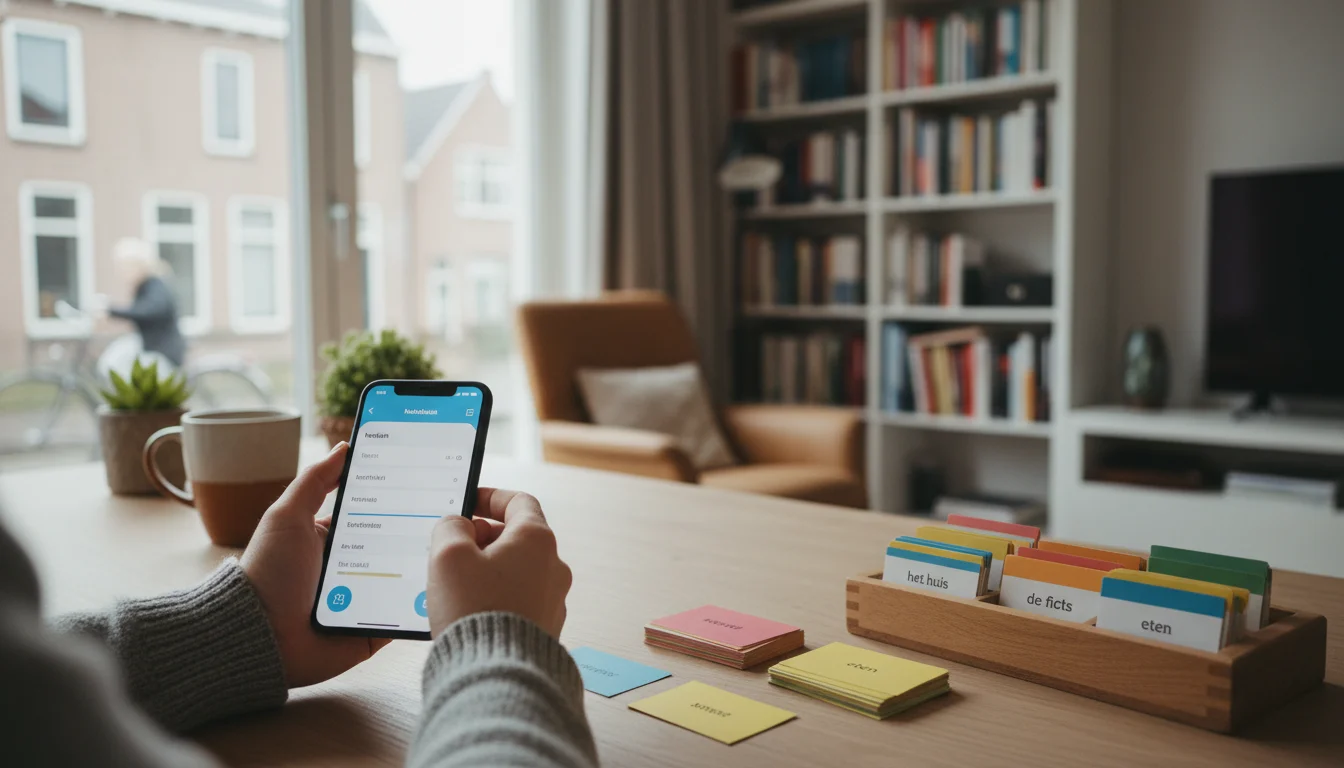
You’ve just spent an hour learning a list of 30 new Dutch words. You feel proud, accomplished. You know what gezellig means, you can order a biertje, and you understand the difference between huis and muis. But the next day, you try to recall them, and... poof. Only a handful remain. The rest have vanished into the ether. Sound familiar? This frustrating cycle is known as the 'forgetting curve', and it’s the biggest hurdle for any language learner.
But what if there was a scientifically proven method to combat this forgetting curve, turning your brain into a super-sponge for Dutch vocabulary? There is, and it’s called Spaced Repetition System (SRS), or simply spaced repetition. In this comprehensive guide, we'll dive deep into what spaced repetition is, why it’s so effective for learning Dutch, and we’ll compare the two main approaches: traditional manual flashcards versus modern learning apps. Which one will lead you to Dutch fluency faster?
Imagine you’re trying to keep a path in a forest clear. The first time you walk it, you have to push through branches and weeds. If you walk it again the next day, it's a bit easier. If you wait a week, it’s easier still. But if you wait a year, the path will be completely overgrown. Your memory works in a similar way.
Spaced repetition is a learning technique based on this principle. Instead of cramming information in one go (massed repetition), you review it at increasing intervals. You review a new Dutch word shortly after you first learn it. Then, you review it again after a slightly longer period, and then an even longer one. Each successful review tells your brain, "Hey, this is important! Keep it."
This method directly counters the Ebbinghaus forgetting curve, a concept discovered by German psychologist Hermann Ebbinghaus in the 19th century. He found that we forget information exponentially over time. You might forget 50% of new information within an hour, and 90% within a week. Spaced repetition interrupts this process at the perfect moment. By reviewing information just before you’re about to forget it, you flatten the curve and reinforce the memory, moving it from your short-term to your long-term memory.
For Dutch learners, this means no more wasted hours on vocabulary lists that don't stick. It’s about studying smarter, not harder.
Before apps dominated our phones, learners used clever manual systems to implement spaced repetition. The most famous of these is the Leitner System, developed by German science journalist Sebastian Leitner in the 1970s. It’s a simple yet powerful way to organize physical flashcards.
Here’s a basic setup:
Enter the digital age. Language learning apps have taken the principles of spaced repetition and supercharged them with technology. Instead of you managing the boxes, a sophisticated algorithm does it for you, creating a seamless and efficient learning experience.
Most modern language apps use algorithms (like SM-2) that track your performance on every single word. When you review a word, you'll typically rate how well you knew it (e.g., 'Easy', 'Good', 'Hard'). The app uses this feedback to calculate the perfect time to show you that word again. Got it right easily? You won’t see it for a while. Struggled a bit? It will pop up again much sooner.
This creates a highly personalized learning path. An app like StroopTaal integrates this technology directly into its vocabulary-building exercises. The AI-powered system learns your personal strengths and weaknesses, ensuring you spend your time on the words you're most likely to forget, making your study sessions incredibly efficient. This is a key part of moving beyond basic flashcards and into a more dynamic learning environment.
So, the big question: should you stick with the classic pen-and-paper method or embrace a digital tool? The answer depends on your learning style, goals, and lifestyle.
For most learners in the 21st century, especially those preparing for integration exams like the inburgeringsexamen where efficiency is key, the advantages of a dedicated app are hard to ignore. When you're trying to build a foundation quickly, having an automated, multimedia-rich system is a game-changer. The process of choosing the right Dutch learning app is about finding one that integrates SRS seamlessly with other essential features.
Spaced repetition isn't just for single words! Its power can be harnessed for all aspects of the Dutch language. You can create 'cards' (whether physical or digital) for:
This is another area where apps excel. A well-designed app will not just drill you on isolated words but will present them in context, integrate them into grammar lessons, and use them in dialogue practice, effectively applying spaced repetition principles to the language as a whole.
The battle against the forgetting curve is one every Dutch learner must fight. Spaced repetition is your most powerful weapon in this fight. While the classic manual Leitner system is a testament to clever, screen-free learning, its modern digital counterparts offer unparalleled efficiency, convenience, and richness.
Apps with built-in Spaced Repetition Systems automate the most tedious parts of learning, freeing you up to focus on what matters: understanding and using the Dutch language. They provide the audio you need for pronunciation, the motivation you need to stay consistent, and the portability you need for a modern lifestyle.
If you're serious about making Dutch vocabulary and grammar stick for the long term, integrating a tool that uses smart, adaptive technology is the logical next step. Why not let an AI-powered system like StroopTaal build your personalized review schedule, so you can spend less time managing flashcards and more time preparing for your next real-life conversation in Dutch?
Share this article:
So, You Want to Learn Dutch? Choosing Your Digital Tutor Gefeliciteerd! Congratulations on deciding to learn Dutch. Whether you're moving to the...
Read moreBeyond Basic Flashcards: Advanced Vocabulary Building with Language AppsYou’ve diligently memorized your first 500 Dutch words. You can name the...
Read moreThe Preposition Predicament: Why 'Op', 'In', and 'Aan' Drive You Crazy You’ve started your Dutch learning journey. You feel confident after...
Read more