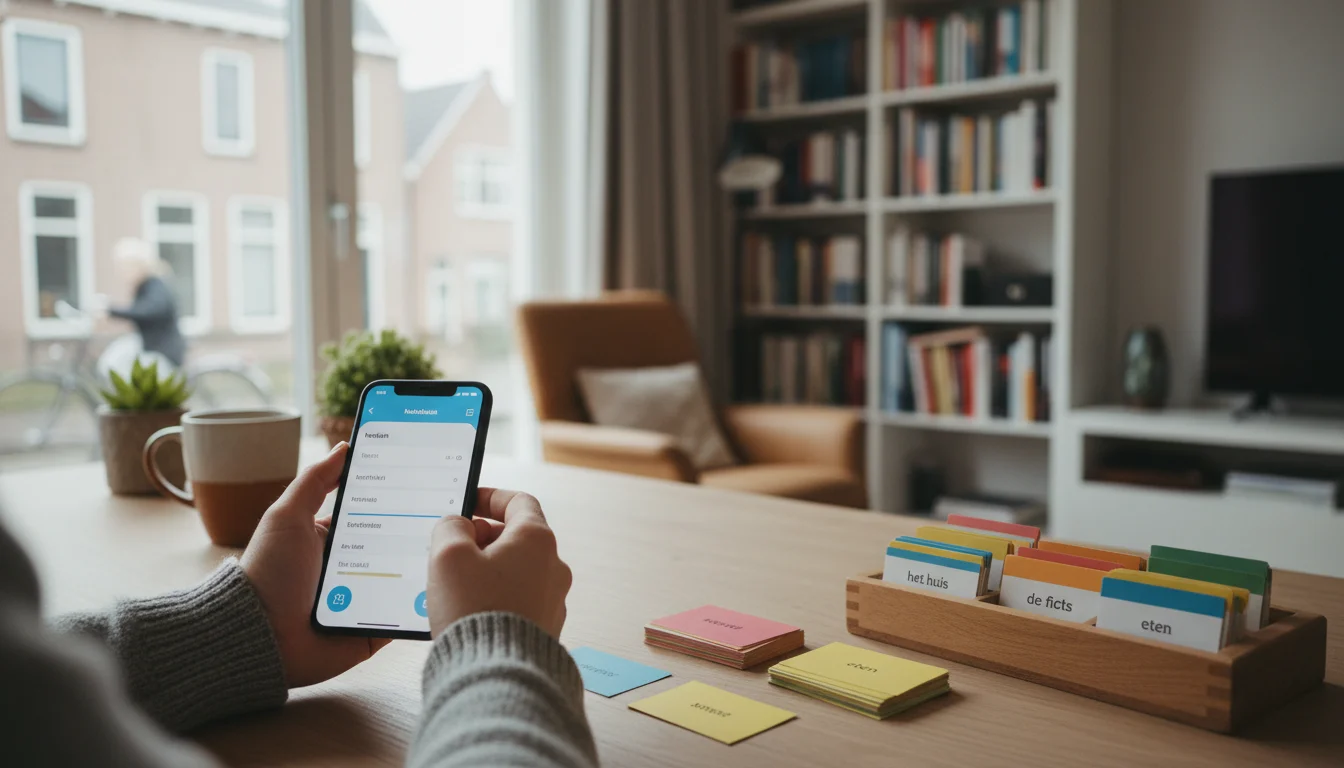
Spaced Repetition for Dutch: Apps vs. Manual Flashcards
Forgetting Dutch Words? Here's the Secret to Making Them Stick You’ve just spent an hour learning a list of 30 new Dutch words. You feel proud,...
Read more
You’ve diligently memorized your first 500 Dutch words. You can name the objects in your room, list common foods, and maybe even describe the weather. You’ve conquered the flashcard pile. But when you try to have a real conversation, the words feel stuck, disconnected. You know the noun, but not whether it’s a 'de' or 'het' word. You understand the verb, but not how it fits into a natural Dutch sentence. This is the 'flashcard plateau', and it’s a sign you’re ready to evolve.
True fluency isn't about the sheer number of words you can recall in isolation; it's about how deeply you understand them and how flexibly you can use them in context. It's time to move beyond basic memorization and embrace advanced vocabulary-building strategies that mirror how we learn language naturally. This guide will show you how to leverage modern language apps and smart techniques to build a robust, active Dutch vocabulary that you can actually use in real life.
Flashcards are a fantastic starting point. They help build a foundational vocabulary quickly. However, relying on them exclusively for intermediate and advanced learning can create significant gaps in your knowledge. The goal is to speak Dutch, not just to know Dutch words.
A traditional flashcard presents a word in isolation. 'Fiets' on one side, 'Bicycle' on the other. This creates what linguists call 'word islands' – isolated pieces of information floating in your memory. You learn the word, but you don't learn its connections:
Flashcards primarily build your passive vocabulary – words you recognize when you see or hear them. This is useful for reading and listening comprehension. However, fluency requires a strong active vocabulary – words you can recall and use correctly on demand when speaking or writing. To move a word from passive to active memory, you need to engage with it in multiple, meaningful contexts.
Our brains are wired to remember stories and connections, not isolated facts. Contextual learning is the principle of learning words as part of a larger picture. This is the single most effective way to build a usable, long-lasting vocabulary.
Instead of memorizing 'afspraak' = 'appointment', learn it in a sentence: 'Ik heb morgen een afspraak bij de tandarts.' (I have an appointment at the dentist tomorrow). By doing this, you learn so much more:
This method transforms one piece of data into a web of grammatical and semantic knowledge, making it stickier and more useful.
Instead of learning random lists of words, focus on themes relevant to your life in the Netherlands. Are you preparing for the inburgeringsexamen (civic integration exam)? Focus on themes like visiting the municipality (gemeente), going to the doctor (huisarts), or talking to your child's teacher. This approach is incredibly practical and prepares you for specific situations you will encounter.
For example, for the theme 'visiting the doctor', you'd learn:
Immerse yourself in real Dutch. Read articles on NU.nl, listen to Dutch podcasts, or watch shows on NPO. When you encounter a new word, don't just look it up. Pay attention to the entire sentence. How is it used? What other words surround it? Modern apps like StroopTaal offer podcasts with a transcript that follows the audio, where you can tap any word to see what it means and save it to practice later.
This is where modern language apps truly shine. They go far beyond digital flashcards by incorporating cognitive science and AI to create a dynamic, effective learning environment.
SRS is the intelligent evolution of the flashcard. It's an algorithm that predicts when you are most likely to forget a word and prompts you to review it at that exact moment. This is far more efficient than reviewing random stacks of cards. It ensures that difficult words are shown more frequently, while words you know well appear less often, optimizing your study time for maximum long-term retention.
Knowing a word is one thing; using it under the pressure of a conversation is another. This is where you activate your vocabulary. Practicing with an AI partner provides a safe, judgment-free space to try out new words and phrases. You can stumble, make mistakes, and try again without embarrassment. This active recall is crucial for moving words into your long-term, usable vocabulary. The rise of AI chatbots for language learning has made this kind of practice more accessible than ever, allowing you to simulate real-life scenarios like ordering coffee or asking for directions.
Consistency is the secret ingredient to language learning. Advanced apps use gamification elements to keep you coming back. Earning points, maintaining daily streaks, and completing challenges provide small dopamine hits that build a positive feedback loop. This isn't just about fun; gamified learning helps build the consistent habits necessary for the long journey to fluency.
Combine the power of technology with these proven linguistic strategies to become a vocabulary-building powerhouse.
Start seeing patterns in Dutch words. Many words are built from a root and various prefixes and suffixes. For example, if you know the verb 'werken' (to work), you can start to understand a whole family of words:
Recognizing these patterns allows you to make educated guesses about new words you encounter, dramatically speeding up your learning process.
This is non-negotiable for serious Dutch learners. From this day forward, never learn a noun by itself. It is not 'boek', it is 'het boek'. It is not 'tafel', it is 'de tafel'. This is the single best habit you can form. Make it a single unit of information in your brain. Apps that include dedicated 'de/het' training, like StroopTaal's Article Mastery games, are invaluable for reinforcing this crucial grammar point.
Keep a digital notebook or a physical journal where you write down new words. But don't just write the word and its translation. Write the full, interesting sentence where you found it. Even better, create your own sentence that is personally meaningful. If you learn the word 'gezellig', don't just write the definition. Write: 'Het was gisteren erg gezellig met mijn vrienden in het café.' (It was very cozy/nice with my friends in the café yesterday). Personal connections create stronger memories.
Moving beyond basic flashcards is about shifting your mindset from passively collecting words to actively building a network of knowledge. It's about understanding that every word is part of a system of grammar, context, and culture. By embracing contextual learning, leveraging the smart tools in modern language apps, and adopting advanced study habits, you can break through the intermediate plateau.
You'll build a vocabulary that isn't just impressive in a quiz, but one that is robust, flexible, and ready for you to use in your next conversation at the Albert Heijn, your next meeting with the IND, or simply your next gezellig chat with a Dutch friend.
Ready to build a Dutch vocabulary that you can actually use? Download StroopTaal today and discover an AI-powered learning plan that uses spaced repetition, real-life conversation practice, and contextual lessons to take you beyond flashcards and towards true fluency.
Share this article:
Forgetting Dutch Words? Here's the Secret to Making Them Stick You’ve just spent an hour learning a list of 30 new Dutch words. You feel proud,...
Read moreThe Preposition Predicament: Why 'Op', 'In', and 'Aan' Drive You Crazy You’ve started your Dutch learning journey. You feel confident after...
Read moreSo, You Want to Learn Dutch? Don't Just Download, Discern. The year is 2026, and the app store is a digital jungle teeming with promises of fluency....
Read more