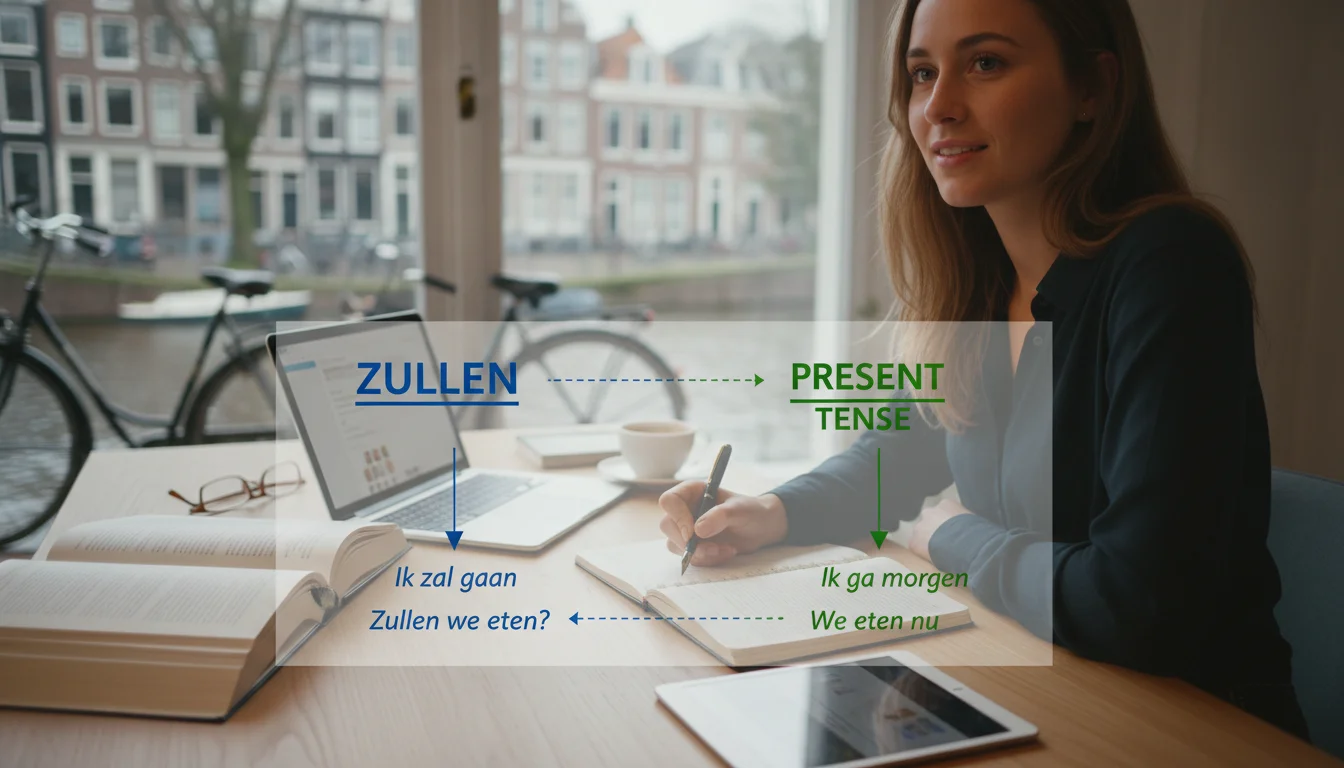
Pronouncing Dutch 'Ui' and 'Ij': An English Speaker's Guide
Introduction: The Phonetic Hurdles of Dutch Welcome to the wonderful, sometimes throat-clearing world of Dutch pronunciation! If you have recently...
Read more
If you have been learning Dutch for a while, you know the feeling. You have memorized hundreds of vocabulary words, you can confidently order a koffie verkeerd, and you can navigate basic daily transactions. But as you transition from an A2 elementary level to a solid B1 intermediate level, you hit a wall. Your sentences feel short, choppy, and robotic. You want to express complex thoughts, explain your motivations, and connect ideas, but you find yourself stuck using child-like sentence structures.
The secret to unlocking natural, fluent, and professional-sounding Dutch lies in mastering subordinate clauses (bijzinnen). In Dutch, the moment you transition from a main clause to a subordinate clause, the grammar rules perform a spectacular gymnastic flip. Verbs that once sat comfortably in the second position of your sentence suddenly get kicked all the way to the very end.
This structural shift can feel incredibly counterintuitive for English speakers. However, once you understand the underlying formula, constructing these sentences becomes an engaging puzzle rather than a source of frustration. In this comprehensive guide, we will break down the mechanics of Dutch subordinate clauses, explore the most common conjunctions, tackle the tricky rules of verb clusters, and provide actionable strategies to make this word order second nature.
Before we dive into the mechanics of the bijzin, we must establish a clear contrast with the hoofdzin (main clause). Understanding this distinction is crucial because the two structures follow entirely different word order rules.
A main clause is a complete thought that can stand alone as a sentence. In a standard Dutch main clause, the finite verb (the conjugated verb) always occupies the second position. This is known as the V2 rule.
Even if you add time or place to the beginning of a main clause, the verb remains in the second position, causing the subject to shift to the third position (inversion): Vandaag leer ik Nederlands.
A subordinate clause is a clause that cannot stand alone. It depends on a main clause to make sense. It is introduced by a subordinating conjunction (like omdat, als, or dat). In a subordinate clause, the finite verb is kicked to the very end of the clause.
When you combine them, you get a beautiful, complex sentence: Ik woon in Amsterdam, omdat ik Nederlands leer. Notice how the verb woon is in position 2 in the first part, but leer flies to the end in the second part.
One of the most common pitfalls for B1 learners is using the wrong conjunction and accidentally applying the wrong word order. In Dutch, conjunctions are divided into two main categories: coordinating (which keep main clause word order) and subordinating (which trigger subordinate word order).
These conjunctions connect two main clauses. The word order in both clauses remains Subject + Verb. You can remember them with the acronym ADDON: Als (when/if - note: can be coordinating or subordinating depending on context, but let's look at the core five), En (and), Maar (but), Want (because), Of (or), Dus (so).
These conjunctions introduce a subordinate clause, sending all verbs to the end. The most common subordinating conjunctions include:
Let's compare want and omdat, as they both mean 'because' but require completely different structures:
Mastering this distinction is highly beneficial when practicing the art of Dutch small talk, where smoothly explaining your preferences or daily activities with omdat makes your speech sound much more natural and integrated.
What happens when your subordinate clause has more than one verb? For example, a modal verb combined with an infinitive (e.g., wil leren - want to learn), or an auxiliary verb combined with a past participle (e.g., heb geleerd - have learned)?
When multiple verbs are sent to the end of a subordinate clause, they form a verb cluster. In Dutch, you often have flexibility in how you order these verbs, but there are preferred patterns.
When you have a modal verb (willen, kunnen, moeten, mogen, zullen) and an infinitive, you can generally place them in two orders: Auxiliary + Main Verb (the 'red' order) or Main Verb + Auxiliary (the 'green' order). In modern Netherlands Dutch, the red order is more common.
Similarly, for the perfect tense (using hebben or zijn with a past participle), both orders are grammatically acceptable, though regional preferences exist.
This flexibility can feel liberating, but it is best to stick to one consistent style when you are starting out. The red order (Auxiliary + Main Verb) is highly recommended for learners aiming for standard Netherlands Dutch.
In Dutch, you do not always have to start your sentence with a main clause. You can start with the subordinate clause. However, doing so triggers a fascinating grammatical reaction in the main clause that follows.
When a sentence begins with a subordinate clause, the entire subordinate clause acts as 'Position 1' for the rest of the sentence. Because the main clause must have its verb in 'Position 2', the very first word of the main clause must be its verb, followed immediately by its subject. This is a classic case of inversion.
Notice the comma separating the two clauses. A helpful mnemonic for Dutch learners is: "Verb, Verb". When you start with a subordinate clause, the last word of the first clause is a verb, and the first word of the second clause is also a verb. They meet at the comma!
This structure is incredibly common in professional environments. For instance, when using essential Dutch phrases for job interviews, starting with conditional clauses (e.g., Als ik deze rol krijg, wil ik...) demonstrates a sophisticated command of the language that immediately impresses recruiters.
Knowing the rules intellectually is one thing; applying them in rapid speech is another. Here are practical exercises and strategies to bridge the gap between theory and fluency:
To accelerate this process, technology can be a game-changer. With the StroopTaal app, you don't have to study dry grammar tables all day. StroopTaal offers AI-powered personalized learning plans and interactive dialogue games that let you practice these exact sentence structures in real-life contexts. You can engage in real-life Dutch conversation practice with an AI tutor that gives you instant feedback on your word order, ensuring you correct mistakes before they become deeply ingrained habits.
Mastering the Dutch bijzin is a major milestone on your path to B1 fluency. It marks the transition from translating English thoughts word-for-word to truly thinking in Dutch. While the shifting verbs might feel chaotic at first, they actually follow a highly logical, mathematical structure. Treat it like a game: spot the subordinating conjunction, and kick those verbs to the goal line.
Are you ready to take your Dutch grammar to the next level? Start incorporating subordinate clauses into your daily conversations, and don't be afraid to make mistakes. If you want structured support, interactive exercises, and gamified progress tracking, download StroopTaal today to master Dutch grammar from A0 all the way to C1 level!
Share this article:
Introduction: The Phonetic Hurdles of Dutch Welcome to the wonderful, sometimes throat-clearing world of Dutch pronunciation! If you have recently...
Read moreTalking About Tomorrow: Unlocking the Dutch Future Tense Ever found yourself trying to make plans with a Dutch friend, only to get stuck on how to...
Read moreFrom 'Hallo' to 'Hoewel': Charting Your Dutch Grammar Journey Do you ever feel like you're stuck in the Dutch beginner's lane? You can introduce...
Read more