Mastering Dutch Sentence Structure: The Ultimate B1 Guide
The B1 Leap: Why Subordinate Clauses are Your Secret Weapon If you have been learning Dutch for a while, you know the feeling. You have memorized...
Read more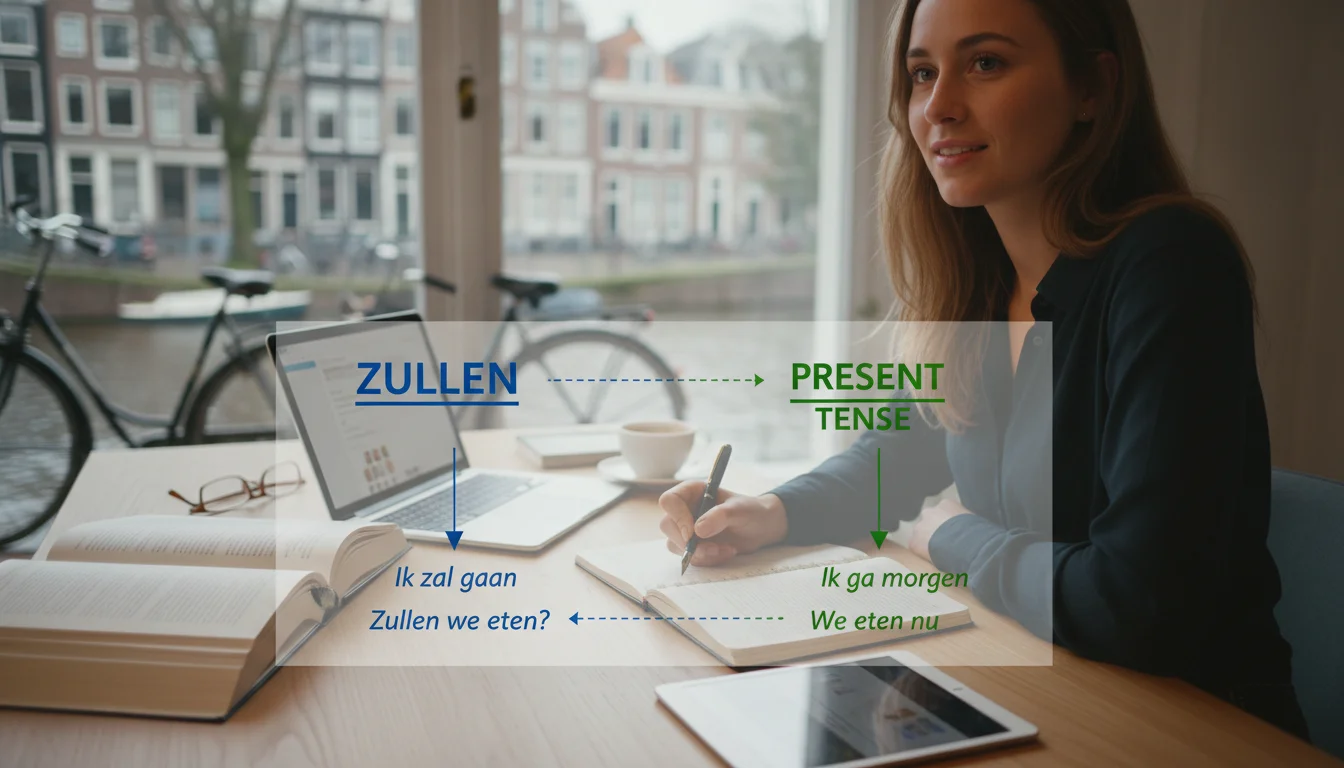
Ever found yourself trying to make plans with a Dutch friend, only to get stuck on how to say 'I will meet you tomorrow'? You're not alone. Talking about the future is a fundamental part of any language, but Dutch has a little twist that often surprises learners. Unlike English, which heavily relies on 'will' or 'going to', Dutch speakers have two primary, and very different, ways to discuss future events. One is incredibly simple, and the other adds a layer of nuance and formality.
Mastering this distinction is the key to sounding less like a textbook and more like a local ordering a biertje on a Friday afternoon. This comprehensive guide will walk you through everything you need to know about using the present tense for future plans and when to bring in the auxiliary verb 'zullen'. We'll explore the rules, the subtle differences in meaning, and how you can practice until it becomes second nature. Let's get started!
Here's the best news you'll get all day: the most common way to talk about the future in Dutch is by using the simple present tense. Yes, you read that right. The same verb forms you use to talk about what's happening now are used for what's happening next week, next month, or next year.
So, how do people know you're talking about the future and not the present? The magic lies in context, specifically through time adverbs. Words like morgen (tomorrow), volgende week (next week), vanavond (tonight), or a specific date are your signposts to the future.
The structure is straightforward. You simply use a standard present tense sentence and add a time indicator.
This method is used when there is a high degree of certainty. Think of it as expressing events that are already planned, scheduled, or considered a sure thing.
Because time indicators are so crucial here, it's worth brushing up on them. For a deeper dive, our guide on mastering Dutch time adverbs can provide more context on how these words shape your sentences.
While the present tense handles most daily situations, there's also a dedicated future tense using the auxiliary verb 'zullen' (will/shall). This is what you might call the 'true' future tense, or Onvoltooid Toekomende Tijd (O.T.T.). Using 'zullen' adds a different flavour to your sentence, often implying a promise, a prediction, or a degree of formality.
First, you need to know how to conjugate it. It's an irregular verb, so pay close attention:
The structure is similar to other sentences with auxiliary verbs (like kunnen or moeten). The conjugated form of 'zullen' takes the second position, and the main verb (the action) moves to the end of the clause in its infinitive form.
Structure: Subject + conjugated zullen + (rest of sentence) + infinitive verb.
Choosing 'zullen' over the present tense is a matter of nuance. Here are the primary scenarios:
Understanding when to use 'zullen' is a key step as you progress through the milestones of Dutch grammar from a beginner to an intermediate speaker.
Just to add another layer of native-sounding nuance, Dutch also uses the verb 'gaan' (to go) + an infinitive to talk about the future. This is very similar to 'going to' in English and is used to express a plan or intention.
It sits somewhere between the certainty of the present tense and the promise of 'zullen'. It signals that you have decided to do something.
Structure: Subject + conjugated gaan + (rest of sentence) + infinitive verb.
This form is extremely common in spoken Dutch for talking about near-future plans and intentions.
Let's put it all together. Imagine you're talking about cooking dinner tonight.
| Sentence | Method | Meaning & Nuance |
|---|---|---|
| Ik kook vanavond. | Present Tense | High Certainty. It's on the schedule. The plan is set. |
| Ik ga vanavond koken. | 'Gaan' + Infinitive | Intention. I've decided to do it. This is my plan. |
| Ik zal vanavond koken. | 'Zullen' + Infinitive | Promise/Offer. Perhaps someone asked 'Who's cooking?'. This is your response, your commitment. |
Theory is great, but practice is what makes perfect. Here’s how you can internalize these rules and start using the future tense like a pro.
Talking about the future in Dutch is a fantastic example of the language's efficiency and nuance. By defaulting to the simple present tense for plans and schedules, you can communicate effectively from day one. As you advance, layering in 'gaan' for intentions and 'zullen' for promises, predictions, and formal statements will elevate your Dutch and make you sound much more natural.
Don't be afraid to make mistakes. The key is to practice, listen, and pay attention to context. With these rules in your toolkit, you're well-equipped to discuss all your future plans, from what you're having for dinner tonight to your long-term goals in the Netherlands.
Ready to put it into practice? Download the StroopTaal app and start building your future tense sentences today with our personalized grammar lessons and interactive dialogue games!
Share this article:
The B1 Leap: Why Subordinate Clauses are Your Secret Weapon If you have been learning Dutch for a while, you know the feeling. You have memorized...
Read moreFrom 'Hallo' to 'Hoewel': Charting Your Dutch Grammar Journey Do you ever feel like you're stuck in the Dutch beginner's lane? You can introduce...
Read moreOops! Au! Hè? The Small Words That Make a Big Difference in Dutch Imagine this: you’ve spent months memorizing Dutch vocabulary, you’ve wrestled...
Read more