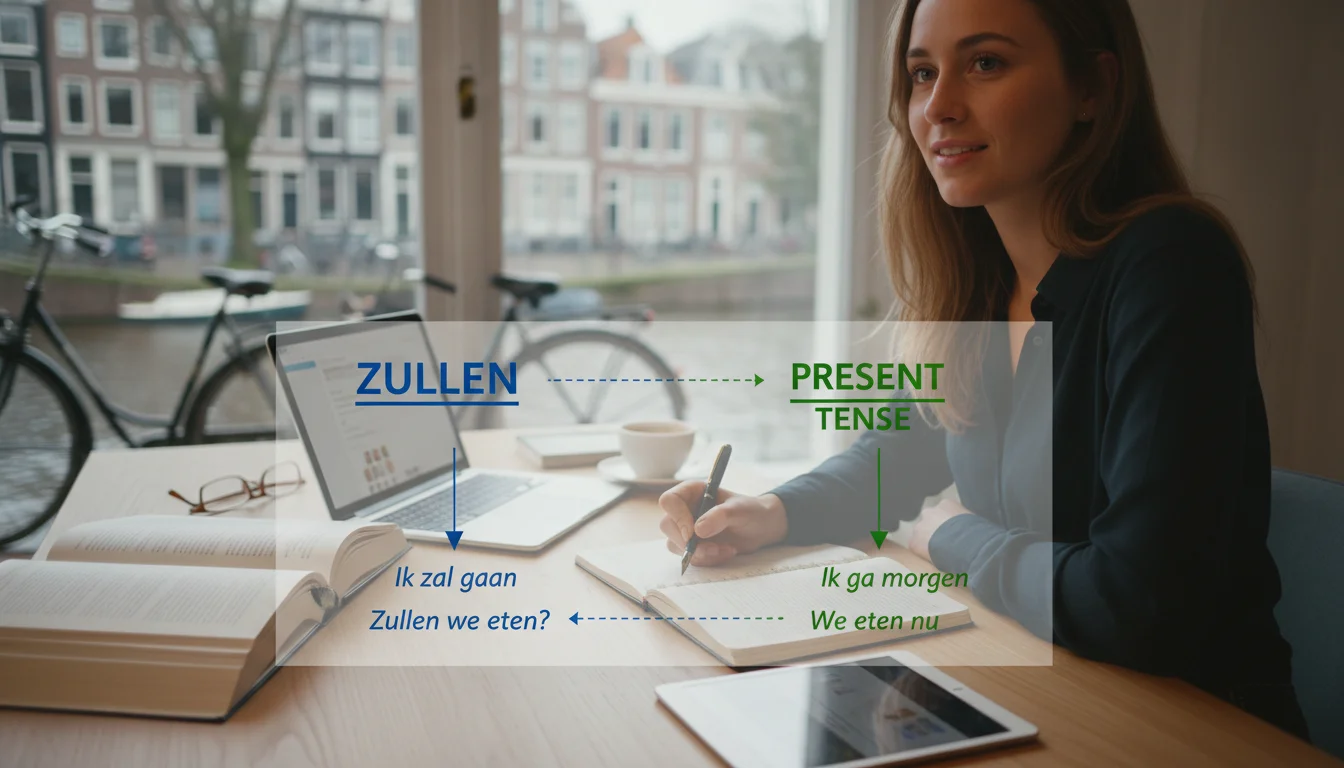
Dutch Future Tense: 'Zullen' vs. Present Tense Guide
Talking About Tomorrow: Unlocking the Dutch Future Tense Ever found yourself trying to make plans with a Dutch friend, only to get stuck on how to...
Read more
Do you ever feel like you're stuck in the Dutch beginner's lane? You can introduce yourself, order a koffie verkeerd, and understand the gist of simple conversations. But when you try to explain why you were late for your appointment, or tell a story about your weekend, you hit a wall. The words get jumbled, the verb flies to the wrong end of the sentence, and you revert to simple, choppy phrases. This is the classic A2 plateau, and the bridge to the B1 intermediate level is built with one crucial material: grammar.
Think of learning Dutch grammar like building a house. At the A1/A2 level, you lay a solid foundation: the concrete slab of present tense, the basic framework of subject-verb-object sentences. It's functional, but it's not a home yet. Reaching the B1 level is like building the walls, installing the plumbing, and wiring the electricity. It's about connecting ideas, adding nuance, and creating a structure that allows for complex, comfortable living. This post is your blueprint, outlining the key grammar milestones you need to achieve to confidently transition from a beginner to an intermediate Dutch speaker.
Before you can build the upper floors, your foundation must be rock-solid. Rushing this stage is a common mistake that leads to wobbly grammar later on. By the end of the A2 level, you should feel comfortable with these core concepts:
If any of these points feel shaky, it's crucial to review and practice them. This foundation is what everything else will be built upon.
This is arguably the biggest and most important milestone. Moving from A2 to B1 means moving from simple sentences to complex ones. You'll learn to connect ideas, show cause and effect, and express conditions. The key? Conjunctions and the word order rules that come with them.
In Dutch, conjunctions fall into two main groups, and they behave very differently:
Mastering this distinction is non-negotiable for reaching B1. It's the difference between saying "I am happy. I see you." and "I am happy because I see you."
Another key B1 skill is mastering inversion. You've already learned it for questions (Kom je? instead of Je komt). Now, you'll apply it when you start a sentence with anything other than the subject (like a time, place, or a subordinate clause). The verb must jump into the second position, right after the introductory element.
With complex sentences under your belt, the next milestone is adding temporal precision to your language. This means getting comfortable with different past tenses and knowing when to use which.
At A2, you learned the basics of the present perfect (ik heb gewerkt). At B1, you need to master it. This involves memorizing irregular past participles (gezien, gesproken, gekomen) and, crucially, understanding the rule for choosing between 'hebben' or 'zijn' as the auxiliary verb. In short, 'zijn' is used with verbs that indicate a change of state or a specific direction of movement (ik ben gegaan, ik ben opgestaan), while 'hebben' is used for most other verbs.
While the perfect tense is used frequently in spoken Dutch to talk about completed actions, the simple past (imperfectum) is the tense of storytelling. If you're recounting a series of events from your holiday or telling a story that happened in the past, you'll use the simple past (ik liep, wij zagen, het was). Learning the conjugations for both regular ('-te'/'-de') and irregular verbs is a key B1 task.
Beyond sentence structure and tenses, several other grammar points will solidify your intermediate status. These add detail, description, and efficiency to your Dutch.
This transition from A2 to B1 is particularly crucial for those preparing for official exams like the Inburgeringsexamen (civic integration exam), as detailed by the Dutch Immigration and Naturalisation Service (IND).
Knowing the rules is one thing; using them automatically in conversation is another. Here’s how to bridge that gap:
Moving from a beginner to an intermediate Dutch speaker is a challenging but incredibly rewarding journey. It's the point where the language opens up, allowing you to express your personality, share your stories, and connect more deeply with the world around you. By focusing on these key grammar milestones—mastering complex sentences, perfecting your tenses, and adding descriptive details—you are building a linguistic home you can truly live in.
It won't happen overnight, but with consistent practice and a clear understanding of the path ahead, you will cross that bridge. Ready to start building? Download the StroopTaal app and begin your personalized journey to Dutch fluency today!
Share this article:
Talking About Tomorrow: Unlocking the Dutch Future Tense Ever found yourself trying to make plans with a Dutch friend, only to get stuck on how to...
Read moreOops! Au! Hè? The Small Words That Make a Big Difference in Dutch Imagine this: you’ve spent months memorizing Dutch vocabulary, you’ve wrestled...
Read moreDutch Prepositions of Place: 'In', 'Op', 'Aan' - When to Use Which Where is the book? It’s… on the table? Simple enough. But in Dutch, this...
Read more