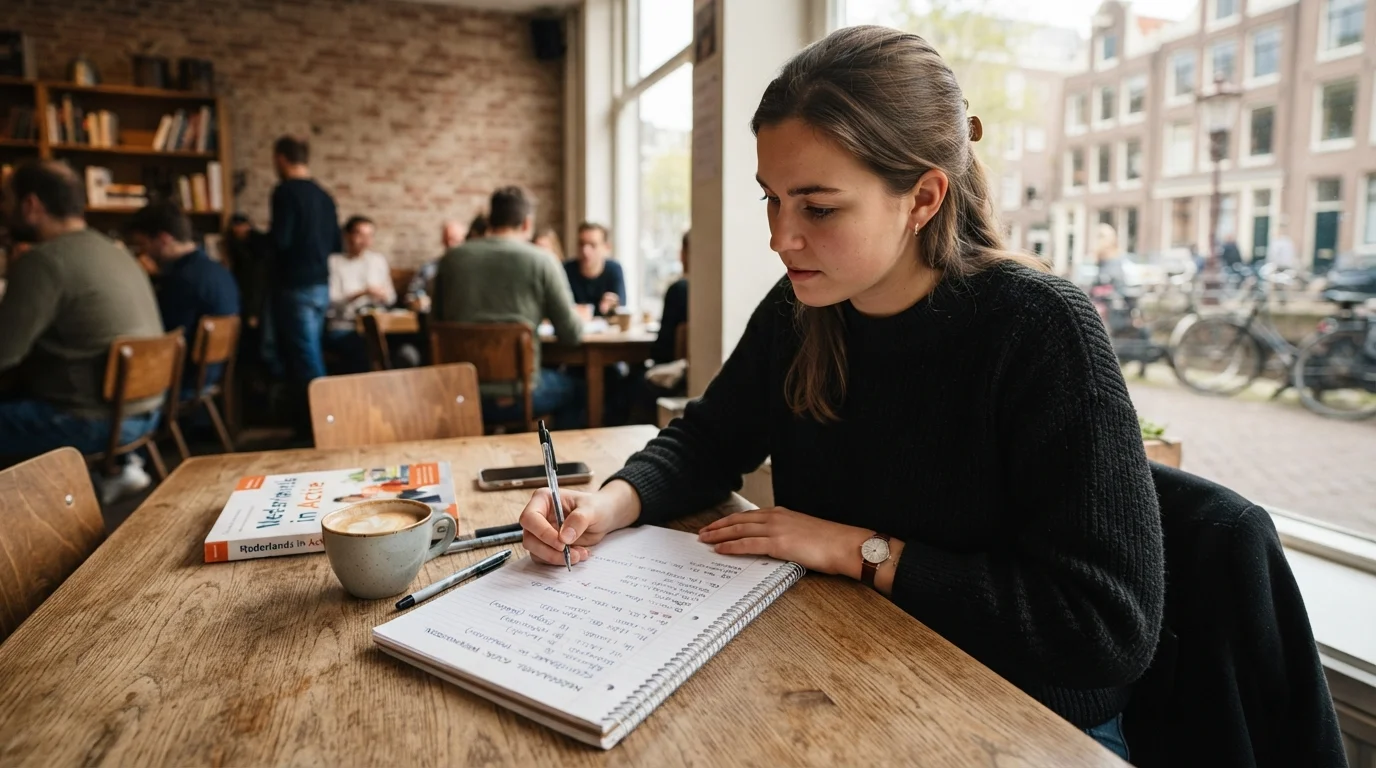
Mastering Dutch Separable Verbs: Tips to Remember Word Order
The Great Dutch Verb Split: Why Separable Verbs Matter Imagine you are sitting in a cozy Dutch cafe, ready to practice your newly acquired language...
Read more
Ask any expat living in the Netherlands what the most frustrating word in the Dutch language is, and they probably won’t say a long, compound word like arbeidsongeschiktheidsverzekering. Instead, they will likely point to a tiny, innocent-looking, two-letter word: “er”.
It seems to pop up everywhere, randomly scattered throughout sentences like confetti. You hear it at the supermarket, you see it in work emails, and you definitely encounter it while trying to chat with locals at a traditional Dutch birthday party. But what does it actually mean? How can a word so small have so many different functions?
The truth is, “er” has no direct single equivalent in English. Depending on where it sits in a sentence, it can mean “there”, “it”, “of them”, or sometimes absolutely nothing at all. To help you demystify this grammatical chameleon, we have broken down its usage into 5 simple, actionable rules. By mastering these, you will transition from sounding like a hesitant beginner to speaking Dutch with natural, local confidence.
The most basic function of “er” is to point to a location. In English, we use the word “there” for this. However, Dutch makes a distinction between stressed and unstressed locations. If you want to emphasize a specific place, you use daar (there) or hier (here). But if the location is already known or doesn’t need special emphasis, you replace it with er.
Consider this scenario: someone asks you if you have ever been to Amsterdam.
Another classic daily example:
“Woon je al lang in Utrecht?” (Have you lived in Utrecht for a long time?)
“Ja, ik woon er nu twee jaar.” (Yes, I have lived there for two years now.)
Using “er” here prevents you from having to repeat “in Utrecht”, making your speech flow much more smoothly. If you are preparing for your integration exams, mastering this unstressed locative “er” is a fantastic way to boost your fluency.
In English, if someone asks you, “How many apples do you want?” you can simply reply, “I want three.” If you translate this literally into Dutch (“Ik wil drie”), it sounds incomplete. In Dutch, when you use a number or a word indicating quantity (like veel, weinig, or genoeg) without repeating the noun, you must use “er”.
In this context, “er” translates roughly to “of them” or “of it”.
This rule is non-negotiable in daily Dutch life. Whether you are ordering drinks at a terrace or buying vegetables at the local market, always remember to pair your numbers with “er” if the noun itself is omitted.
Just like English uses “there” as a placeholder to introduce something new (e.g., “There is a cat on the roof”), Dutch uses “er” as a dummy subject. This is used with the verb zijn (to be) or other verbs when the real subject of the sentence is indefinite (introduced by een, a number, or no article at all).
Dutch speakers love to start sentences with “er” even when there is an active verb, as long as the subject is indefinite. This can feel counterintuitive, but it is essential for natural phrasing.
This structure shifts the focus of the sentence, making it sound much softer and more natural. To practice these word-order shifts, StroopTaal offers AI-powered personalized learning plans that specifically target tricky Dutch syntax, helping you build muscle memory for where “er” belongs in a sentence.
This is where “er” gets highly creative. In Dutch, you cannot combine a preposition (like op, in, met, voor, van) directly with the pronoun het (it) or ze (them, when referring to things). Instead, the pronoun “het” turns into er, and it merges with the preposition to form a single word. These are called pronominal adverbs.
If you have ever wondered why Dutch people say words like erop, ermee, or ervan, this is the reason!
| Preposition + Het | Becomes... | English Meaning | Example Sentence |
|---|---|---|---|
| met + het | ermee | with it / with them | Wat doe je ermee? (What are you doing with it?) |
| op + het | erop | on it / on them | Ik reken erop. (I am counting on it.) |
| naar + het | ernaar | at it / to it | We kijken ernaar. (We are looking at it.) |
| van + het | ervan | of it / from it | Ik hou ervan! (I love it! / I enjoy it!) |
Note that when “er” is combined with met, it changes to ermee, and with tot it becomes ertoe. This directness is key when mastering Dutch business etiquette. Instead of long, winding sentences, a quick “Ik ga ermee aan de slag” (I will get to work on it) shows both linguistic capability and professional readiness.
The fifth and most advanced use of “er” is in the impersonal passive voice. In Dutch, it is common to describe an action that is happening without specifying who is doing it. This is often done by starting the sentence with “er” followed by the passive auxiliary verb worden (to be/become).
This construction is very common in formal settings, news broadcasts, and when understanding formal texts, such as documents detailing the role of the Ondernemingsraad (Works Council) in Dutch companies.
By using “er” this way, the focus remains entirely on the activity itself rather than the people performing it. It might sound complex at first, but it is a cornerstone of natural Dutch sentence structure.
Since “er” has so many different functions, a logical question arises: *Can you use “er” more than once in a single sentence?*
Technically, yes! If a sentence requires “er” as a placeholder subject, a location, and a quantity, you could theoretically have multiple instances. However, Dutch speakers dislike repetition. To keep the language sounding clean, multiple “er”s are almost always combined into just one or two.
For example, if you want to say: “There are three of them in there”:
Instead of: “Er zijn er drie erin” (which sounds clunky), a Dutch speaker will simplify it to: “Er zijn er drie in.” or “Er zitten er drie in.”
To get a feel for how these combinations work in real-life scenarios, you can use the StroopTaal app. Its real-life Dutch conversation practice with AI allows you to text or speak with an AI partner who will naturally correct your use of “er” in real-time, giving you instant, actionable feedback.
Learning grammar rules is one thing, but applying them in real-time conversation is another. Here are three practical tips to help you integrate “er” into your active vocabulary:
For official guidelines on integration exams (Inburgeringsexamen) where proper grammar usage is assessed, you can consult the official Inburgering website to see how grammar standards are evaluated.
The word “er” may be small, but mastering it is one of the most rewarding milestones in your Dutch language journey. It bridges the gap between structured classroom Dutch and the vibrant, idiomatic language spoken on the streets of the Netherlands. By practicing these five rules, you will gain the confidence to express yourself more naturally and accurately. Ready to start? Download the StroopTaal app today to practice these nuances with AI-driven feedback and take your Dutch to the next level. Succes!
Share this article:
The Great Dutch Verb Split: Why Separable Verbs Matter Imagine you are sitting in a cozy Dutch cafe, ready to practice your newly acquired language...
Read moreIntroduction: Why 'Nog' and 'Al' Matter Learning Dutch can feel like solving a puzzle: words that look small, like nog and al, change meaning...
Read moreConjugating Dutch Irregular Verbs in the Past Tense: A Practical Cheat Sheet Learning Dutch irregular verbs in the past tense can feel like learning...
Read more