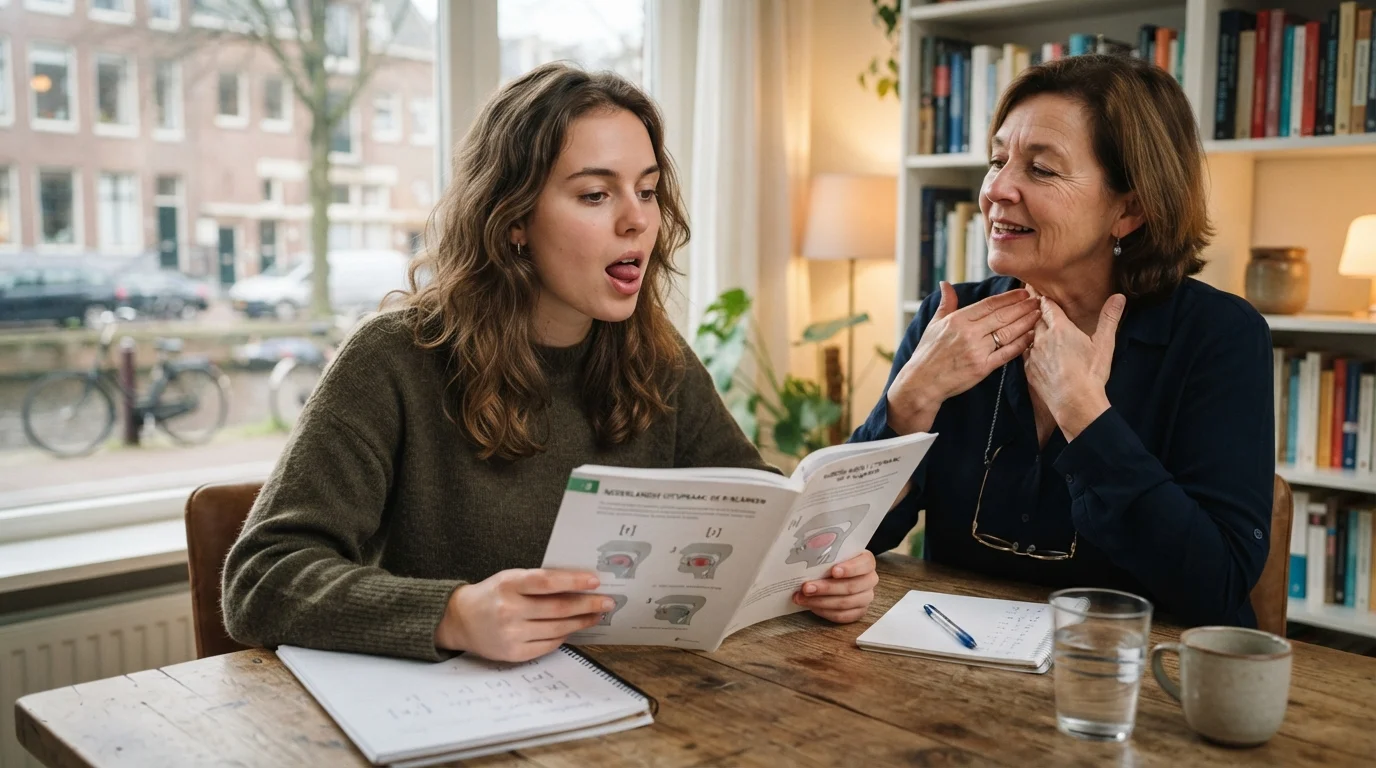
Master the Dutch R: Trilled, Guttural, and Vocalic Secrets
The Ultimate Guide to Mastering the Elusive Dutch 'R' If you have ever tried to order a warm, crispy broodje at a local bakery, introduce yourself to...
Read more
Imagine you are sitting in a cozy Dutch cafe, ready to practice your newly acquired language skills. You want to tell your friend that you are calling your mother. You know that the verb for 'to call' is opbellen. Confidently, you say: 'Ik opbel mijn moeder.' Your Dutch friend smiles warmly but gently corrects you: 'Ik bel mijn moeder op.'
Welcome to the wonderful, sometimes baffling world of Dutch separable verbs (scheidbare werkwoorden). For many expats, students, and language learners, the concept of a verb splitting in two and sending one half to the very end of the sentence feels like a grammatical magic trick. However, mastering separable verbs is one of the most critical milestones in transitioning from a basic A1 level to confident fluency.
In this comprehensive guide, we will break down the mechanics of Dutch separable verbs, explore the rules governing their word order in different tenses, and provide you with actionable strategies to remember where each part of the verb belongs.
In Dutch, many verbs are compound words consisting of a prefix and a main verb. A large portion of these compound verbs are separable. This means that in certain sentence structures, the prefix detaches from the main verb and moves to a different position—usually the very end of the clause.
Let's look at a simple example with the verb schoonmaken (to clean):
In a simple present tense sentence, these two parts split up:
'Ik maak mijn huis schoon.' (I clean my house.)
Notice how maak stays in the second position of the sentence (the standard spot for the conjugated verb in Dutch), while the prefix schoon flies all the way to the end. This structure is often referred to as the 'Dutch verb sandwich,' where the rest of the sentence is hugged by the two parts of the verb.
The position of the prefix and the main verb depends entirely on the structure of your sentence and the tense you are using. Let's look at the four most common scenarios you will encounter.
In a simple, independent clause in the present tense, the verb always splits. The main verb is conjugated and placed in the second position, while the prefix goes to the absolute end of the sentence.
Formula: Subject + Conjugated Verb + Other Information + Prefix
When you use an auxiliary or modal verb (like willen, kunnen, moeten, or mogen), the modal verb takes the second position and is conjugated. Because the modal verb is doing the heavy lifting, the separable verb moves to the end of the sentence in its infinitive (unconjugated) form. When this happens, the prefix and the main verb stay together!
Formula: Subject + Conjugated Modal Verb + Other Information + Whole Separable Verb
How do separable verbs behave when we talk about the past? It depends on which past tense you use.
In the simple past tense, separable verbs behave exactly as they do in the present tense: they split. You simply conjugate the main verb in its past tense form.
In the present perfect tense, we use an auxiliary verb (hebben or zijn) in the second position. The past participle of the separable verb goes to the end of the sentence. To form the past participle of a separable verb, you insert the prefix -ge- between the prefix and the main verb.
Formula: Subject + Conjugated Auxiliary + Other Information + Prefix + ge + Verb Stem (+t/d/en)
In Dutch, subordinate clauses (sentences starting with conjunctions like omdat, als, toen, or dat) kick all verbs to the very end of the clause. When a separable verb is pushed to the end of a subordinate clause, it stays together as a single word, with the prefix attached to the conjugated verb.
Formula: Conjunction + Subject + Other Information + Whole Conjugated Separable Verb
Just like masterfully placing 'er' in a sentence (which you can master in our guide on how to use 'er' in Dutch), getting the verb order right in subordinate clauses requires a bit of practice but quickly becomes second nature with exposure.
Not all compound verbs in Dutch are separable. Some, like voorspellen (to predict) or voorkomen (to prevent), are inseparable. How can you tell them apart? The secret lies in pronunciation and word stress.
In Dutch, separable verbs always place the primary stress on the prefix. Inseparable compound verbs place the stress on the main verb.
When learning new vocabulary, always listen carefully to where the emphasis lies. For a deeper look at the linguistic evolution of these structures, you can read more about separable verbs on Wikipedia.
Knowing the rules is one thing; applying them in real-time conversation is another. Here are some actionable tips to help you internalize Dutch separable verbs:
When writing or speaking, imagine the conjugated verb and its prefix as the two slices of bread in a sandwich. Everything else in your clause—the direct object, time indicators, location—is the filling that sits between them. Keep the 'top slice' (the conjugated verb) in position two, and don't drop the 'bottom slice' (the prefix) until you have finished speaking the rest of the sentence.
Instead of trying to memorize schoonmaken as a single entity, think of it as 'to make... clean'. When you construct the sentence, say 'I make my room... [pause]... clean.' This mental translation framework matches the physical Dutch word order perfectly: 'Ik maak mijn kamer... schoon.'
Mastering these patterns takes active recall and consistent exposure. This is where the StroopTaal app can elevate your studies. With StroopTaal's AI-powered personalized learning plans, you can target these tricky word order rules directly. You can practice using separable verbs in real-life Dutch conversation practice with AI, and read the conversation back afterwards with feedback on your Dutch.
To integrate smoothly into Dutch life, you will need to use separable verbs constantly. Whether you are navigating the workplace or attending a social gathering, these verbs are everywhere.
For example, if you are attending a classic Dutch social event, you will likely hear hosts say 'Kom binnen!' (Come in! — from binnenkomen) or 'Neem plaats!' (Take a seat! — from plaatsnemen). If you want to prepare yourself for these unique cultural settings, check out our humorous and practical guide on how to survive a Dutch birthday party.
In a professional setting, mastering separable verbs like voorstellen (to introduce), afspreken (to schedule an appointment), and voorbereiden (to prepare) is essential for clear communication. If you are working in the Netherlands, understanding these linguistic nuances goes hand-in-hand with mastering local workplace dynamics. You can learn more about navigating these situations in our article on Dutch business etiquette.
To jumpstart your progress, here is a list of highly common separable verbs that you will use daily:
| Infinitive | Meaning | Example Sentence |
|---|---|---|
| Opstaan | To get up / stand up | Ik sta om zeven uur op. |
| Meenemen | To take along | Neem je een paraplu mee? |
| Uitleggen | To explain | De docent legt de grammatica uit. |
| Afwassen | To wash the dishes | Wie wast vanavond af? |
| Deelnemen | To participate | Zij nemen deel aan de cursus. |
While the word order of Dutch separable verbs might feel counterintuitive at first, it is a logical system governed by clear syntactic rules. By remembering the 'verb sandwich' concept, paying attention to spoken word stress, and practicing with real-world examples, you will soon find yourself splitting verbs naturally without a second thought.
Are you ready to take your Dutch grammar to the next level? Download the StroopTaal app today to access structured grammar lessons from A0 to C1 level, interactive dialogue games, and bite-sized exercises designed to help you master Dutch word order effortlessly. Start practicing today and watch your confidence soar!
Share this article:
The Ultimate Guide to Mastering the Elusive Dutch 'R' If you have ever tried to order a warm, crispy broodje at a local bakery, introduce yourself to...
Read moreThe Mystery of the Tiny Dutch Word “Er” Ask any expat living in the Netherlands what the most frustrating word in the Dutch language is, and they...
Read moreIntroduction: Why 'Nog' and 'Al' Matter Learning Dutch can feel like solving a puzzle: words that look small, like nog and al, change meaning...
Read more