Guide to Huisartsenpost: Access Dutch Healthcare After Hours
It is 8:00 PM on a Friday evening in Amsterdam, Utrecht, or Rotterdam. You suddenly develop a high fever, a severe allergic reaction, or acute pain...
Read more
This article was written by AI and published by StroopTaal.
AI can get things wrong. For anything official, check the source it points to.
AI-generated image
Touching down in the Netherlands as an international student, working professional, or digital nomad is an exhilarating experience. From riding your bike alongside picturesque canals to navigating public transit with an OV-chipkaart, life in the Low Countries moves fast. However, one of your absolute top priorities upon arrival should be securing mobile connectivity. Having a local Dutch mobile number with the country code +31 is essential for seamless daily life in Holland.
Without a local number, simple administrative tasks can quickly become major hurdles. You will need a Dutch phone number to set up two-factor authentication for bank accounts, request a DigiD (your official Dutch digital identity), receive delivery updates, and join WhatsApp group chats with roommates or colleagues. Furthermore, while you are managing other key moving logistics—such as setting up home internet and TV in the Netherlands—a reliable phone plan ensures you stay connected without incurring exorbitant international roaming fees.
In this comprehensive guide, we will break down everything you need to know about getting a Dutch SIM card. We will compare prepaid SIM cards, Sim-Only subscriptions, and handset contracts, highlight the top telecom providers, warn you about key financial pitfalls, and provide the essential Dutch vocabulary you need to navigate phone services with confidence.
The Dutch telecommunications market is modern, competitive, and boasts some of the highest 4G and 5G network coverage percentages in Europe. Mobile operators in the Netherlands fall into two main categories: Network Operators (companies that own the physical cellular infrastructure) and Mobile Virtual Network Operators (MVNOs, which lease network capacity from the big providers).
If you are looking for budget-friendly alternatives that still operate on these high-speed networks, MVNOs are an excellent choice:
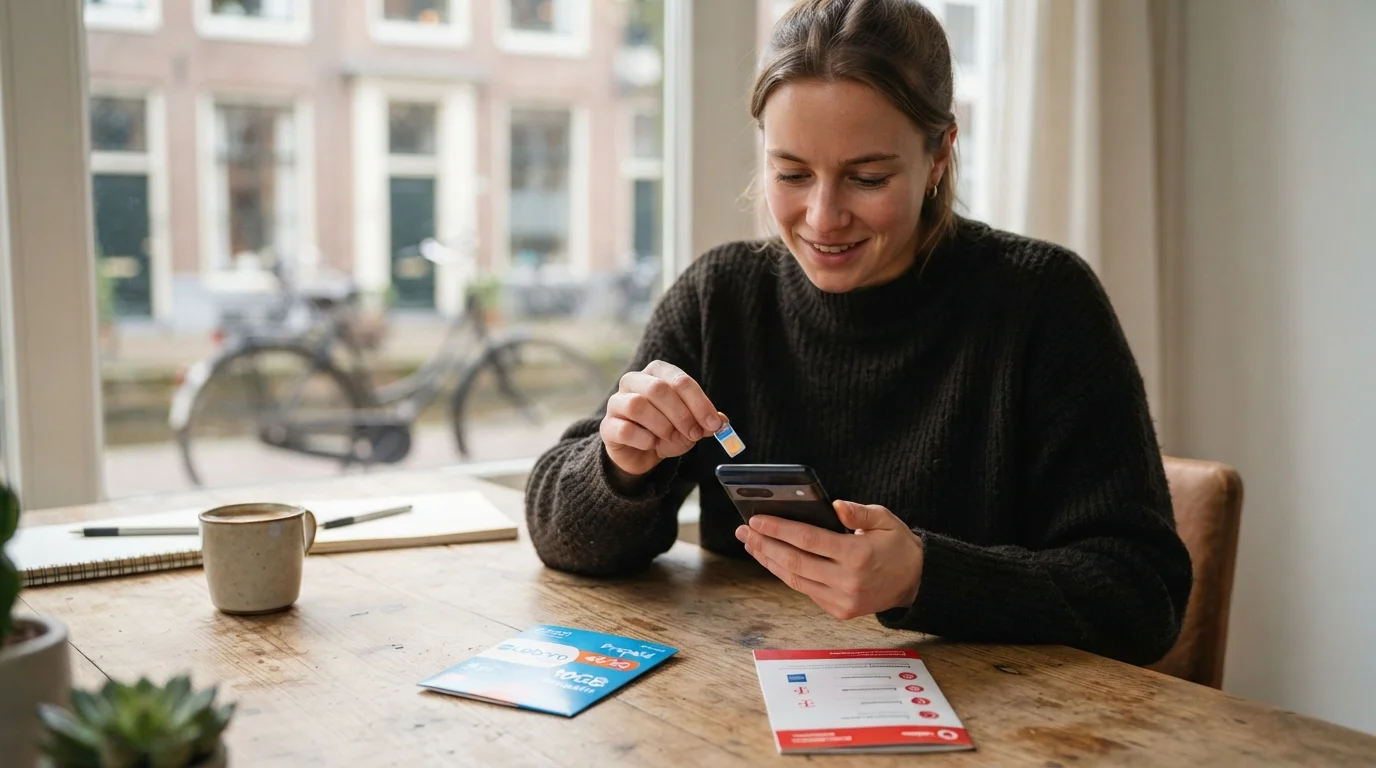
A prepaid SIM card (known as prepaid in Dutch) is the fastest, lowest-friction way to get connected the moment you step off the plane or train.
With prepaid, you purchase a physical SIM card or activate an eSIM, insert it into your smartphone, and pay upfront for credits or specific data/calling bundles. You can purchase starter kits at airports, railway station kiosks, supermarkets (like Albert Heijn and Jumbo), or convenience stores (such as HEMA and Kruidvat).
Best for: Expats during their first 1 to 3 weeks in the Netherlands, short-term visitors, or anyone waiting for their municipal registration appointment and Dutch bank account approval.
For almost every expat staying in the Netherlands longer than a couple of months, a Sim-Only contract offers the best balance of affordability, data allowance, and convenience.
With a Sim-Only plan, you receive a mobile subscription (data, minutes, SMS) without buying a new phone. The provider sends you a SIM card or eSIM, and fees are automatically deducted from your bank account every month via SEPA direct debit (automatische incasso).
You can choose between different contract lengths:
To sign up for a Dutch Sim-Only subscription, you will typically need to present:
Best for: Working expats, international students staying a full academic year, and highly skilled migrants looking for high data limits at affordable prices.
If you need a new smartphone alongside your mobile plan, major Dutch operators offer bundled plans where you pay off the cost of the phone in monthly installments over 12 or 24 months.
Before opting for a bundled phone contract in the Netherlands, you must understand Dutch consumer credit regulations. Under Dutch law, if you finance a mobile handset with a remaining credit value of €400 or more, the plan is legally categorized as a consumer loan.
According to official financial guidelines published by Government.nl, any mobile phone financing above €400 is automatically registered with the Dutch Credit Registration Office (Bureau Krediet Registratie or BKR).
Why does a BKR registration matter for expats?
Pro-Tip for Expats: To avoid BKR registration, either buy your new phone upfront (unlocked) with cash/savings, or pay off the phone hardware portion so that the total loan amount remains strictly below €400, then pair it with an unencumbered Sim-Only contract.
Navigating customer dashboards, store interactions, or mobile settings in the Netherlands becomes much smoother when you know key Dutch telecom terms. Here is a handy reference table:
Mastering everyday terminology like this is essential for building confidence in your new life abroad. Practicing everyday Dutch scenarios—like dealing with customer service or discussing plans in a phone shop—is effortless with StroopTaal, where AI-powered conversation practice and interactive dialogue games help you master practical, real-life Dutch in context.
Most modern smartphones support eSIM technology, which allows you to activate a digital profile on your device without needing to insert a physical plastic card.
eSIMs are widely available from major operators like KPN, Odido, Vodafone, and Simyo. Choosing an eSIM provides two distinct advantages for expats:
Ready to get your Dutch phone number? Follow this simple step-by-step process:
Ensure that your mobile device is unlocked from your home country carrier network. If your handset is carrier-locked, foreign SIM cards will not function.
If you do not yet have a Dutch bank account (IBAN) or your BSN, purchase a temporary prepaid SIM card at Schiphol Airport or a local supermarket to ensure instant access to navigation apps and emergency services.
Once settled into your apartment, complete your BSN registration at the local municipality (gemeente) and open a Dutch bank account. While managing administrative errands like registering with a Dutch dentist and local healthcare providers, you can use your temporary number.
Compare deals using Dutch price comparison tools like Independer or Mobiel.nl. When ordering your long-term Sim-Only contract, select the nummerbehoud (number porting) option. Your new provider will automatically transfer your temporary prepaid Dutch number onto your new subscription contract for free!
Just as you must exercise caution when navigating housing markets to avoid housing scams in the Dutch rental market, always ensure you purchase SIM plans directly from official carrier websites, physical stores, or reputable comparison platforms. Never share personal ID details over unverified online channels.
Navigating phone contracts, understanding cancellation clauses (opzegtermijn), and dealing with utility billing in a foreign country can initially feel intimidating. While many Dutch telecom staff speak English, contracts, self-service web portals, and billing statements are routinely written in Dutch.
Learning practical Dutch quickly bridges this gap, allowing you to handle official paperwork independently, understand contractual fine print, and communicate naturally with local staff. Apps like StroopTaal empower expats with personalized learning plans, vocabulary builders with spaced repetition, and grammar lessons ranging from A0 to C1 level. By spending just a few minutes a day practicing realistic dialogue scenarios, you gain the confidence needed to effortlessly handle daily errands across the Netherlands.
Getting connected in the Netherlands is a straightforward process once you know the lay of the land. For instant connectivity upon landing, pick up a temporary prepaid SIM card. Once your BSN and Dutch bank account are up and running, switch to a budget-friendly Sim-Only contract to enjoy fast 5G data, automatic payments, and seamless EU roaming—all while keeping your phone financing off the BKR credit registry.
With your new +31 phone number ready to go, you are officially set up to explore your vibrant host country. Take the next step in making the Netherlands feel truly like home by downloading StroopTaal today to start mastering practical Dutch conversation from day one!
Share this article:
It is 8:00 PM on a Friday evening in Amsterdam, Utrecht, or Rotterdam. You suddenly develop a high fever, a severe allergic reaction, or acute pain...
Read moreNavigating Dutch Housing Allowances as an Expat Finding an apartment in the Netherlands can feel like winning the lottery. Once you have secured a...
Read moreFinding a home in the Netherlands can feel like a race. Affordable rooms and apartments disappear within minutes, landlords may ask for documents...
Read more