Opening a Business in the Netherlands: Your Guide to the KVK
Your Entrepreneurial Dream in the Netherlands Starts Here So, you’re captivated by the Dutch entrepreneurial spirit. You see the canals of...
Read more
This article was drafted by AI and edited by a person before it was published.
AI can get things wrong. For anything official, check the source it points to.
AI-generated image
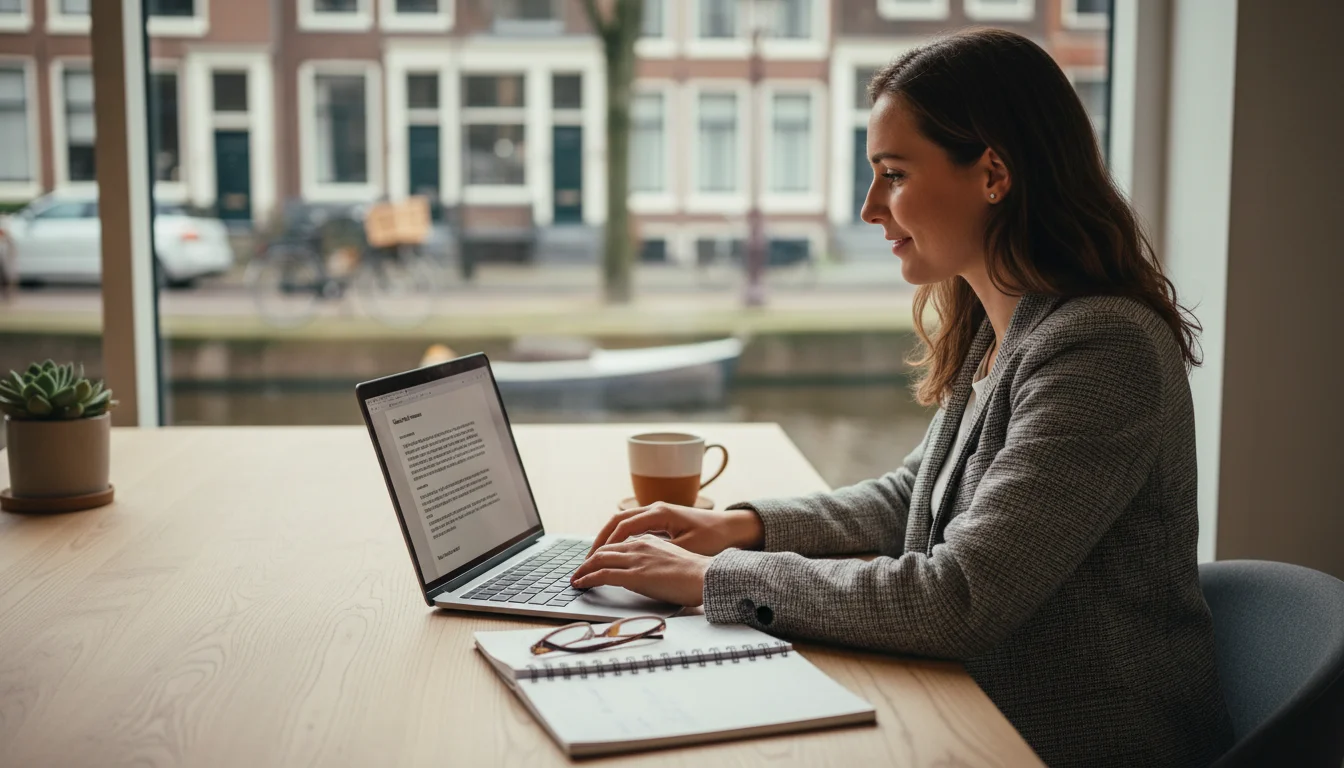
You’ve drafted the perfect email. It’s clear, concise, and professional. But as your cursor hovers over the 'Send' button, a wave of doubt washes over you. Did you start it correctly? Is the closing too casual? Or worse, too stuffy? Sending a formal email in a new language, especially in a professional context, can feel like navigating a minefield. In the Netherlands, where communication is famously direct yet bound by specific rules of etiquette, getting the tone right is crucial.
Whether you're applying for a job, contacting a government agency like the IND, or reaching out to a new business contact, your email is your digital first impression. A poorly chosen salutation or an overly casual sign-off can unintentionally signal disrespect or a lack of professionalism. This guide will demystify the art of Dutch business correspondence, focusing on the two most critical parts of any formal email: the beginning (de aanhef) and the end (de afsluiting). Let's ensure your digital handshake is firm, confident, and perfectly Dutch.
Before we dive into specific phrases, we must address the cornerstone of Dutch formal communication: the distinction between 'u' (formal you) and 'jij/je' (informal you). This choice dictates the entire tone of your email.
The golden rule is to always start with 'u'. It's a sign of respect and is the standard in professional settings. You should use 'u' when:
Think of 'u' as your default setting for all professional communication. You can only switch to 'jij' once the other person initiates it or in a very relaxed and established work environment. Making the switch prematurely can be seen as overly familiar.
This initial formality is a key aspect of Dutch business culture, which, despite its reputation for directness, places a high value on proper procedure and respect in initial interactions. Your professional communication, from emails to networking on platforms like LinkedIn, sets the stage for your career in the Netherlands.
The salutation, or aanhef, sets the tone for your entire message. Choosing the right one is simple if you follow these guidelines. Note that in Dutch, the salutation is always followed by a comma, and the next line begins with a lowercase letter (unless it's a proper noun).
To start an email in Dutch correctly, open with Geachte [Achternaam] for formal situations or Beste [Voornaam] for standard professional correspondence. Knowing how to start an email in dutch depends entirely on your relationship with the recipient, but using standard Dutch email greetings ensures you set a respectful tone right from the opening line.
'Geachte' is the Dutch equivalent of 'Dear Sir/Madam' and is your safest and most professional option. It's formal, respectful, and can be used in almost any business context.
Geachte heer/mevrouw,Geachte heer [Achternaam], (Dear Mr. [Last Name],)Geachte mevrouw [Achternaam], (Dear Ms. [Last Name],)Pro Tip: Always try to find the person's name. It shows you've done your research. A quick look at the company's website or their professional profile on LinkedIn can often provide the name you need.
'Beste' translates to 'Dear' but is a step down in formality from 'Geachte'. It's still considered polite and is very common in day-to-day business communication, especially between colleagues who know each other but aren't close friends.
Beste heer [Achternaam],Beste mevrouw [Achternaam],You can also use 'Beste' with a first name (Beste [Voornaam],) once a more informal relationship has been established. If someone replies to your 'Geachte' email using 'Beste [Voornaam]', it's generally a green light for you to do the same in your next reply.
Once your salutation is in place, you need to state your purpose clearly. Dutch business communication values efficiency and directness. Here are some standard phrases to help you bridge the gap between your opening and closing.
Feeling confident using these phrases is key. Repetition and practice are essential for them to become second nature. Practicing these key phrases in real-life scenarios, like the interactive AI-powered dialogues in the StroopTaal app, can help you use them naturally and confidently in any situation.
Just as you started formally, you must end formally. The closing, or afsluiting, is your final word. Fortunately, the choice here is even simpler than the salutation.
To know how to end an email in dutch properly, use Met vriendelijke groet as your go-to Dutch email sign off in almost all professional situations. Learning how to sign off an email in dutch or figuring out how to end email in dutch effectively comes down to choosing between a few standard options depending on formality.
The standard phrase for kind regards in dutch and best regards in dutch is "Met vriendelijke groet" (or plural "Met vriendelijke groeten"). If you want a slightly warmer tone while remaining professional—such as when sending job applications tailored after reading how to write a Dutch-style CV—you can use "Met hartelijke groet".
'Met vriendelijke groet,' (or its plural form, Met vriendelijke groeten,) is the undisputed champion of Dutch email closings. It translates to 'With friendly regards' and is the equivalent of 'Kind regards' or 'Sincerely' in English. It is suitable for virtually every single business situation, from a first contact to daily correspondence.
You can never go wrong with this. When in doubt, use Met vriendelijke groet,.
To understand how to end a letter in dutch compared to an email, note that traditional paper letters use Hoogachtend for extreme formality, whereas emails almost universally favor Met vriendelijke groet. While formal letters to judges, municipalities, or lawyers still feature Hoogachtend, using it in an e-mail can sound overly stiff.
You might encounter 'Hoogachtend,' which translates to 'Yours faithfully' or 'Respectfully yours'. This is extremely formal and has become quite dated in modern business. You would typically only see it in very official legal documents or letters to royalty. For day-to-day business emails, it sounds overly stiff and archaic. It's good to recognize, but you will likely never need to use it.
Writing an effective Dutch email requires understanding both common inbox vocabulary and standard formatting rules. Following clear guidelines on Dutch business etiquette will ensure your email body, attachments, and headers are clear and professional.
uw e-mailadres on forms. In spoken Dutch, the @ symbol is pronounced "apenstaartje" (little monkey tail) and a dot is "punt".Let's apply these rules to a common scenario: following up on a job application. This kind of professional follow-up is a great step before you hopefully get invited for an interview, where you'll need to master a different set of communication skills, as we cover in our guide to acing your 'sollicitatiegesprek'.
Subject: Betreft: Sollicitatie Marketing Manager
Geachte heer De Wit,
naar aanleiding van mijn sollicitatie voor de functie van Marketing Manager op 15 mei, schrijf ik u om mijn aanhoudende interesse in deze positie te bevestigen.
De waarden en de innovatieve projecten bij [Bedrijfsnaam] spreken mij zeer aan, en ik ben ervan overtuigd dat mijn ervaring in [uw specifieke ervaring] goed aansluit bij de vereisten van de functie. De mogelijkheid om bij te dragen aan uw team zou een geweldige stap zijn in mijn carrière.
Mocht u nog vragen hebben over mijn sollicitatie of cv, dan hoor ik het graag.
Ik zie uw reactie met belangstelling tegemoet.
Met vriendelijke groet,
[Uw Volledige Naam]
[Uw Telefoonnummer]
[Link naar uw LinkedIn-profiel (optioneel)]
This email is polite, professional, direct, and adheres to all the rules we've discussed. For more information on official procedures regarding work in the Netherlands, you can always consult authoritative sources like the Dutch government's official website for internationals, government.nl.
Mastering Dutch email etiquette is a powerful skill that will open doors in your professional life in the Netherlands. By remembering a few key principles—start formally with 'u' and 'Geachte', state your purpose clearly, and always close with the reliable 'Met vriendelijke groet'—you can communicate with confidence and professionalism.
Like any language skill, practice makes perfect. The more emails you write, the more natural it will become. Ready to master not just emails, but all facets of Dutch communication? The StroopTaal app offers AI-powered conversation practice and grammar lessons from A0 to C1 to help you work toward professional Dutch. Download it today and start your journey to professional Dutch proficiency!
Share this article:
Your Entrepreneurial Dream in the Netherlands Starts Here So, you’re captivated by the Dutch entrepreneurial spirit. You see the canals of...
Read moreYour Guide to Acing a Dutch Job Interview You’ve polished your CV, perfected your cover letter, and landed an interview for your dream job in the...
Read moreNavigating the Dutch Job Market: Why LinkedIn is Your Most Powerful Tool Moving to the Netherlands opens up a world of opportunities, but breaking...
Read more