Best AI Dutch Language Tutor for Conversational Practice in 2026
The Conversational Revolution: Learning Dutch in 2026 For years, learning a new language meant sitting with heavy grammar books, memorizing listless...
Read more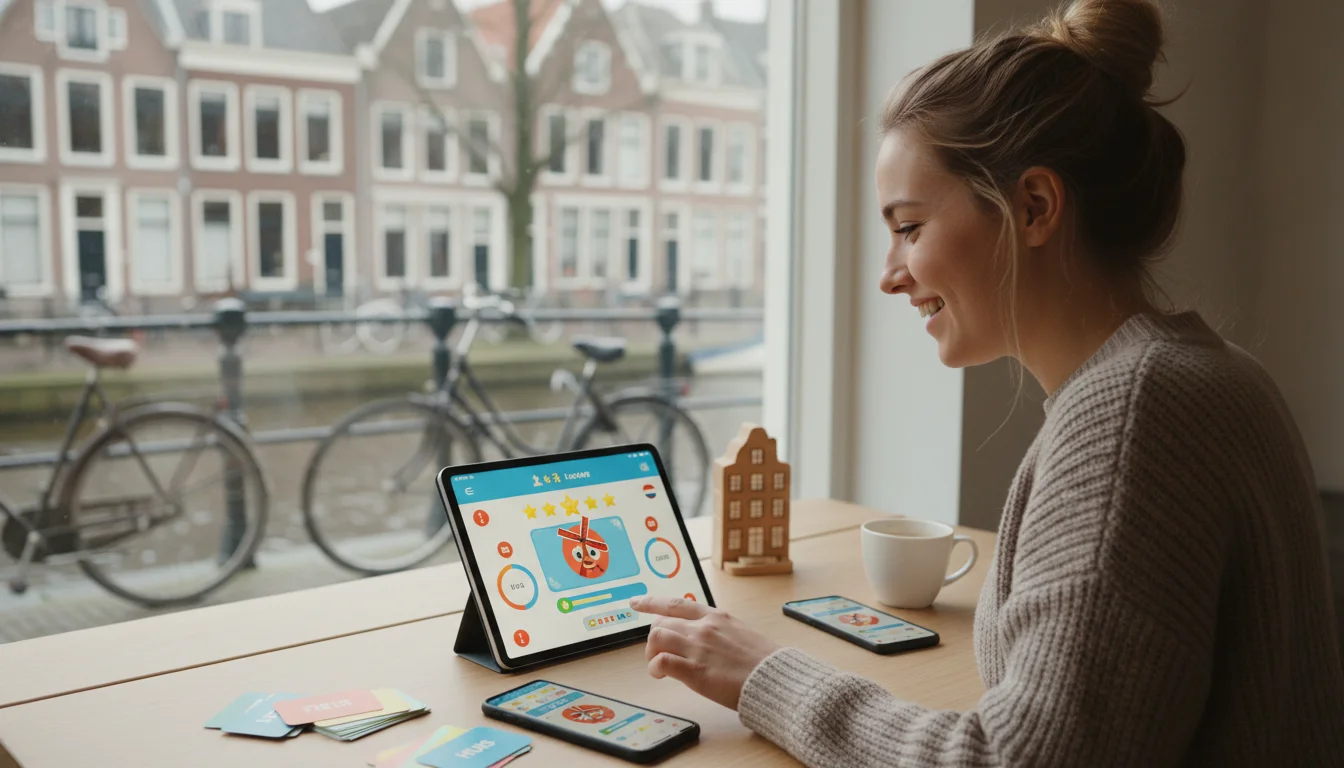
Picture this: You have just moved to the Netherlands. You are surrounded by beautiful canals, historic windmills, and a sea of bicycles. You want to integrate, chat with your neighbors, and comfortably order a koffie verkeerd at your local café. But then you encounter the Dutch language. Between the guttural 'g' sounds, the complex word order, and the seemingly arbitrary rules of de and het articles, your initial enthusiasm begins to wane.
Learning Dutch is a marathon, not a sprint. Whether you are an expat striving for professional fluency or a newcomer preparing for the civic integration exams required by the Immigration and Naturalisation Service (IND), staying motivated over months or years is the ultimate challenge. This is where modern technology steps in. Walk into any tram in Amsterdam or Utrecht, and you will likely see commuters tapping away at their phones, chasing daily streaks, earning virtual coins, and climbing digital leaderboards.
But does this gamification of language learning actually help you speak Dutch? Or is it merely a clever psychological trick designed to keep you addicted to an app without delivering real-world fluency? In this comprehensive guide, we will dive deep into the science of gamification, explore its benefits and pitfalls, and show you how to leverage gamified features to genuinely master the Dutch language.
To understand its impact, we must first define what gamification actually is. In short, gamification is the practice of integrating game mechanics and design elements into non-game contexts. When applied to language learning, it transforms the academic (and often tedious) process of memorizing grammar tables and vocabulary lists into an interactive, engaging experience.
Typical gamified elements in Dutch learning apps include:
By wrapping pedagogical content in these game-like structures, apps aim to lower the barrier to entry, making the act of opening a Dutch lesson feel less like homework and more like play.
Why do these digital rewards work so well? The answer lies in human psychology and neurobiology. Gamification taps directly into our brain's reward center, specifically triggering the release of dopamine—the neurotransmitter associated with pleasure, learning, and motivation.
When you complete a quick Dutch lesson and hear a satisfying 'ding' sound accompanied by a burst of colorful animations, your brain receives a micro-dose of dopamine. This creates a positive feedback loop: your brain associates learning Dutch with a feeling of success, prompting you to repeat the behavior tomorrow to get that same rewarding sensation.
Psychologists divide motivation into two primary categories:
Critics of gamification often argue that apps focus too heavily on extrinsic motivation. If you are only practicing Dutch to keep a virtual owl happy or to stay in the 'Diamond League,' what happens when you inevitably lose your streak? For many learners, a broken streak leads to immediate demotivation, causing them to abandon the app entirely.
However, when designed correctly, gamification acts as a bridge. It uses extrinsic rewards to build a daily habit. Over time, as your vocabulary expands and you start understanding real-world Dutch, that habit transitions into intrinsic motivation. You keep learning because you realize you can actually speak and comprehend the language.
While gamification has immense potential, not all gamified apps are created equal. In fact, poorly designed gamification can actually hinder your progress. This is often referred to as 'lazy' or 'superficial' gamification.
Have you ever found yourself opening a language app at 11:55 PM, rushing through a single, incredibly easy matching exercise just to save your streak? If so, you have fallen into the streak preservation trap. When an app prioritizes engagement metrics over actual cognitive effort, learning suffers. You might feel productive, but matching simple pictures of 'de appel' and 'de banaan' for the fiftieth time does not build the complex cognitive pathways needed to hold a real conversation in Dutch.
Many gamified platforms rely on repetitive, translation-based mechanics. They turn language learning into a series of multiple-choice puzzles. While this is highly addictive and easy to gamify, it fails to prepare you for the chaotic, unpredictable nature of real-life Dutch conversations. When comparing popular market options, such as in our deep dive into StroopTaal vs Duolingo, it becomes clear that translation-only games often leave learners stranded when they actually need to speak.
Real fluency requires active production—putting sentences together yourself, practicing pronunciation, and navigating contextual dialogues. If an app's games don't challenge you to produce original thoughts in Dutch, they are merely entertaining you, not educating you.
How do we separate superficial games from meaningful, scientifically backed gamification? The key lies in choosing tools that combine robust pedagogical methods with engaging mechanics. When exploring choosing the right Dutch learning app features, look for systems that gamify deep cognitive processes rather than just surface-level interactions.
One of the most powerful tools in cognitive science is Spaced Repetition. Instead of cramming vocabulary, you review words at scientifically calculated intervals just as you are about to forget them. While traditional flashcards can feel dry, modern apps turn this process into a dynamic game. By gamifying SRS, apps make vocabulary building feel effortless. For a detailed comparison of how this works, check out our analysis of spaced repetition for Dutch apps.
At StroopTaal, we believe gamification should serve pedagogy, not replace it. We have designed our features so that the games you play build skills you can use in real-world Dutch. Here is how we apply meaningful gamification:
By combining daily streaks and gamified progress with high-level AI personalized learning plans, StroopTaal ensures your screen time translates directly into real-world confidence.
If you want to use gamified apps to successfully learn Dutch, you need a strategic approach. Here are our top tips for getting the absolute most out of your gamified learning experience:
Never complete a gamified lesson in silence. Whenever a Dutch word or sentence appears on your screen, say it out loud. This simple habit bridges the gap between passive visual recognition (tapping the screen) and active physical production (moving your mouth and vocal cords to produce Dutch sounds).
In video games, losing a life is just an opportunity to learn the level's layout and try again. Adopt the same mindset in your Dutch studies. Don't let the fear of losing points or dropping in a virtual leaderboard stop you from attempting difficult lessons. Making mistakes in grammar and pronunciation is the only way your brain adapts and learns.
Gamified apps are incredible tools for building a daily habit and expanding your vocabulary, but they should not exist in a vacuum. Combine your app usage with real-world exposure. Try reading Dutch children's books, watching Dutch television shows with Dutch subtitles, or committing to speaking only Dutch for the first five minutes of your interaction with your local baker.
Instead of setting a goal like 'I want a 300-day streak,' set tangible, real-world goals. For example: 'By the end of this month, I want to be able to order my entire lunch in Dutch without switching to English.' Use the gamified app as your daily training ground to reach that specific milestone.
Does gamification really boost motivation? The scientific and practical answer is a resounding yes—but with a crucial caveat. Gamification is incredibly effective at building consistency, lowering learning anxiety, and turning a daunting task into an enjoyable daily habit. However, the games you play must be pedagogically sound. Chasing points for simple translation tasks won't make you fluent. But playing interactive dialogue games, conquering article mastery challenges, and receiving instant pronunciation feedback will.
Are you ready to experience gamification done right? Start your Dutch learning journey today with StroopTaal. With our personalized AI learning plans, interactive games, and real-life conversation practice, you will build the habits, vocabulary, and confidence you need to truly thrive in the Netherlands. Succes!
Share this article:
The Conversational Revolution: Learning Dutch in 2026 For years, learning a new language meant sitting with heavy grammar books, memorizing listless...
Read moreMastering the Sounds of Dutch with Modern Technology For many expats, language learners, and those preparing for the civic integration exam...
Read moreSo, You Want to Learn Dutch? Choosing Your Digital Tutor Gefeliciteerd! Congratulations on deciding to learn Dutch. Whether you're moving to the...
Read more