Babbel vs Pimsleur for Dutch: Which Method Works Better?
Choosing the Right Path to Dutch Fluency Moving to the Netherlands is an exciting adventure. Whether you are settling in the historic canals of...
Read more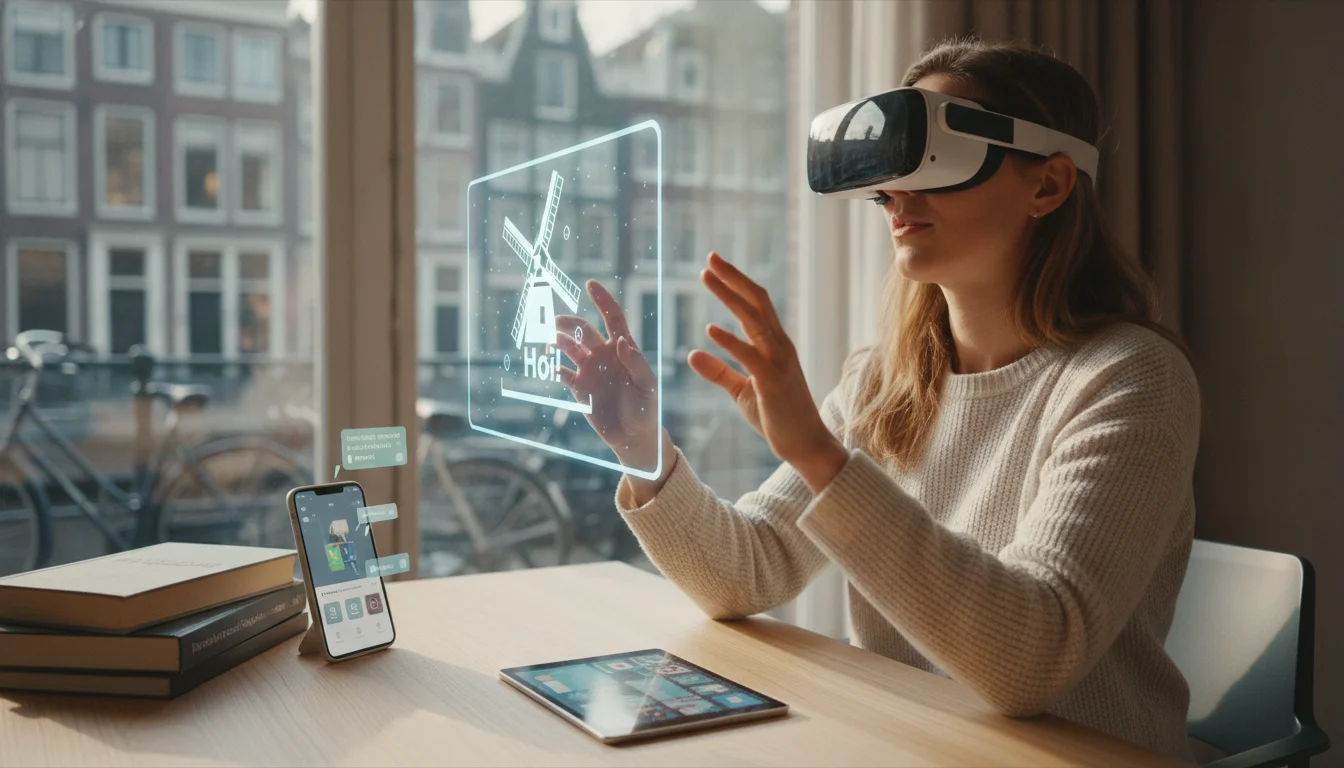
Imagine walking into a bustling Amsterdam 'bruin café'. The rich aroma of bitterballen and craft beer fills the air, and the rapid-fire chatter of locals surrounds you. You want to order a drink, but your mind suddenly goes blank. For years, expats, students, and language learners have tried to prepare for these high-pressure, real-life moments by staring at flat textbook pages or tapping on 2D screens. But the landscape of education is undergoing a massive paradigm shift. The future of Dutch language learning is no longer confined to classrooms or standard mobile interfaces; it is moving into the immersive worlds of Virtual Reality (VR) and Augmented Reality (AR).
As technology advances, the tools we use to study Dutch are becoming more interactive, contextual, and deeply integrated into our physical environments. By simulating real-world scenarios and overlaying digital information onto our immediate surroundings, VR and AR are changing the game for language learners. Whether you are an expat trying to navigate daily life in Rotterdam, a student preparing for your integration exams, or a professional aiming to speak Dutch confidently in the workplace, these emerging technologies offer unprecedented ways to accelerate your path to fluency.
Virtual Reality completely detaches you from your physical location and transports you into a fully simulated, three-dimensional environment. Instead of simply reading a dialogue about ordering a coffee at a Dutch 'bakkerij', you can put on a VR headset and actually stand in front of a virtual counter. You look the baker in the eye, hear the ambient noise of other customers, and must physically speak the words to complete your order.
This level of immersion addresses one of the greatest hurdles in language learning: foreign language anxiety. Many learners possess a strong grasp of grammar and vocabulary but freeze when put on the spot. VR provides a safe, low-stakes environment where you can practice speaking Dutch without the fear of judgment or embarrassment. If you make a mistake while talking to a virtual avatar, you can simply restart the scenario and try again.
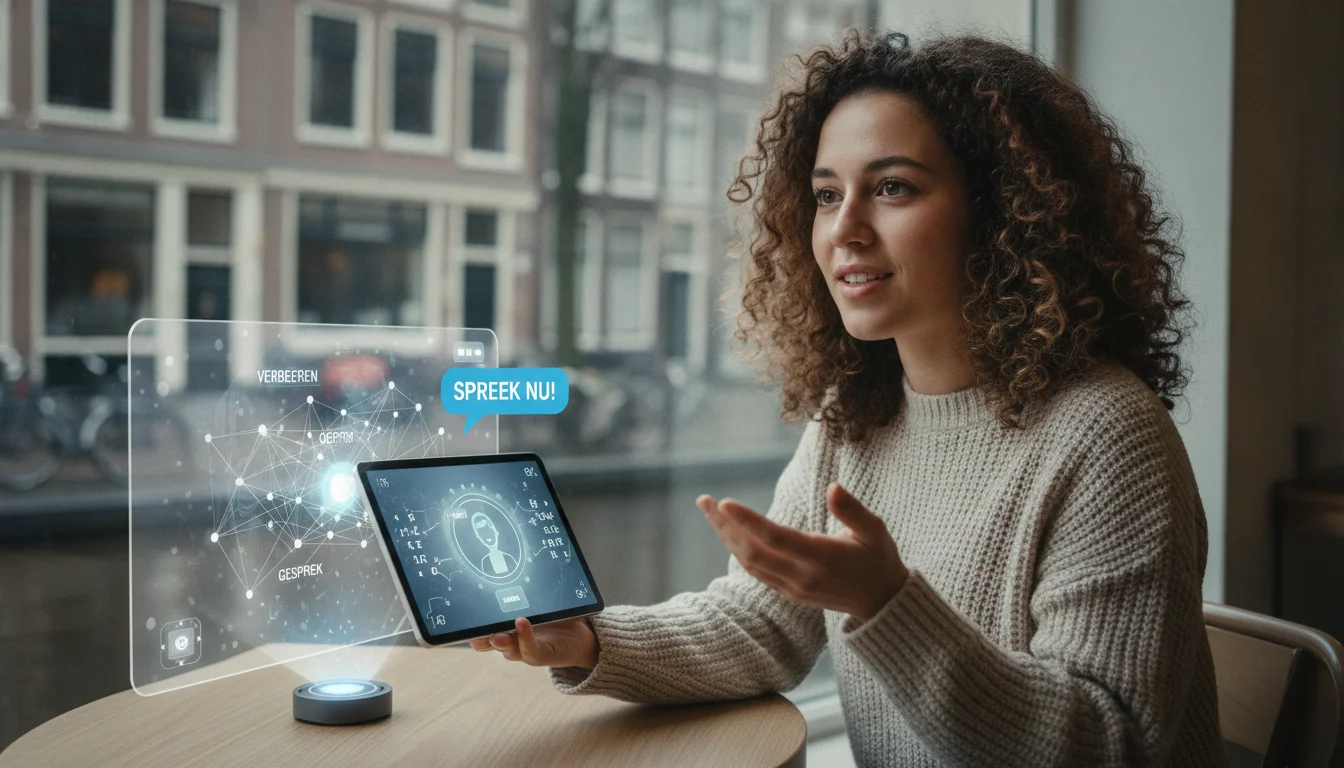
Furthermore, VR allows you to practice highly specific scenarios that are highly relevant to expats. You can simulate a job interview with a Dutch manager, practice registering at the local municipality ('gemeente'), or navigate a simulated doctor's visit. If you are looking for the best AI Dutch language tutor for conversational practice in 2026, you already know how powerful interactive AI can be when paired with realistic, simulated environments. VR takes this conversational AI and gives it a physical presence, making your practice sessions feel incredibly real.
While VR transports you to a different world, Augmented Reality (AR) does the opposite: it brings digital elements into your actual physical surroundings. Using an AR-enabled smartphone, tablet, or smart glasses, you can overlay Dutch translations, interactive labels, and virtual tutors directly onto the objects around you.
Imagine walking through your own home and pointing your phone camera at your furniture. Instead of sticky notes that fall off, AR labels float dynamically above your table ('de tafel'), your fridge ('de koelkast'), and your coffee maker ('het koffiezetapparaat'). You can tap on these virtual labels to hear the correct pronunciation, view example sentences, or play quick vocabulary matching games.
This interactive approach is a massive leap forward, taking your study sessions and Dutch vocabulary beyond basic flashcards into a highly contextualized, real-world space. AR makes language learning a passive, continuous part of your daily routine. By associating Dutch words with the actual physical objects you interact with every day, your brain builds stronger cognitive connections, making recall much faster and more natural.
Why are VR and AR so effective for language acquisition? The answer lies in how the human brain processes and stores information. Traditional learning relies heavily on semantic memory—memorizing abstract facts, rules, and words from a page. However, our brains are evolutionary wired to excel at spatial and episodic memory. We remember places we have been, actions we have performed, and experiences we have lived far better than lists of words.
When you learn Dutch in a spatial 3D environment, your brain treats the session as a real-life experience. When you physically reach out to select a virtual 'appel' in a VR supermarket, your motor cortex, visual cortex, and language centers all fire simultaneously. This multi-sensory encoding creates deeply rooted neural pathways. You are no longer just memorizing the word for apple; you are storing the memory of grabbing an apple while hearing and speaking the Dutch word. This is the modern, digital equivalent of the ancient 'Memory Palace' technique, and it dramatically increases long-term retention rates.
While VR and AR represent the exciting future of language learning, they are most powerful when paired with structured, pedagogical tools. Immersive experiences are fantastic for practice, but you still need a systematic way to build your vocabulary, master complex grammar rules, and track your progress over time.
This is where an advanced AI-powered platform like StroopTaal comes in. StroopTaal acts as your personal launchpad, offering AI-powered personalized learning plans and structured grammar lessons from A0 to C1 level. Before you dive into a fully immersive VR simulation of a Dutch business meeting, you can use StroopTaal to master the necessary vocabulary using spaced repetition and practice your sentence structures.
StroopTaal's interactive dialogue games and real-life conversation practice prepare you for the spontaneous nature of virtual interactions, while its article mastery games ensure you confidently know whether to use 'de' or 'het' before you speak. When choosing the right Dutch learning app features for 2026, smart learners look for systems that offer this perfect blend of structured, gamified progression and practical, conversational application.
For expats moving to the Netherlands, passing the Dutch Civic Integration Exam ('Inburgeringsexamen') is a crucial milestone. According to the official Dutch Government integration guidelines, candidates must demonstrate proficiency in reading, writing, listening, and speaking Dutch, as well as a solid understanding of Dutch society and the labor market.
VR and AR are uniquely suited to prepare candidates for this exam. Traditional preparation often involves reading dry texts about Dutch customs or watching outdated videos. With VR, you can virtually experience Dutch cultural scenarios firsthand. You can practice the speaking portion of the exam with an AI examiner that mimics the exact format and pressure of the actual test. By simulating the test environment beforehand, you can significantly reduce exam-day anxiety and walk into the test center feeling fully prepared and confident.
You do not need to wait for a sci-fi future to start using immersive technology to learn Dutch. You can start integrating these methods into your routine today:
The days of boring grammar drills and passive rote memorization are quickly coming to an end. Virtual and Augmented Reality are paving the way for a future where learning Dutch is active, experiential, and deeply engaging. By merging the cognitive benefits of spatial learning with cutting-edge AI technology, these tools allow you to learn faster, retain information longer, and speak with genuine confidence.
Ready to start building the foundational language skills you need to thrive in both the physical and virtual Netherlands? Download StroopTaal today to access personalized learning plans, master Dutch grammar, and practice real-life conversations with our advanced AI tutor. Your journey to Dutch fluency starts here!
Share this article:
Choosing the Right Path to Dutch Fluency Moving to the Netherlands is an exciting adventure. Whether you are settling in the historic canals of...
Read moreThe Conversational Revolution: Learning Dutch in 2026 For years, learning a new language meant sitting with heavy grammar books, memorizing listless...
Read moreThe Dutch Language Challenge: Why We Need Motivation Picture this: You have just moved to the Netherlands. You are surrounded by beautiful canals,...
Read more