Personalized Dutch Learning: How AI Builds Your Study Plan
The Evolution of Language Learning: From Textbooks to Algorithms Imagine landing at Schiphol Airport, your mind buzzing with excitement and a resolve...
Read more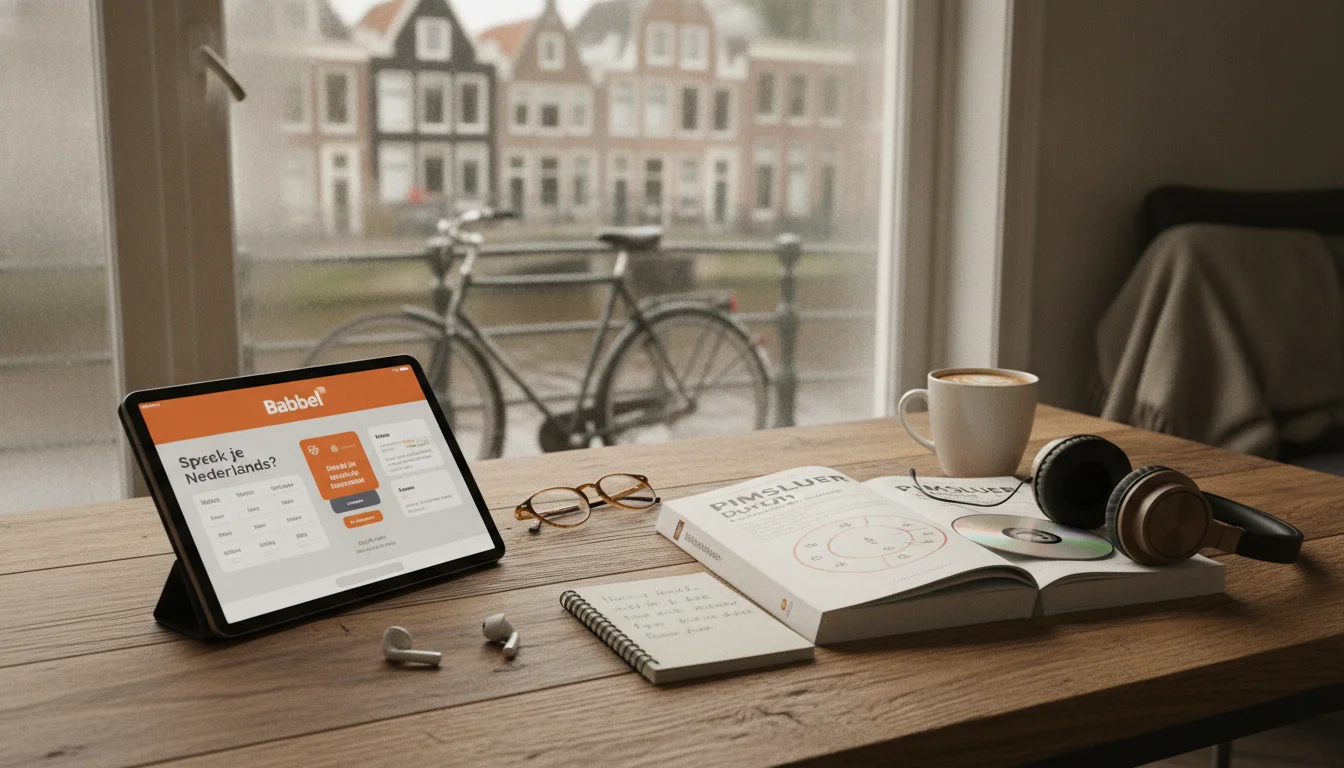
Moving to the Netherlands is an exciting adventure. Whether you are settling in the historic canals of Amsterdam, the modern architecture of Rotterdam, or the cozy streets of Utrecht, mastering the local language is the key to truly feeling at home. If you want to integrate into Dutch society, land a local job, or pass the civic integration exam (Inburgering), you need a learning method that actually works.
Two of the biggest names in the language-learning market are Babbel and Pimsleur. Both promise to take you from a complete beginner to a confident speaker, but they use completely opposite philosophies. When choosing the right Dutch learning app, it helps to analyze your personal learning style and how these platforms tackle the unique challenges of the Dutch language.
In this comprehensive guide, we will break down the differences between Babbel and Pimsleur for Dutch, examine their pros and cons, and help you decide which method is best for your language journey.
Before diving into the specifics of their Dutch courses, it is important to understand how Babbel and Pimsleur approach language acquisition. They are built on fundamentally different pedagogical theories.
Developed by Dr. Paul Pimsleur decades ago, the Pimsleur Method is entirely audio-focused. It operates on the principle of organic learning and graduated interval recall (a form of spaced repetition). The core of each lesson is a 30-minute audio track where you listen to native speakers, participate in simulated conversations, and repeat phrases on demand.
Pimsleur believes that you should learn a language the way you learned your mother tongue: by listening and speaking before reading and writing. There are almost no grammar explanations, vocabulary lists, or writing exercises in the core lessons. You are expected to absorb the structure of the language naturally through context and repetition.
Babbel takes a more traditional, classroom-style approach, adapted for the digital age. It is a balanced, multi-sensory app that integrates reading, writing, listening, and speaking from day one. Babbel structures its lessons around short, 10-to-15-minute interactive blocks.
Unlike Pimsleur, Babbel embraces explicit grammar instruction. It explains the rules of sentence structure, verb conjugations, and gendered nouns as you go. For a broader perspective on how Babbel compares to other popular gamified apps, you might also want to look at our Babbel vs Duolingo vs StroopTaal comparison.
Babbel’s Dutch course is highly structured and guides you step-by-step through the CEFR levels (Common European Framework of Reference for Languages), primarily focusing on A1 to B2 proficiency.
A typical Babbel lesson starts by introducing a handful of new vocabulary words with images, spelling, and audio pronunciation. You then complete various interactive exercises, such as:
Each lesson ends with a realistic dialogue that puts the new words and grammar points into a practical context, such as ordering food at a café or asking for directions in Utrecht.
Pimsleur offers a hands-free, conversational approach. If you spend a lot of time commuting, doing chores, or walking, Pimsleur’s audio format is incredibly convenient.
Each Pimsleur Dutch lesson is a 30-minute audio track. A narrator guides you through a conversation between two native Dutch speakers. The narrator will break down a phrase, explain what it means, and then ask you to say it. For example: "How do you say 'I understand a little Dutch'?" You are given a few seconds to respond out loud before a native speaker provides the correct pronunciation for you to mimic.
Pimsleur uses "back-chaining" to teach difficult words. For instance, with the word alstublieft (please), the audio will have you pronounce the last syllable first (-ft), then the middle (-blieft), and finally the whole word. This is highly effective for training your mouth muscle memory.
To truly understand which app is better, let us look at how they handle the specific hurdles of learning Dutch.
Dutch is famous for its throat-clearing "G" sound (the voiceless velar fricative) and tricky diphthongs like ui (as in huis) and eu (as in keuken).
Winner: Pimsleur. Pimsleur’s back-chaining technique and focus on auditory mimicry make it much better at training your mouth to produce these foreign sounds. Babbel’s speech recognition can be sluggish and often lets poor pronunciation slide.
Dutch syntax changes depending on whether you are using a main clause or a subordinate clause. In addition, you must learn whether a noun takes de or het, which affects adjectives and pronouns.
Winner: Babbel. Babbel’s explicit grammar pop-ups and structured drills make it much easier to grasp these complex rules. Pimsleur’s implicit approach makes it very difficult to understand why words suddenly shift positions in a sentence.
How far can each app actually take you on your Dutch journey?
Winner: Babbel. Because Pimsleur only offers 30 lessons (Level 1) for Dutch, it is impossible to reach intermediate fluency using Pimsleur alone. Babbel’s Dutch course is significantly deeper, covering a wider range of vocabulary, grammar, and cultural contexts that can take you much closer to conversational independence.
While both Babbel and Pimsleur have their merits, they represent older paradigms of language learning. Pimsleur is based on cassette-era audio drills, while Babbel relies on static, pre-written curricula. Neither app offers dynamic, open-ended conversational practice where you can say whatever you want and receive real-time corrections.
If you want to transition from passive studying to actually speaking Dutch with confidence, you need a method that adapts to you. This is where modern platforms like StroopTaal bridge the gap. StroopTaal combines the structured grammar progression of Babbel with advanced, AI-powered features.
With StroopTaal, you get access to real-life Dutch conversation practice with AI, allowing you to practice realistic scenarios without the anxiety of talking to a native speaker right away. Furthermore, its pronunciation training with instant feedback scores what you say and tells you what to improve, which helps with that tricky Dutch "G" sound. While both Babbel and Pimsleur are useful starting points, incorporating modern AI chatbots for Dutch fluency into your routine can dramatically accelerate your progress.
| Feature | Babbel Dutch | Pimsleur Dutch |
|---|---|---|
| Primary Focus | Reading, writing, grammar, and basic speaking | Spoken conversation and listening comprehension |
| Format | Interactive mobile/web app lessons (15 mins) | Audio-focused active recall tracks (30 mins) |
| Grammar Instruction | Explicit, clear explanations and rules | Implicit, absorbed through context |
| Course Depth | Comprehensive (A1 to B2 levels) | Very limited (Only 1 Level / 30 lessons) |
| Best For | Visual learners who want structural understanding | Auditory learners who want to speak quickly |
The choice between Babbel and Pimsleur ultimately depends on your learning style, lifestyle, and goals.
If you are serious about mastering Dutch, relying on a single app is rarely the best approach. Pimsleur is fantastic for the first month to train your ear and build speaking confidence, but its lack of grammar and limited course depth means you will quickly hit a wall. Babbel provides the necessary structural foundation and reading practice, but it can feel static and academic.
To get the best of both worlds, consider a hybrid approach: use Pimsleur to build initial pronunciation confidence, Babbel to learn the core grammar rules, and supercharge your daily routine with an interactive, AI-powered tool like StroopTaal to practice natural, fluid conversations. Ready to take your Dutch to the next level? Start practicing today and speak Dutch like a local in no time!
Share this article:
The Evolution of Language Learning: From Textbooks to Algorithms Imagine landing at Schiphol Airport, your mind buzzing with excitement and a resolve...
Read moreThe Dawn of a New Era in Language Acquisition Imagine walking into a bustling Amsterdam 'bruin café'. The rich aroma of bitterballen and craft beer...
Read moreThe Conversational Revolution: Learning Dutch in 2026 For years, learning a new language meant sitting with heavy grammar books, memorizing listless...
Read more