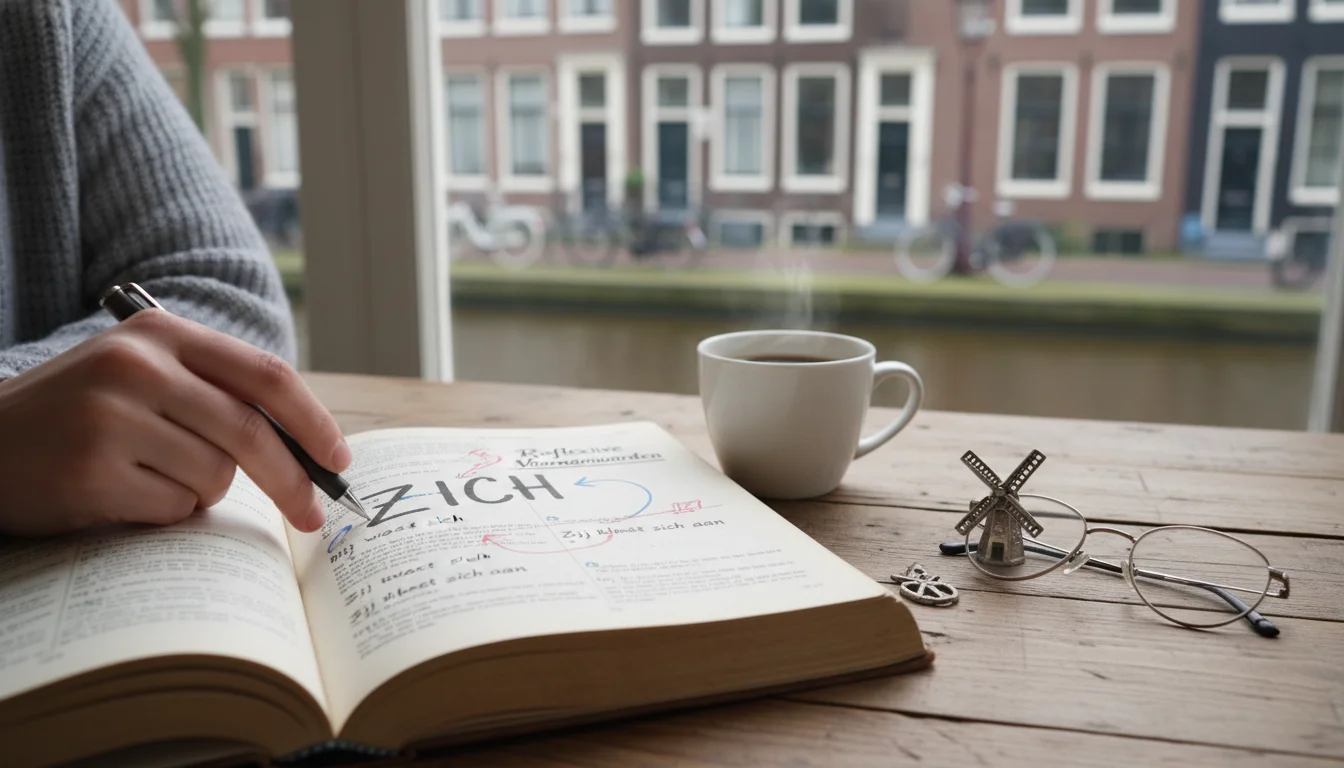
The Nuances of 'Zich' in Dutch: Reflexive Pronouns Explained
Introduction: The Mystery of the Dutch 'Zich' Imagine you’re sitting in a cozy café in Utrecht, sipping a warm coffee, and eavesdropping on the...
Read more
You have spent months memorizing vocabulary cards, practicing grammar drills, and perfecting your conjugation tables. You feel confident. But the moment you step into a local bakery in Amsterdam or sit down for lunch with your Dutch colleagues, disaster strikes. Someone asks a question at lightning speed, and it sounds like a single, continuous, unintelligible word: "Wajadoen?" (which you later realize was "Wat ga je doen?").
If this sounds familiar, you are not alone. For most expats, students, and language learners preparing for their integration exams, transitioning from clean, slow classroom Dutch to the rapid-fire cadence of native speakers is the ultimate hurdle. Spoken Dutch is full of swallowed syllables, linked words, and regional accents that can leave even B1-level learners feeling completely lost.
Fortunately, listening is a cognitive skill that can be trained. In this comprehensive guide, we will break down why spoken Dutch sounds so fast, explore powerful active listening strategies, and show you how to train your brain to decode rapid conversations effortlessly.
To solve a problem, you must first understand it. Native Dutch speakers do not actually speak faster than speakers of other languages; rather, they employ phonetic shortcuts that make separate words blend into a single stream of sound. Here are the primary linguistic phenomena you need to recognize:
In standard written Dutch, plural nouns and infinitive verbs end in -en (e.g., lopen, maken, boeken). In spoken Dutch, however, the final 'n' is almost always dropped. Native speakers pronounce these words as "lope", "make", and "boeke". The final unstressed 'e' becomes a neutral "schwa" sound (like the 'a' in "about"). If your brain is constantly waiting to hear that final 'n', you will fall behind the rhythm of the sentence.
Dutch speakers love efficiency. If one word ends in a consonant and the next begins with a vowel, they merge them. For example, "Ik heb er een" (I have one) is pronounced as "Ikkebbereen". Similarly, "Wat is dat?" sounds like "Wassisdat?". This continuous stream of sound makes it incredibly difficult for learners to identify where one word ends and the next begins.
In casual conversations, pronouns undergo a dramatic transformation. High-frequency words are reduced to their unstressed equivalents:
Many learners believe that simply leaving the Dutch radio or television on in the background (passive listening) will magically make them fluent. While passive listening helps you get used to the natural rhythm and prosody of the language, it does very little to improve your comprehension of fast conversations. To make real progress, you must practice active listening.
One of the most effective ways to bridge the gap between spoken and written Dutch is the transcription method. Find a short audio clip (1 to 2 minutes long) that has accurate Dutch subtitles or a transcript—such as a clip from the youth news program Jeugdjournaal or a Dutch podcast.
When native speakers listen to each other, they do not decode every single syllable in real-time. Instead, their brains constantly predict what the speaker is going to say next based on context, grammar, and sentence structure. As a learner, you can replicate this strategy by mastering the structural rules of the language.
If you understand where the verb belongs in a sentence, your brain can easily bypass the filler words and focus on the core message. For example, knowing how subordinate clauses shift the verb to the very end of the sentence is vital. You can dive deep into this topic by reading our comprehensive guide on mastering Dutch sentence structure.
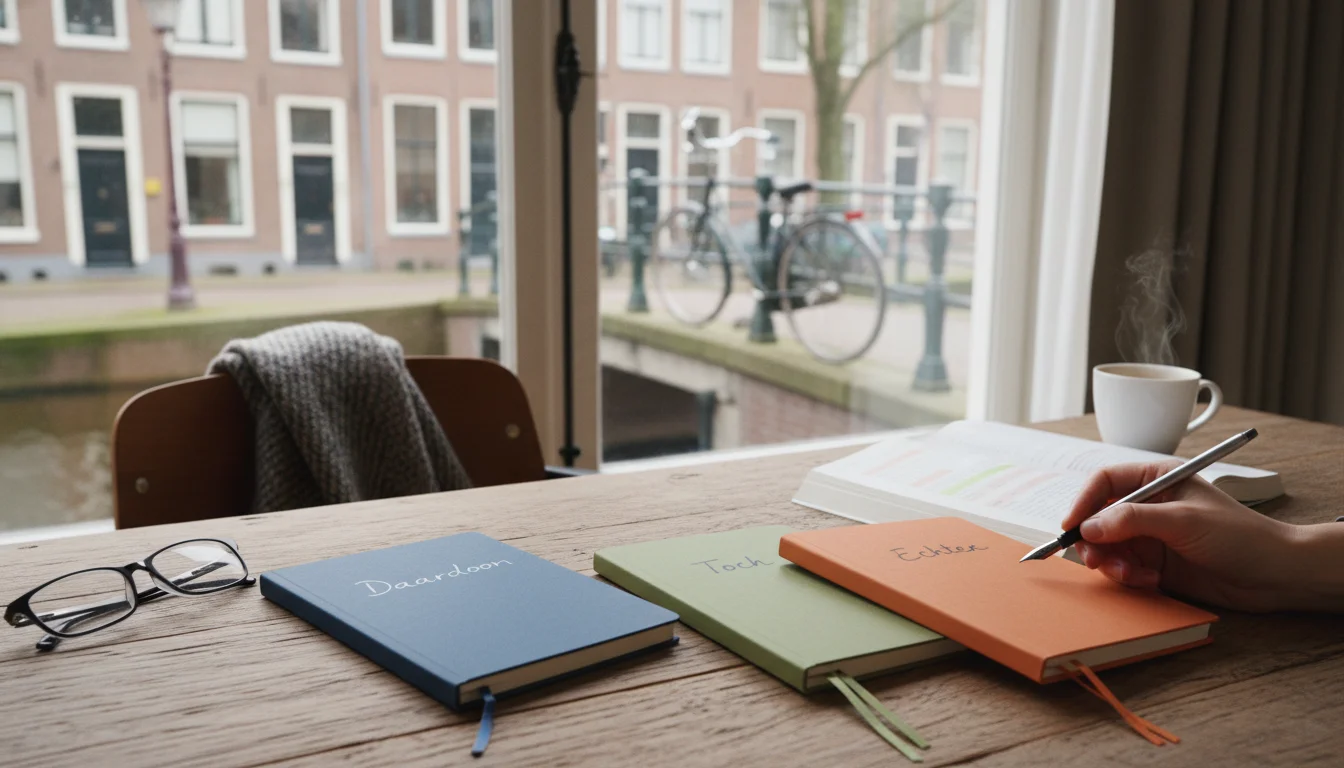
Furthermore, native speakers use logical transitions to signal where their thoughts are going. Recognizing these transitions instantly allows you to follow the thread of a fast conversation without getting derailed. To build this skill, make sure to study essential Dutch connectors like daardoor, toch, and echter. When you hear these words, your brain immediately knows whether to expect a cause, a contrast, or a conclusion, giving you crucial processing time.
There is a profound neurological link between speech production and speech perception. Simply put: if you cannot pronounce a sound correctly, your brain will struggle to recognize it when spoken quickly by someone else.
If you struggle with pronouncing tricky Dutch vowel sounds like the ui, ij, or eu, your auditory system will often misclassify these sounds when they fly past in a fast conversation. By actively practicing these pronunciations, you build the neural pathways required to spot them instantly in the wild.
This is where smart technology becomes an invaluable asset. With the StroopTaal app, you can practice real-life Dutch conversations with an AI-powered tutor that gives you instant feedback on your pronunciation. By speaking in a safe, interactive environment and hearing natural, simulated native responses, you train both your mouth and your ears simultaneously. StroopTaal's pronunciation training scores the words and sentences you say and tells you what to improve, so you can work on the subtle nuances of spoken Dutch.
To turn passive ears into active listening powerhouses, integrate these daily habits into your routine:
When listening to Dutch podcasts (such as Echt Gebeurd or Een Podcast over Media) or watching YouTube videos, use the playback speed setting. Slowing the audio down to 0.8x or 0.9x can give your brain the extra milliseconds it needs to identify word boundaries. Once 0.9x feels comfortable, bump it back up to normal speed.
Do not try to translate every single word in your head. If you get stuck on a word you did not understand, you will miss the next three sentences. Instead, focus entirely on the "content words"—nouns, verbs, and adjectives. If you hear "gisteren" (yesterday), "trein" (train), and "te laat" (too late), you can easily reconstruct the meaning without needing to decode every preposition or pronoun.
If you are preparing for the Dutch integration exams (Inburgeringsexamen), listening comprehension is a major component of your evaluation. The official guidelines and exam requirements, which you can read about on the Dutch Government website, place a strong emphasis on understanding everyday interactions. Practice listening to announcements at train stations, supermarket dialogues, and basic news reports to build practical, exam-ready listening skills.
Improving your Dutch listening skills is not about studying for five hours once a week. It is about exposing your brain to 15 to 20 minutes of active, focused listening every single day. Over time, your brain will naturally begin to group sounds, recognize word boundaries, and decode rapid-fire Dutch without conscious effort.
Are you ready to take your Dutch listening and speaking skills to the next level? Download the StroopTaal app today. With our interactive dialogue games, AI-powered personalized learning plans, and real-life conversation practice, you can build the confidence and comprehension skills that help you take part in real-world Dutch conversations.
Share this article:
Introduction: The Mystery of the Dutch 'Zich' Imagine you’re sitting in a cozy café in Utrecht, sipping a warm coffee, and eavesdropping on the...
Read moreHave you ever felt like your Dutch sounds a bit robotic? You know the vocabulary, your grammar is mostly correct, but your sentences feel short,...
Read moreThe Ultimate Guide to Mastering Dutch Questions for Beginners Imagine walking into a cozy Dutch bruin café in Amsterdam, navigating a bustling...
Read more