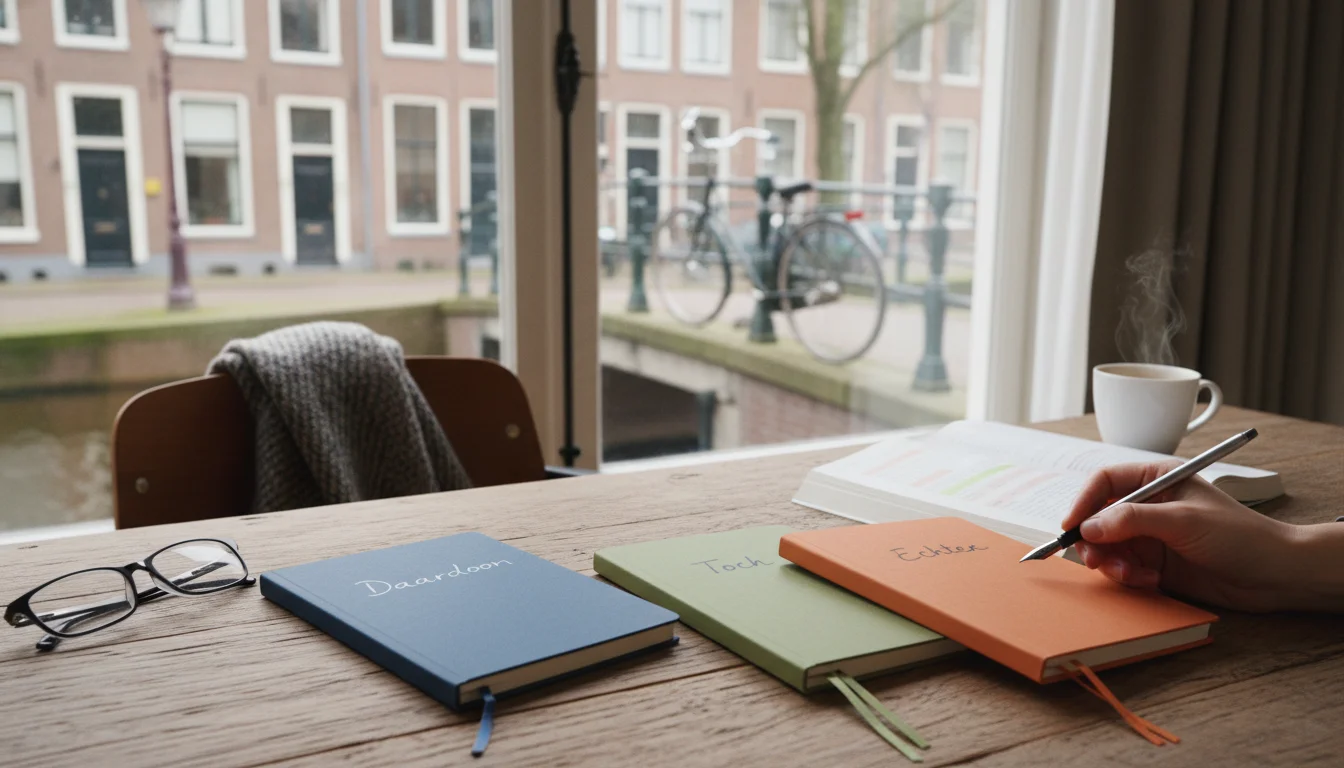
Dutch Connectors for Fluency: Master Daardoor, Toch, and Echter
Have you ever felt like your Dutch sounds a bit robotic? You know the vocabulary, your grammar is mostly correct, but your sentences feel short,...
Read more
Imagine walking into a cozy Dutch bruin café in Amsterdam, navigating a bustling street market in Utrecht, or trying to register at the local municipality (gemeente). What is the single most important tool in your linguistic toolkit? The ability to ask questions.
Asking questions is the lifeblood of communication. It helps you clarify directions, order your favorite stroopwafel, connect with locals, and successfully pass your integration exams. However, for English speakers, forming questions in Dutch can feel a bit like putting together a puzzle backward. Unlike English, which relies heavily on auxiliary verbs like 'do' or 'does' (e.g., 'Do you speak Dutch?'), Dutch uses an elegant system of direct word order manipulation called inversion, alongside a specific set of question words.
In this comprehensive guide, we will break down the mechanics of asking questions in Dutch. You will master yes/no questions, understand the rules of inversion, learn the essential 'W-words', and discover the quirky spelling rules that catch many beginners off guard. Ready to start conversing like a local? Let us dive in!
The simplest type of question is the yes/no question (ja/nee-vraag). In English, we almost always need the helper verb 'to do' to make these: 'Do you live here?' or 'Does he drink coffee?'
In Dutch, there is no equivalent to 'do' or 'does' for questions. Instead, Dutch uses a grammatical mechanism called inversion. Inversion simply means that you swap (invert) the positions of the subject and the conjugated verb.
Let us look at a standard declarative sentence (a statement):
To turn this statement into a yes/no question, you simply move the verb to the very first position in the sentence, and place the subject immediately after it:
It is as simple as that! Let us look at a few more examples to see this pattern in action:
To fully grasp how this fits into the broader picture of Dutch syntax, explore our ultimate guide on mastering Dutch sentence structure.
There is one crucial, highly specific spelling rule in Dutch inversion that trips up almost every beginner. It is a frequent point of confusion in formal exams, so mastering it now will save you plenty of headaches later!
In the present tense, regular Dutch verbs conjugated with the second person singular (jij or je - meaning 'you') end in a -t. For example:
However, when you invert the sentence to form a question, and the subject 'jij' or 'je' comes immediately AFTER the verb, the -t is dropped.
This 'drop-the-t' rule only applies to the informal second-person singular pronoun jij/je. It does not apply to the formal 'you' (u), nor does it apply to third-person singular pronouns (hij, zij, het). Observe the differences:
If you are practicing these structural shifts, StroopTaal's interactive dialogue games and real-life Dutch conversation practice with AI are excellent tools to build muscle memory. The app instantly corrects you if you accidentally leave the 't' on 'je' during a spoken or written prompt.
Sometimes, a simple yes or no isn't enough. When you need more information, you use open questions initiated by question words (interrogative pronouns). Just like in English, most of these words start with a 'W' (or an 'H').
If you want to dive deeper into the specific nuances of each interrogative pronoun, check out our comprehensive guide to master Dutch question words. For now, here is a quick-reference breakdown of the core question words you must know:
| Dutch Word | English Translation | Example Sentence | English Meaning |
|---|---|---|---|
| Wie | Who | Wie is dat? | Who is that? |
| Wat | What | Wat doe je? | What are you doing? |
| Waar | Where | Waar woon je? | Where do you live? |
| Wanneer | When | Wanneer kom je? | When are you coming? |
| Waarom | Why | Waarom lach je? | Why are you laughing? |
| Hoe | How | Hoe gaat het? | How is it going? |
| Welk / Welke | Which | Welk boek lees je? | Which book are you reading? |
When you use a question word, the structure of the sentence remains inverted, but the question word is placed at the very beginning of the sentence. The formula is:
Question Word + Verb + Subject + Rest of Sentence
Let us look at how a statement transforms into an open question:
Notice how the verb woon still immediately precedes the subject je. To make your questions sound even more natural and descriptive, you can also learn how to expand your Dutch adjective vocabulary to describe things in your answers!
One unique feature of the Dutch language that often puzzles beginners is how prepositions combine with the word waar (where). In English, we often end sentences with prepositions: 'What are you listening to?' or 'What are you writing with?'
In formal Dutch, you cannot easily leave a preposition dangling at the end, nor do you use 'wat' with a preposition. Instead, you combine waar with the preposition to form a single compound word. Here are some common examples:
While native speakers in casual conversation sometimes split these words (e.g., 'Waar luister je naar?'), learning the compound forms is highly recommended, especially if you are preparing for official language exams. You can read more about integration requirements on the official Netherlands Government website.
When your question involves a modal verb (like kunnen - can, willen - want, moeten - must, or mogen - may), the word order follows a specific pattern. The conjugated modal verb undergoes inversion with the subject, while the second verb (the main action verb) is kicked to the very end of the sentence in its infinitive form.
This structure is highly useful for polite requests. Using kun je... (can you...) or zou je... (would you...) is the standard way to ask for assistance politely in Dutch shops, offices, and restaurants.
Understanding the grammar of Dutch questions is one thing; using them spontaneously in real-life conversations is another. Here are some practical tips to help you build confidence:
Mastering inversion and question words is a major milestone in your Dutch learning journey. It shifts you from a passive listener to an active participant in conversations. Remember: don't fear making mistakes with the 'drop-the-t' rule or word order. Dutch speakers truly appreciate the effort, and every question you ask is an opportunity to learn something new. Start practicing today—your confidence will grow with every sentence!
To accelerate your progress, download the StroopTaal app today. With our AI-powered personalized learning plans, interactive dialogue games, and comprehensive grammar lessons spanning from A0 to C1, you will get the exact, bite-sized practice you need to make Dutch questions second nature. Succes!
Share this article:
Have you ever felt like your Dutch sounds a bit robotic? You know the vocabulary, your grammar is mostly correct, but your sentences feel short,...
Read moreThe Cult of "Lekker": Why We Use It and Why We Must Move Beyond It If you have spent even a single day in the Netherlands, you have undoubtedly heard...
Read moreImagine walking into a cozy Dutch bakery (bakkerij) on a rainy Tuesday morning. The air is thick with the scent of cinnamon and warm caramelized...
Read more