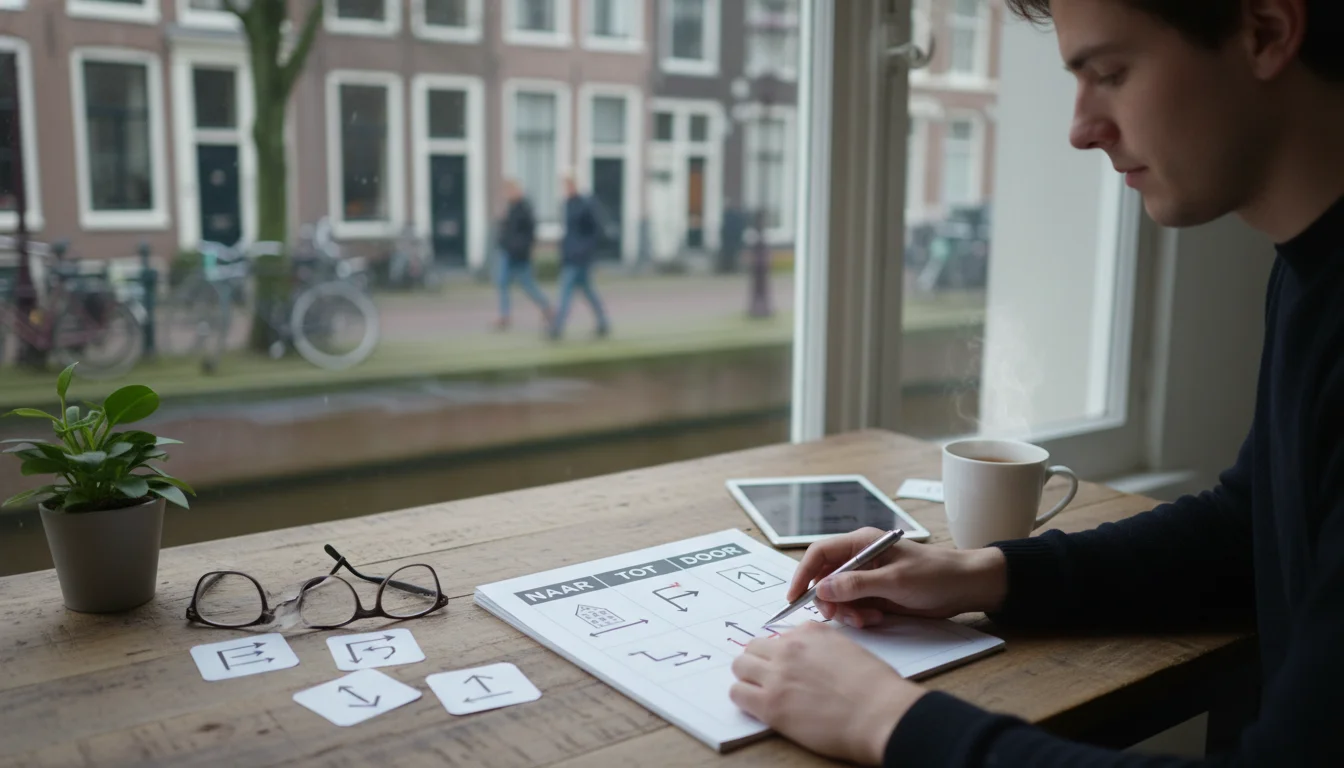
Dutch Prepositions of Direction: Master Naar, Tot, and Door
Navigating the Dutch Landscape: Why Prepositions of Direction Matter Imagine you are cycling along a scenic canal in Utrecht. You want to head to...
Read more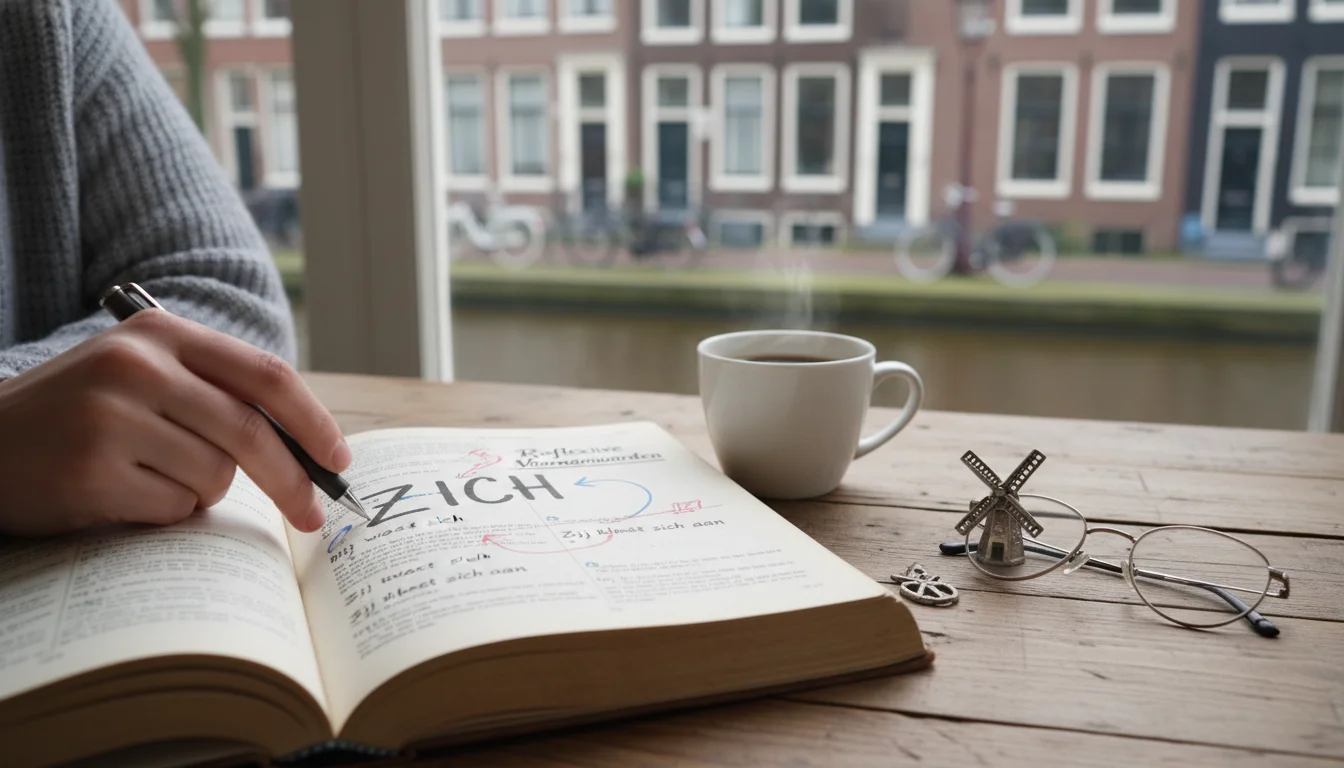
Imagine you’re sitting in a cozy café in Utrecht, sipping a warm coffee, and eavesdropping on the conversations around you. You hear a local say, 'Ik herinner me dat niet meer,' followed by another who laughs and says, 'Hij vergist zich altijd!' As a Dutch language learner, you might find yourself scratching your head. Why did the first speaker use 'me' instead of 'mij'? And what on earth is this floating 'zich' that keeps popping up in everyday Dutch conversations?
Reflexive pronouns (wederkerende voornaamwoorden) are one of the most intriguing yet challenging aspects of Dutch grammar. While basic reflexive verbs like zich wassen (to wash oneself) or zich aankleden (to dress oneself) are taught early on, the real magic—and confusion—happens when you move beyond the basics. Dutch is packed with verbs that require a reflexive pronoun for no apparent logical reason, as well as subtle distinctions between 'zich', 'zichzelf', and 'zelf'.
Whether you are an expat striving for professional integration, a student preparing for your civic integration exams (inburgeringsexamen), or an intermediate learner looking to polish your fluency, mastering the nuances of 'zich' is your ticket to sounding like a native speaker. In this comprehensive guide, we will break down the mechanics of Dutch reflexive pronouns, explore the verbs that demand them, untangle complex word order rules, and show you how to naturally integrate them into your speech.
Before we dive into the deep end, let us establish a solid foundation. A reflexive pronoun is used when the subject of the sentence and the object of the verb are the same person. In English, we use words ending in "-self" (himself, myself, ourselves). In Dutch, the system is slightly more nuanced. Here is how reflexive pronouns align with subject pronouns:
Notice how 'zich' is the universal reflexive pronoun for the third person singular (hij/zij/het) and plural (zij). It is a highly efficient little word, but it can feel incredibly foreign to English speakers because English often drops reflexive pronouns entirely. For example, while an English speaker says "I shave," a Dutch speaker must say 'Ik scheer me' (literally: "I shave myself"). Omitting the pronoun in Dutch makes the sentence grammatically incomplete or changes the meaning entirely.
To master Dutch reflexives, you must understand that verbs fall into two distinct categories: verplichte wederkerende werkwoorden (mandatory reflexive verbs) and toevallige wederkerende werkwoorden (accidental or optional reflexive verbs).
These are verbs that simply cannot exist without their reflexive pronoun. The pronoun does not add "self" emphasis; it is an inseparable part of the verb's anatomy. If you omit it, the sentence is incorrect. Here are some of the most common mandatory reflexive verbs that you will encounter daily in the Netherlands:
When learning these verbs, it is best to memorize them as a package deal. Do not just memorize "herinneren"; memorize "zich herinneren." Doing this will save you endless grammatical headaches down the road.
These verbs can be used both reflexively and transitively (with a direct object). When used reflexively, the action is directed back at the subject. When used transitively, the action is directed at someone or something else. Let us look at some clear examples:
Understanding this distinction is crucial for mastering Dutch sentence structure, as the presence of a direct object completely shifts how the verb operates grammatically.
As you progress toward B1 and B2 proficiency levels, you will encounter 'zich' in more abstract, idiomatic contexts. These are expressions where the literal translation fails, and only cultural context and exposure can help you grasp the meaning.
Let us explore some advanced reflexive expressions that will instantly elevate your Dutch:
Notice how these verbs are often paired with specific prepositions (op, aan, met). This is where many learners stumble. When writing or speaking, you must juggle both the correct reflexive pronoun and the correct preposition. To make your sentences flow smoothly, you can practice connecting these ideas by using Dutch connectors for fluency to build longer, more complex thoughts.
One of the biggest hurdles for expats and language students is placing the reflexive pronoun in the correct position within a sentence. Dutch sentence structure can be notoriously fluid, but there are strict rules governing reflexive pronouns.
In a standard main clause, the reflexive pronoun directly follows the finite verb.
Subject + Verb + Reflexive Pronoun + Rest
Example: Jan (S) verveelt (V) zich (Refl) tijdens de vergadering. (Jan is bored during the meeting.)
When inversion occurs—usually because the sentence starts with a time indicator, place indicator, or question word—the reflexive pronoun's position depends on whether the subject is a pronoun or a noun. This is a subtle rule that even advanced learners miss!
In a subordinate clause, the verbs are kicked to the very end of the sentence. The reflexive pronoun stays close to the subject at the beginning of the clause.
Example: Ik denk dat (Conjunction) hij (S) zich (Refl) vandaag niet zo goed voelt (Verbs). (I think that he does not feel very well today.)
If you find these word order shifts confusing, you are not alone. Practicing these structures in real-life contexts is key. The StroopTaal app offers interactive dialogue games and real-life Dutch conversation practice with AI that instantly flags if you have placed your reflexive pronoun in the wrong position, giving you the immediate feedback needed to build muscle memory.
Many learners ask: "Can I just say zichzelf instead of zich?" The answer is: sometimes, but they are not always interchangeable. Let us break down the differences between these three terms.
This is the standard, neutral reflexive pronoun. It is used when the action is routine, expected, or purely grammatical. There is no special emphasis on the person.
Example: Hij wast zich. (He washes himself—a normal daily routine.)
Adding '-zelf' to the reflexive pronoun adds strong emphasis or contrast. It implies that the action is directed at the subject *specifically*, often in contrast to other people, or in situations where the action is unexpected.
Example: Hij kent zichzelf heel goed. (He knows himself very well—emphasizing self-knowledge.)
Example: Zij praat altijd tegen zichzelf. (She always talks to herself—not to others.)
The word 'zelf' on its own is an emphasizing pronoun, not a reflexive pronoun. It means "personally" or "without help" (on one's own). It can be paired with non-reflexive verbs.
Example: Ik heb deze taart zelf gebakken. (I baked this cake myself/on my own.)
Understanding these distinctions is a great way of mastering Dutch demonstrative pronouns and other emphasizing words, allowing you to express exact shades of meaning without sounding repetitive.
Now that you know the theory, how do you make these rules second nature? Here are some practical steps to master the nuances of 'zich':
Mastering 'zich' and its reflexive companions is a major milestone in your Dutch language journey. It transitions you from translating word-for-word from English to genuinely thinking and feeling in Dutch. By understanding the difference between mandatory and accidental reflexives, practicing word order variations, and recognizing when to use zichzelf for emphasis, you are well on your way to fluent, natural communication.
Are you ready to take your Dutch grammar to the next level? Start practicing today by writing down three things you remember about your first week in the Netherlands using the verb zich herinneren. For structured, engaging, and AI-powered practice that fits right into your pocket, download the StroopTaal app today and start mastering Dutch grammar from A0 to C1 level!
For more authoritative insights into Dutch grammar standards, you can consult official resources like the Taaladvies Nederlandse Taalunie or explore historical linguistic overviews on Wikipedia's Dutch Grammar Guide.
Share this article:
Navigating the Dutch Landscape: Why Prepositions of Direction Matter Imagine you are cycling along a scenic canal in Utrecht. You want to head to...
Read moreThe Ultimate Guide to Cracking the Code of Fast Dutch Speech You have spent months memorizing vocabulary cards, practicing grammar drills, and...
Read moreHave you ever felt like your Dutch sounds a bit robotic? You know the vocabulary, your grammar is mostly correct, but your sentences feel short,...
Read more