A Complete Guide to the MAP (Module Arbeidsmarkt en Participatie) for Expats
Welcome to the Dutch Labor Market Moving to the Netherlands is an exciting adventure filled with bicycles, stroopwafels, and picturesque canals....
Read more
This article was drafted by AI and edited by a person before it was published.
AI can get things wrong. For anything official, check the source it points to.
AI-generated image
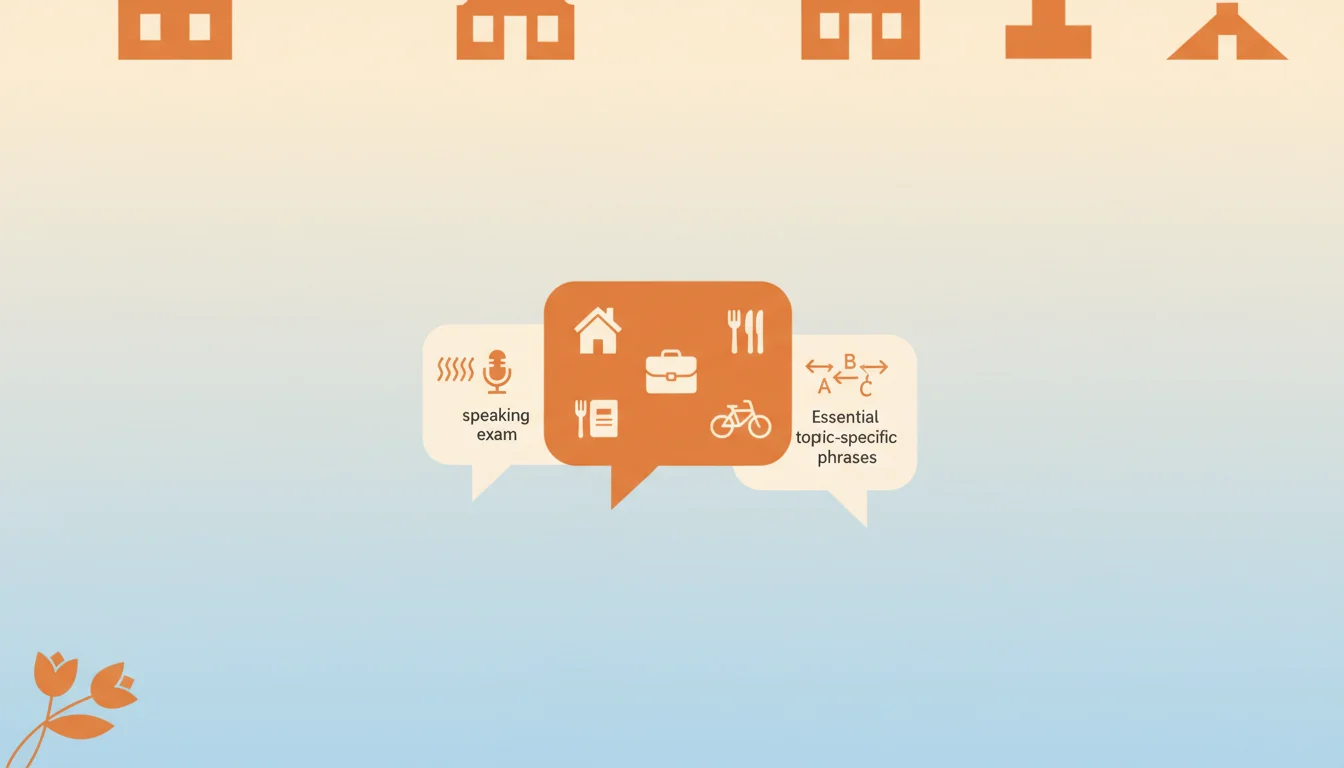
For many expats and newcomers in the Netherlands, the speaking portion of the civic integration exam—known as the Spreekvaardigheid exam—is the most intimidating hurdle. While reading and listening allow you to passively process information, speaking requires on-the-spot vocabulary retrieval, correct pronunciation, and rapid sentence construction. However, passing the Inburgering speaking exam doesn't require native-level fluency; it requires strategic preparation and a solid grasp of topic-specific phrases.
In this comprehensive guide, we will break down the essential Dutch phrases you need to master for the most common exam scenarios. Whether you are aiming for the A2 level or preparing for the upcoming B1 level transition, mastering these specific situations will give you the confidence to speak naturally and accurately.
Before diving into the vocabulary, it is crucial to understand how the exam works. The official speaking exam, administered by DUO (Dienst Uitvoering Onderwijs), tests your ability to handle everyday situations in the Netherlands. You will sit at a computer with a headset, watch short video clips of people asking you questions, and record your spoken responses.
The exam generally consists of two parts:
Because the exam simulates real life, the topics are highly predictable. They revolve around healthcare, employment, housing, transportation, and education. Let's explore the essential phrases for each category.
Navigating the Dutch healthcare system is a guaranteed topic on the exam. You will likely need to make an appointment, describe an illness, or speak to an assistant at the huisarts (general practitioner).
When the exam prompts you to explain what is wrong, keep it simple and direct. Use the construction "Ik heb last van..." (I suffer from...) or "Ik heb pijn aan..." (I have pain in...).
Employment scenarios are incredibly common. You might be asked to respond to a colleague, ask your boss for time off, or call in sick. Understanding workplace etiquette in Dutch is essential.
If a video scenario shows your boss asking why you aren't at work, you must respond clearly and professionally.
This category covers everything from dealing with a broken appliance in your rental home to talking to your neighbors or shopping at the supermarket.
A classic exam scenario involves calling the housing association (woningbouwvereniging) or a landlord to report a defect.
The Dutch value good neighborly relations. You might be tested on politely asking a neighbor to turn down their music or asking about a delivered package.
If you have children (or even if you don't, as the exam assumes various personas), you must know how to communicate with schools and teachers.
The Netherlands runs on its trains, trams, and buses. You must be able to ask for directions, check schedules, and report lost items.
To score higher on the speaking exam, you shouldn't just use short, choppy sentences. The examiners want to see that you can connect your thoughts logically. Using conjunctions correctly is a massive advantage.
Want (Because) - Does NOT change word order:
"Ik ga naar de dokter, want ik ben ziek." (I am going to the doctor, because I am sick.)
Omdat (Because) - Sends the verb to the end of the sentence:
"Ik ga naar de dokter, omdat ik ziek ben."
Maar (But) - Does NOT change word order:
"Ik wil graag komen werken, maar ik heb koorts." (I would like to come to work, but I have a fever.)
Practicing these structures until they feel natural is key. For more foundational strategies on passing all sections of the test, be sure to read our comprehensive integration exam guide.
Memorizing phrases is only half the battle. Delivery matters just as much. Here are some actionable tips to ensure you maximize your score on exam day:
When we are nervous, we tend to rush. Rushing leads to mispronunciations and grammatical errors. Take a deep breath before you press record. Speak at a measured, deliberate pace. The computer (and the human graders at DUO) needs to understand every syllable. Remember, clarity is far more important than speed.
Do not try to translate complex thoughts from your native language into Dutch. If the prompt asks what you did on the weekend, do not try to say, "I went to a fascinating modern art exhibition where I met an old acquaintance." Keep it simple: "Ik ben naar het museum geweest. Het was erg leuk. Daarna heb ik koffie gedronken." (I went to the museum. It was very nice. After that, I drank coffee.) Simple, accurate sentences score higher than complex, broken ones.
Listen carefully to the prompt. If the video asks "Waar en hoelaat spreken we af?" (Where and what time are we meeting?), you MUST provide both a location and a time. Failing to answer both parts of a compound question will result in lost points. Because speaking and listening are deeply connected, we also highly recommend checking out our resources on improving your listening skills so you never miss a detail in the prompt.
Reading Dutch in your head is entirely different from physically producing the sounds. Dutch contains challenging vowels and guttural consonants (like the famous hard 'G'). You must train your mouth muscles to form these sounds.
While textbooks and flashcards are helpful, they can't correct your accent or simulate the pressure of a real conversation. This is where modern technology makes a massive difference.
With the StroopTaal app, you get access to real-life Dutch conversation practice with AI. Our platform lets you practice everyday situations—from booking a doctor's appointment to complaining to your landlord—and its exam practice covers the speaking part of the Inburgering exam. Furthermore, StroopTaal features advanced pronunciation training with instant feedback. You speak into your phone, and the app instantly highlights which words you nailed and which syllables need more work. It is like having a private Dutch tutor in your pocket 24/7.
Coupled with our AI-powered personalized learning plans, you can focus specifically on the vocabulary and grammar rules you need to pass the exam, without wasting time on irrelevant material.
Passing the Inburgering Speaking Exam is entirely achievable with the right preparation. By memorizing these topic-specific phrases, understanding when to use them, and practicing your pronunciation diligently, you will walk into the exam room feeling prepared and confident. Remember to keep your answers simple, answer the exact question asked, and don't be afraid to speak up!
Ready to perfect your Dutch pronunciation and conquer the integration exam? Download the StroopTaal app today and start your journey with our interactive dialogue games and AI speaking features. Succes met studeren! (Good luck with studying!)
Share this article:
Welcome to the Dutch Labor Market Moving to the Netherlands is an exciting adventure filled with bicycles, stroopwafels, and picturesque canals....
Read moreThe Dutch integration process is evolving, and if you are planning to build a long-term life in the Netherlands, you need to be prepared. For years,...
Read moreConquering the Dutch Leesvaardigheid Exam For many expats and newcomers in the Netherlands, the Leesvaardigheid (reading comprehension) portion of...
Read more