Werklozenuitkering: The Complete Guide to Dutch Unemployment Benefits
A werklozenuitkering (commonly referred to as a WW-uitkering or simply WW) is the official Dutch unemployment benefit. Administered by the government...
Read more
This article was drafted by AI and edited by a person before it was published.
AI can get things wrong. For anything official, check the source it points to.
AI-generated image
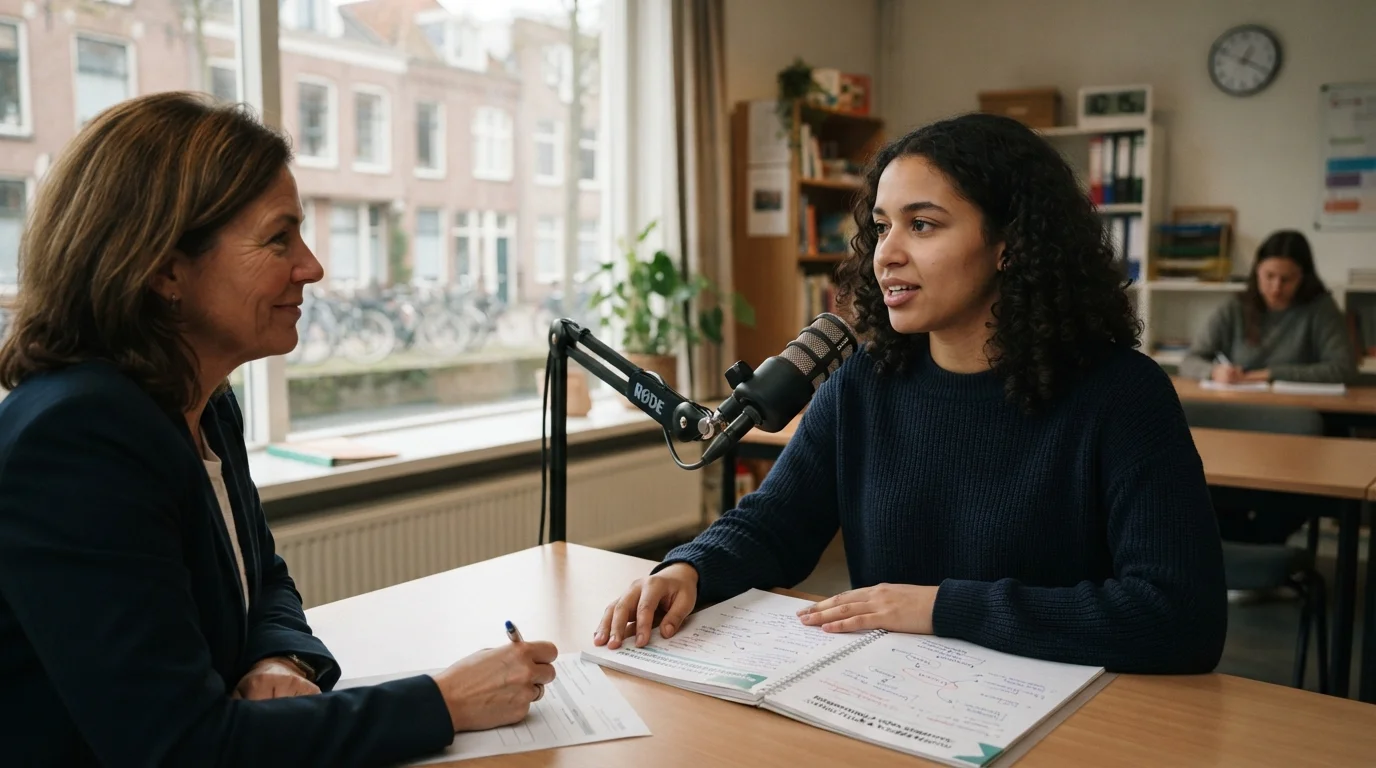
Are you preparing to take the Dutch integration exam (Inburgeringsexamen) in 2026? If so, the speaking portion (Spreken) is likely the component causing you the most sleepless nights. Speaking a new language under exam conditions is intimidating. The ticking clock, the headphones, the sterile computer screen, and the pressure of knowing your residency or citizenship depends on it can make even the most confident expats freeze.
But here is a secret that successful test-takers know: the Inburgering speaking exam is not just a test of your Dutch fluency; it is a test of your structure.
In 2026, with the Dutch government continuing its strict enforcement of the B1 language level for many integration pathways (under the Wi2021 law), assessors are looking for structured, coherent, and grammatically sound answers. You do not need to speak like a native Dutch television presenter. You do, however, need to deliver responses that follow a predictable, logical flow that the grading examiners can easily mark as correct.
In this comprehensive guide, we will break down the exact templates, formulas, and structural frameworks you need to ace the Inburgering Speaking Exam in 2026. We will also look at how to handle unexpected questions, use natural transitions, and build the muscle memory required to pass on your first attempt.
Before diving into the structures, let us clarify what you will face on exam day. The speaking exam is taken on a computer at an official test location managed by DUO (Dienst Uitvoering Onderwijs). You will wear a headset with a microphone, listen to prompts, watch short video clips, and record your answers.
The exam generally consists of two main parts:
While you are preparing for this vocal hurdle, do not forget that reading is equally critical to your integration success. To ensure you are balanced in your preparation, check out our comprehensive guide on strategies for the B1 reading exam to master both halves of your integration journey.
For official, up-to-date information on exam registration and rules, always refer to the official DUO integration portal.
For the short-answer section of the exam, candidates often fail because they overcomplicate their responses. They try to use complex grammatical structures, get tangled up in word order, and run out of time. The key here is brevity, accuracy, and directness.
To structure your short answers, use the Direct Answer + Support (DAS) formula:
Prompt: "Je wilt een afspraak maken bij de tandarts. Wat zeg je tegen de assistent?" (You want to make an appointment at the dentist. What do you say to the assistant?)
Notice how the structured response directly addresses the prompt in the first sentence ("ik wil graag een afspraak maken") and supports it with a clear reason in the second ("Ik heb deze week veel last van mijn tand").
When constructing these short sentences, pay close attention to your grammar. Small errors can add up. Ensure you are comfortable with basic word order and adjective endings. If you need a refresher on when to add that pesky "-e" to your adjectives, take a look at our guide on adjective ending rules to avoid losing easy points on the exam.
The longer speaking tasks require you to express a preference or an opinion. For example, you might be asked whether you prefer working from home or in an office, or whether you think children should be allowed to use smartphones at school.
To prevent your mind from going blank, you must use a structural framework. The most effective framework for the Inburgering exam is the OREO Method:
State your opinion clearly right at the beginning. Do not leave the examiner guessing. Use clear Dutch introductory phrases:
Explain why you hold this opinion. Use subjunctions like omdat (because) or want (for/because) to link your opinion to your reason. Be careful with word order when using omdat (which sends the conjugated verb to the very end of the clause!).
Provide a concrete, personal, or general example to illustrate your reason. Personal stories are highly effective and easy to formulate.
Summarize your point and close your answer cleanly. This signals to the assessor that you have finished your thought, preventing awkward silence at the end of your recording.
To achieve a passing grade at the B1 level, you must show that you can connect sentences logically. If your speech is a series of disjointed, short sentences, your score will suffer. You need cohesive devices (connectors) to glue your thoughts together.
Here are the essential connectors you should memorize and practice before the 2026 exam:
| Connector | Meaning | Grammar Rule |
|---|---|---|
| Want | Because | Normal word order (SVO) |
| Omdat | Because | Sends verb to the end (SOV) |
| Daarnaast | In addition / Besides | Inversion (verb comes immediately after) |
| Hoewel | Although | Sends verb to the end (SOV) |
| Aan de ene kant... aan de andere kant | On one hand... on the other hand | Inversion in both clauses |
In addition to connectors, using natural Dutch filler words can buy you precious seconds to formulate your next sentence without sounding like you have frozen. One of the most versatile words in the Dutch language for adding nuance, emphasis, or soft transitions is "toch". Learning how to use this word correctly can instantly elevate your spoken Dutch from textbook-stiff to naturally fluent. To master this linguistic Swiss Army knife, take a look at our detailed guide on mastering the word 'toch' in Dutch.
Even with perfect preparation, you might make a grammatical mistake or forget a word during the actual exam. Do not panic. The examiners do not expect absolute perfection; they expect communication.
If you make a mistake, the best course of action is to self-correct calmly. If you realize you used the wrong word order or verb conjugation, simply say:
Then, restate the sentence correctly. This actually demonstrates a high level of language awareness to the assessor, which can work in your favor.
If you completely forget a specific word, do not stop speaking. Use circumlocution—describe the word using simpler Dutch terms. For example, if you forget the word for "vacuum cleaner" (stofzuiger), you can say: "de machine waarmee je de vloer schoonmaakt" (the machine with which you clean the floor). The examiner will appreciate your resourcefulness and maintain your flow of speech.
Knowing the OREO and DAS structures intellectually is not enough; you must build muscle memory. When the exam timer is ticking down, you cannot afford to spend 10 seconds deciding how to start your sentence.
Here is how you can build this muscle memory in your daily life:
Passing the Inburgering Speaking Exam in 2026 is entirely within your reach. By shifting your focus from "trying to sound fluent" to "structuring your answers logically," you take control of the exam format. Remember to keep your short answers direct using the DAS formula, build your long answers using the OREO method, and link your thoughts with strong Dutch connectors.
Combine these structural strategies with consistent daily practice. Make use of advanced tools like StroopTaal to get the real-time feedback you need to build confidence. Step by step, you can walk into the DUO exam center prepared to give clear, structured answers. Succes met je examen!
Share this article:
A werklozenuitkering (commonly referred to as a WW-uitkering or simply WW) is the official Dutch unemployment benefit. Administered by the government...
Read moreIntroduction: The Shift to B1 and Why It Matters If you are an expat, highly skilled migrant, or long-term resident in the Netherlands, you have...
Read moreMoving to the Netherlands is an exciting adventure filled with cycling, stroopwafels, and picturesque canals. However, it also comes with a fair...
Read more