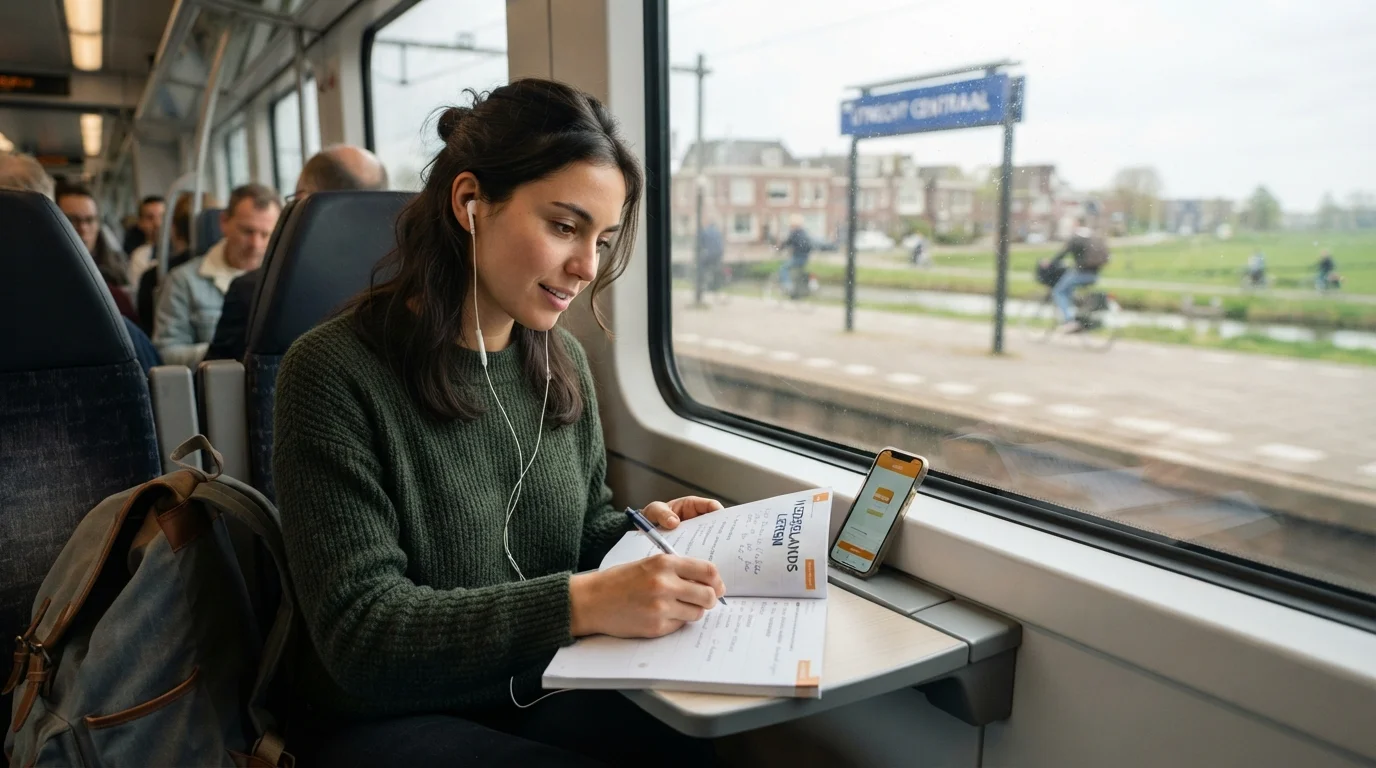
Learn Dutch on the Go: The Ultimate Guide for Commuters
Turn Your Travel Time into Fluency: How to Dutch for Commuters Commuting in the Netherlands is a unique, sensory experience. Whether you are riding...
Read more
Picture this: You are standing in a cozy bakery in Amsterdam, ready to order a delicious Dutch treat. You want to ask for a tasty bread. In your head, you translate: tasty is lekker, and bread is brood. But as you prepare to speak, a sudden wave of doubt hits you. Do you say "een lekkere brood" or "een lekker brood"? Why does the letter "e" randomly attach itself to the end of some Dutch adjectives, while leaving others completely bare?
If you have ever felt confused by these shifting endings, you are far from alone. The rules governing Dutch adjective endings (buiging van het bijvoeglijk naamwoord) are among the most notorious stumbling blocks for expats, language learners, and those preparing for their civic integration exams (Inburgeringsexamen). If you’ve ever wondered about the nuances of everyday Dutch vocabulary, you might already know what lekker means and how versatile it is, but applying it grammatically to nouns requires mastering a specific set of linguistic rules.
In this comprehensive guide, we will demystify the Dutch adjective ending rules once and for all. We will break down the golden formula, explore the crucial role of noun genders, highlight the rare exceptions where adjectives never change, and provide practical tips to help you develop a natural intuition for the language.
Before we look at when to add the "-e" ending, we must first make a vital grammatical distinction: where does the adjective stand in relation to the noun it describes? In Dutch, adjectives can be either predicative or attributive. This position determines whether you even need to consider adding an ending.
A predicative adjective stands apart from the noun it describes, usually connected by a linking verb (such as zijn - to be, worden - to become, blijven - to stay, or lijken - to seem).
The rule here is beautifully simple: predicative adjectives never get an "-e" ending. They always remain in their base (dictionary) form, regardless of whether the noun is singular, plural, masculine, feminine, or neuter.
An attributive adjective stands directly before the noun it describes. This is where the magic (and the confusion) happens. These adjectives modify the noun directly, and they usually receive an "-e" ending.
Notice how groot became grote, klein became kleine, and duur became dure. (Note: spelling shifts like dropping a double vowel are simply to keep the vowel sound long in open syllables, which is a standard Dutch spelling rule!). But wait—why did we say "een lekker brood" earlier without an "-e"? Let’s look at the deciding factor.
To know whether to add an "-e" to an attributive adjective, you must first know the gender of the noun. Dutch nouns are divided into two categories:
Understanding noun genders and articles is also crucial when forming complex sentences. For instance, when demystifying Dutch relative clauses using die, dat, and wat, you will notice that the choice of relative pronoun depends entirely on whether you are referring to a de-noun or a het-noun. The same grammatical awareness dictates your adjective endings.
If you are describing a plural noun, the distinction disappears because all plural nouns use the article "de" (e.g., de boeken, de huizen). Therefore, plural attributive adjectives always get an "-e" ending (e.g., mooie huizen, snelle auto's).
Many language learners try to memorize when to add the "-e". However, it is much easier to memorize the opposite: there is only one specific scenario where you do NOT add an "-e" to an attributive adjective.
We call this the Triple-Condition Rule. You skip the "-e" ending if and only if the noun meets all three of the following conditions simultaneously:
What makes a noun "indefinite"? A noun is indefinite when it is preceded by:
Let's look at this rule in action with the neuter noun het huis (the house):
Now contrast this with the common noun de auto (the car):
Because auto is a de-noun, it fails condition #1 of our Triple-Condition Rule. Therefore, it must always take the "-e" ending, regardless of whether it is definite or indefinite.
Just when you think you have mastered the formula, Dutch grammar reveals its quirky side. There are several categories of adjectives that never take an "-e" ending, regardless of the noun's gender, quantity, or definiteness.
Adjectives that describe what something is made of usually end in -en. These material adjectives are completely rigid and never receive an extra "-e".
Modern materials borrowed from English (like plastic, rubber, or nylon) also remain unchanged: een plastic tas (a plastic bag).
When a verb's past participle ends in -en and is used as an adjective, it behaves just like a material adjective and does not take an "-e".
Many modern loanwords or adjectives ending in a long vowel (like prima, roze, beige, oranje, lila, or gratis) do not change because adding an "-e" would disrupt their pronunciation or spelling conventions.
Words indicating relative position or direction that end in -er (such as linker - left, and rechter - right) never take an "-e".
As you navigate these complex rules, keep an eye out for common Dutch false friends that English speakers often trip over, which can complicate your vocabulary acquisition and lead to amusing misunderstandings.
While understanding the underlying grammar is essential for passing exams, you cannot run through a three-step logical checklist in your head during a fast-paced conversation. To speak Dutch fluently, you need to transition from conscious rule-following to subconscious intuition. Here is how you can train your brain to get it right automatically:
You cannot apply the adjective ending rules correctly if you do not know whether a noun is de or het. Never memorize a noun in isolation. Do not just learn that "house" is huis; learn it as het huis. Do not just learn "street" as straat; learn it as de straat.
Dutch has a distinct rhythmic cadence. To a native speaker, "een mooie boek" sounds physically jarring, much like saying "an book" sounds wrong to an English speaker. By exposing yourself to spoken Dutch daily through podcasts, TV shows, and conversational practice, your ears will naturally begin to flag incorrect adjective endings.
This is where leveraging modern technology can accelerate your progress. With the StroopTaal app, you can access interactive dialogue games designed specifically for practical, real-life scenarios. StroopTaal's AI-powered personalized learning plans adapt to your specific weak points, offering targeted pronunciation training with instant feedback and dedicated article mastery games to build your muscle memory for de and het words.
Here is a comforting truth: even if you make a mistake and say "een grote huis" instead of "een groot huis", every Dutch person will still understand you perfectly. Making minor grammatical slip-ups is a natural part of the learning journey. The key is to keep speaking, keep practicing, and let your confidence grow alongside your grammatical accuracy.
To help you visual the rules at a glance, use this simple matrix when writing or practicing your Dutch grammar:
| Noun Type | Definite / Specific (De/Het/Dit/Mijn) | Indefinite / General (Een/Geen/Bare) |
|---|---|---|
| De-noun (Singular) | +e (de grote man) | +e (een grote man) |
| Het-noun (Singular) | +e (het grote huis) | No ending (een groot huis) |
| Plural (All nouns) | +e (de grote huizen) | +e (grote huizen) |
For official spelling guidelines and complex edge cases, you can always consult the authoritative Taaladvies service by the Taalunie, which governs standard Dutch language rules.
Mastering Dutch adjective endings does not have to be a source of constant anxiety. By focusing on the Triple-Condition Rule—knowing that you only drop the "-e" for singular, indefinite het-nouns—you instantly eliminate 90% of your doubts. Combine this logical framework with consistent spoken practice, and you will soon find yourself ordering "een lekker brood" or complimenting someone's "mooie auto" without a second thought.
Ready to turn these rules into second nature? Download the StroopTaal app today to practice real-life Dutch conversations with AI, master your de/het articles through gamified daily streaks, and take your Dutch language skills to the next level!
Share this article:
Turn Your Travel Time into Fluency: How to Dutch for Commuters Commuting in the Netherlands is a unique, sensory experience. Whether you are riding...
Read moreHave you ever heard a Dutch speaker say "Moge de beste winnen" or "Koste wat kost" and wondered why the verbs look slightly out of place? If you...
Read moreUnlock Fluent Dutch: Why Transition Words Are Your B1 Secret Weapon Moving from an elementary A2 level to an intermediate B1 level in Dutch is an...
Read more