How to Extend Your Dutch Civic Integration Deadline: Step-by-Step
Relocating to the Netherlands brings a wave of exciting changes: cycling through historic streets, discovering local traditions, and mastering the...
Read more
This article was written by AI and published by StroopTaal.
AI can get things wrong. For anything official, check the source it points to.
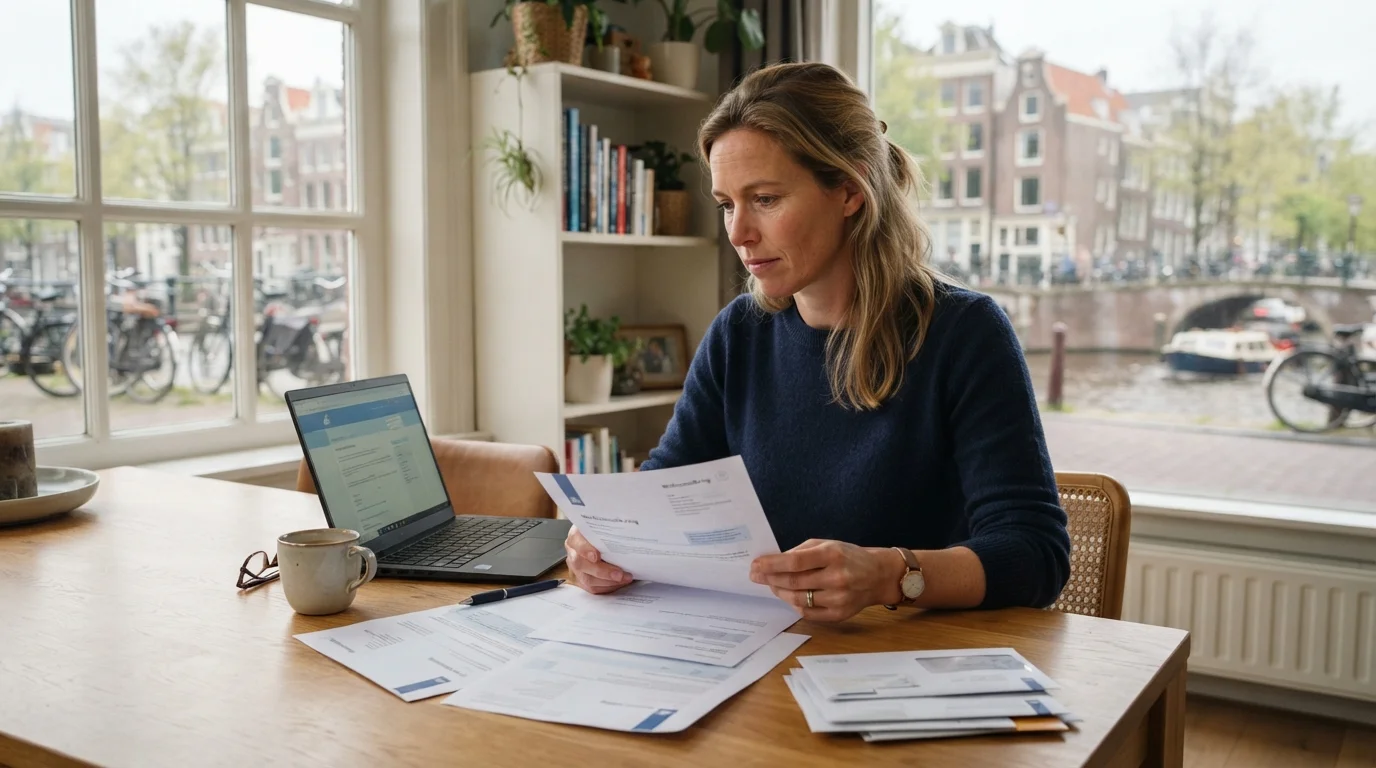
AI-generated image
A werklozenuitkering (commonly referred to as a WW-uitkering or simply WW) is the official Dutch unemployment benefit. Administered by the government agency UWV (Uitvoeringsinstituut Werknemersverzekeringen), this social security benefit provides temporary financial compensation to workers in the Netherlands who lose their jobs through no fault of their own. To qualify for a basic werklozenuitkering, you must meet the primary requirement known as the wekeneis: you must have worked at least 26 weeks out of the 36 weeks immediately preceding the first day of your unemployment. During the first two months, the benefit equals 75% of your daily wage (dagloon), after which it drops to 70% for the remainder of your benefit period.
Navigating employment changes in a foreign country can feel overwhelming, especially when official communications from Dutch authorities are written entirely in formal Dutch (bestuurstaal). Whether you are an expat working in Amsterdam, a international worker in Eindhoven, or preparing for your integration process, understanding how the werklozenuitkering works is essential for protecting your financial security and staying compliant with Dutch labor laws.
In this definitive guide, we break down everything you need to know about the Dutch unemployment benefit: eligibility criteria, payment calculations, step-by-step application procedures with the UWV, important expat rules, and essential Dutch terminology.
The term werklozenuitkering literally translates to 'unemployment allowance' or 'unemployment benefit'. In everyday Dutch speech and official documentation, it is almost universally called a WW-uitkering, where WW stands for Werkloosheidswet (Unemployment Insurance Act).
The WW is an employee insurance scheme funded by contributions deducted from payroll taxes. This distinguishes it from general social assistance (bijstandskering or participatiewet), which is welfare paid by local municipalities (gemeenten) for residents without income who do not qualify for employee insurance. If you want a broader overview of how this system applies specifically to foreign nationals, check out our guide on navigating the Dutch unemployment benefit system for expats.
Key traits of the werklozenuitkering include:
To receive a werklozenuitkering, you must satisfy several legal requirements established by the UWV and Dutch employment law. Missing even one requirement can lead to a rejection or temporary sanctions.
You must have worked as an employee for at least 26 weeks within the 36 weeks right before you became unemployed. A week counts as 'worked' if you worked at least one hour during that calendar week. Weeks spent on paid leave or paid sick leave generally count toward this total.
You must lose at least 5 working hours per week (or at least half of your weekly working hours if you worked fewer than 10 hours per week average), along with the corresponding salary. You must also remain available to accept new employment for those lost hours.
You cannot receive a werklozenuitkering if you resigned voluntarily without a legally compelling reason, or if you were dismissed for gross misconduct (ontslag op staande voet, such as theft or fraud). Qualifying scenarios include:
You must live in the Netherlands and be legally permitted to work. Furthermore, you must be available to accept job offers immediately. If you embark on an unapproved extended vacation outside the country, your benefit payments may be paused or cancelled.
The amount of money you receive from your WW benefit is based on your dagloon (daily wage). The UWV calculates your daily wage by looking at the income on which you paid social security taxes during the 12-month period before you became unemployed.
The percentage of your daily wage you receive follows a fixed schedule:
Note that the maximum daily wage considered for this calculation is capped by the Dutch government (the maximum dagloon, which is updated twice a year). If your previous monthly salary exceeded this statutory cap, your payout will be capped at 75% (and then 70%) of that maximum limit rather than your full former salary.
The duration of your werklozenuitkering depends on your overall working history:
Applying for your benefit requires interacting with official Dutch digital portals. Following these steps ensures your application proceeds smoothly without delays.
You need an active DigiD (Digital Identity) with SMS verification or the DigiD app to log into Dutch government services. Make sure your DigiD details are up to date well before your last working day.
Visit werk.nl (the job portal of the UWV). You must register as a job seeker (werkzoekende) no later than one week after your last day of employment, though you can register up to 4 weeks before your contract ends.
On werk.nl or uwv.nl, complete the online application form for the WW-uitkering. You will need details regarding your last employer, start and end dates of employment, final salary slips, and bank details (IBAN) for benefit payments.
At the end of every calendar month, you must log into Mijn UWV to fill out the Inkomstenopgave. You must submit this form even if you had zero extra income during that month. The UWV will only pay out your monthly benefit after receiving this completed declaration.
Receiving a werklozenuitkering is not passive income; it comes with strict legal duties managed by the UWV:
1. Active Application Obligation (Sollicitatieplicht): You must perform and log a minimum number of job application activities (typically at least 4 per 4-week period). Activities include sending CVs, attending job interviews, or registering with employment agencies (uitzendbureaus).
2. Reporting Duty (Informatieplicht): You must notify the UWV within one week of any changes in your situation, such as moving address, starting a part-time job, entering freelance work, or falling ill.
3. Accepting Suitable Work (Passende arbeid): During the first 6 months of unemployment, you are expected to look for work matching your educational level and previous salary. After 6 months, any available job is considered 'suitable work' (passende arbeid), and you may be required to accept positions below your qualification level or previous income.
4. Vacation Rules (Vakantiedagen): You are allowed to take vacation days while receiving WW (up to 20 days per calendar year), but you must report these dates in advance via Mijn UWV so that job search duties are paused for those specific days.
Dealing with administrative bureaucracy in a second language requires specific terminology. Being comfortable reading terms on government portals like werk.nl or official letters (brieven van het UWV) is essential. If you are preparing for official exams or working on your language skills, review our guides on strategies for mastering Dutch reading comprehension and structuring clear oral responses in official Dutch settings.
Here is a list of essential Dutch words related to the werklozenuitkering:
When filling out government forms or communicating with an assigned UWV coach (werkcoach), clear comprehension prevents costly mistakes. App-based tools like StroopTaal can help you build practical Dutch vocabulary and practice real-life communication scenarios. Through AI-guided dialogue practice and context-focused grammar lessons, StroopTaal helps expats and learners speak and read formal Dutch with confidence.
If you are an expat living in the Netherlands on a residence permit, receiving a werklozenuitkering requires extra attention to your immigration status:
If you hold a Highly Skilled Migrant residence permit, losing your job triggers a three-month search period (zoekperiode). During these 3 months, you are allowed to look for a new sponsor. You have the legal right to apply for a werklozenuitkering if you meet the wekeneis. However, claiming public funds does not automatically invalidate your permit, provided you find a new qualifying employer before your 3-month search period expires. For official details regarding residence rights after job loss, consult the Immigration and Naturalisation Service (IND).
Citizens of EU/EEA countries share the same rights as Dutch nationals regarding social security. Under EU regulations, you can sometimes transfer periods of insurance completed in another EU member state (using Form U1) to fulfill the 26-week requirement in the Netherlands, provided you were employed in the Netherlands when you became unemployed.
If you face redundancy or contract expiration, follow this quick checklist to ensure your rights are protected:
Understanding the werklozenuitkering allows you to navigate career transitions in the Netherlands with clarity and peace of mind. By knowing the rules surrounding the wekeneis, daily wage calculations, and reporting obligations with the UWV, you can ensure that you receive the financial safety net you are entitled to while actively searching for your next position.
Building your Dutch language skills is one of the most effective ways to accelerate your job search and feel completely at home in Dutch professional environments. With StroopTaal, you can master real-world Dutch dialogues, understand official government terminology, and build conversational fluency using personalized AI feedback. Start expanding your career opportunities in the Netherlands today with StroopTaal!
Share this article:
Relocating to the Netherlands brings a wave of exciting changes: cycling through historic streets, discovering local traditions, and mastering the...
Read moreMaster the Inburgering Speaking Exam 2026: How to Structure Your Oral Answers Are you preparing to take the Dutch integration exam...
Read moreIntroduction: The Shift to B1 and Why It Matters If you are an expat, highly skilled migrant, or long-term resident in the Netherlands, you have...
Read more