
Comparing Dutch Vocabulary Apps: StroopTaal vs Drops vs Memrise (2026)
Expanding your Dutch vocabulary is often the single biggest hurdle between surviving on English in the Randstad and feeling genuinely at home in the...
Read more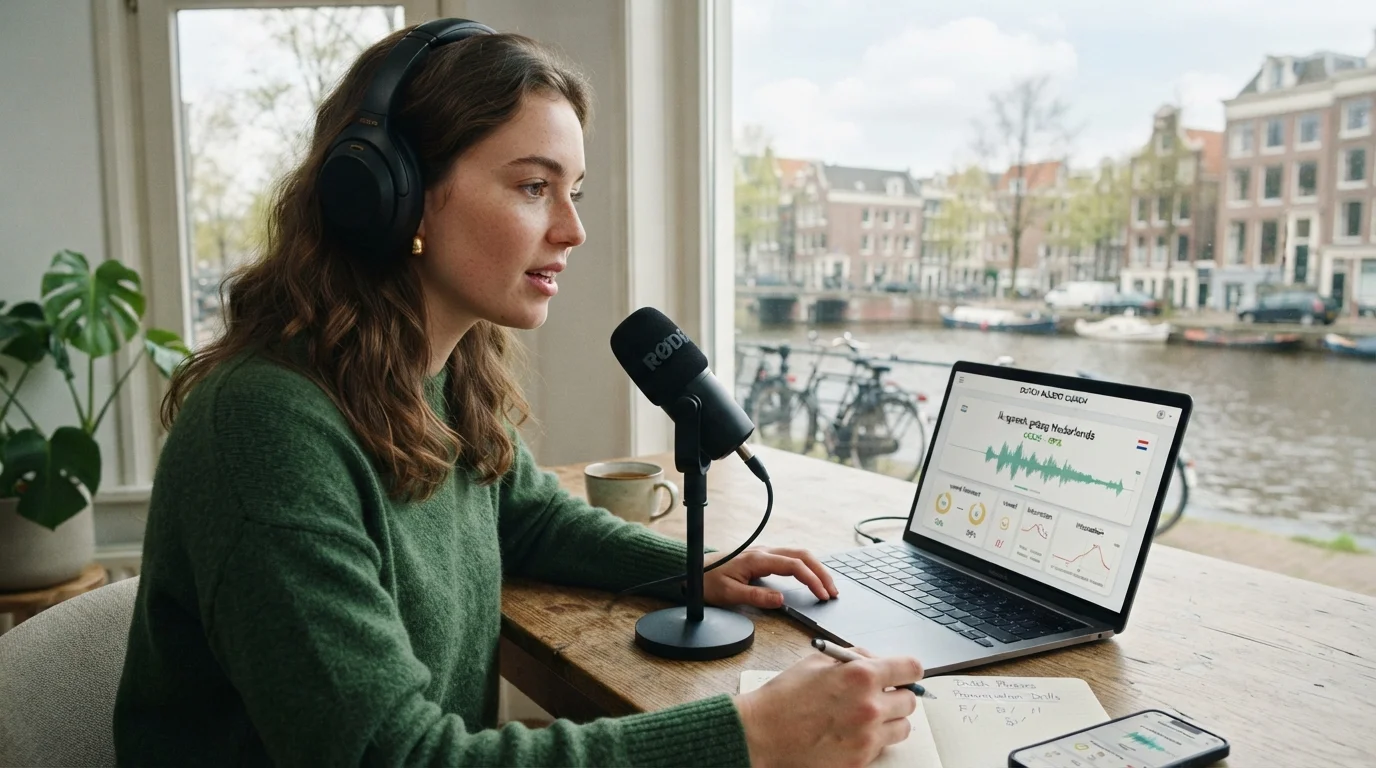
Few moments in language learning feel more deflating than ordering a coffee in Amsterdam or Utrecht, only to have the barista respond instantly in English. For thousands of expats and international residents in the Netherlands, this scenario is all too familiar. You memorize vocabulary, study conjugation tables, and even grasp word order rules, but the moment you open your mouth, your accent signals that you are not a native speaker.
Dutch pronunciation presents a formidable obstacle. Between the throat-clearing harde g, subtle diphthongs like ui and eu, and unforgiving vowel length distinctions, mastering Dutch spoken phonetics takes focused effort. Historically, fine-tuning your accent required either expensive private tutoring or native friends with endless patience. Today, artificial intelligence has fundamentally shifted this dynamic. Modern language learning apps use sophisticated speech recognition and acoustic modeling to provide real-time, phoneme-by-phoneme feedback on spoken Dutch.
In this article, we examine how AI pronunciation analysis works, why Dutch sounds present such a unique hurdle for learners, and how incorporating intelligent acoustic feedback into your daily study routine can accelerate your speaking clarity and confidence.
Dutch is widely considered one of the closest relatives to English, sharing substantial Germanic vocabulary and sentence structures. Yet, many learners discover that speaking clear, natural Dutch feels dramatically harder than reading it. This disconnect stems directly from Dutch phonology.
In Dutch, vowel length and tongue placement change the meaning of words entirely. A minor error in vowel length transforms man (man) into maan (moon), or bom (bomb) into boom (tree). Romance and English speakers frequently struggle with:
To explore the linguistic mechanics of these sounds in depth, the comprehensive overview of Dutch phonology details standard phonetic transcriptions and articulation points.
No discussion of Dutch phonetics is complete without mentioning the velar and uvular fricatives represented by g and ch. Depending on whether you reside north or south of the rivers, this sound ranges from a sharp scrape at the back of the palate to a softer, palatal friction (the zachte g). Combine this with dense consonant clusters—such as in herfst (autumn) or angstschreeuw (scream of fear)—and non-native tongues quickly run into physical tension.
A major reason adult learners struggle with accents is that our brains filter out phonetic contrasts not present in our native languages. If your ears cannot distinctly perceive the gap between the short u in bus and the long uu in buur, your vocal cords cannot reliably produce it. This makes independent self-correction nearly impossible without external, objective feedback.
Traditional language apps relied on rudimentary voice recognition: you spoke into the microphone, and the app produced a simple binary result—either green for "correct" or red for "try again". These systems evaluated whether the speech recognition engine could identify the overarching word, not whether your pronunciation was phonetically accurate.
Modern AI-driven language tools have transformed this process through specialized acoustic modeling and natural language processing tailored specifically for pronunciation analysis.
State-of-the-art speech engines break down audio inputs into individual phonetic units (phonemes). When you pronounce the word ziekenhuis (hospital), the AI does not simply listen for the complete word. Instead, it segments your audio waveform into [z], [iː], [k], [ə], [n], [h], [œy], and [s]. By mapping your recording against acoustic models trained on native Dutch speech from the Netherlands, the model pinpoint exactly which syllable or sound drifted off target.
Vowels are characterized by specific acoustic resonances called formants (F1 and F2 frequencies), determined by the shape of your oral cavity, tongue height, and lip rounding. Modern AI tools evaluate these formant frequencies in real time. If your tongue is positioned too low when trying to pronounce the eu in leuk, the AI detects the acoustic mismatch and alerts you to adjust your mouth position.
For learners trying to understand Dutch in real situations, training the ear and vocal tract together bridges the gap between passive listening and active comprehension.
Why is AI feedback proving so effective for Dutch learners? The psychological and pedagogical benefits extend far beyond convenience.
Speaking anxiety—often referred to as xenoglossophobia—is a primary reason expats freeze up in shops or offices. When a Dutch speaker switches to English, it often feels like an implicit critique of your Dutch. Practicing with an objective digital engine creates a zero-judgment environment. You can repeat a difficult phrase like Scheveningen or vijfentwintig fifty times without feeling self-conscious or inconveniencing anyone.
In linguistic acquisition, "fossilization" occurs when a learner repeats an incorrect phonetic pattern so often that it becomes ingrained as muscle memory. If you mispronounce gracht for six months unchecked, unlearning that motor pattern takes deliberate, arduous work. Real-time feedback alerts you to errors instantly, preventing bad habits before they take root.
For immigrants preparing for the civic integration examinations, speaking clearly is an explicit requirement. The Dutch government outlines language proficiency benchmarks under the Dutch integration requirements. Whether sitting for the Inburgeringsexamen (A2 or B1) or the Staatsexamen NT2, candidates must produce intelligible spoken Dutch under timed test conditions. Practicing speaking aloud with objective evaluation is essential preparation; our guide on the Inburgering speaking exam: how it works and how to practise covers these testing requirements in detail.
When selecting a study tool, having structured pronunciation support integrated directly alongside daily grammar and vocabulary makes a noticeable difference. This is where using StroopTaal's pronunciation feedback fits seamlessly into a study regimen.
StroopTaal is an independent mobile app designed to teach the Dutch of daily life, work, and exams in the Netherlands, taking learners from complete beginner (A0) all the way to C1. Within its core curriculum, StroopTaal combines structured lessons with listening, dictation, and speaking exercises where you immediately see why an answer is right or wrong.
With StroopTaal Premium, pronunciation training becomes hands-on:
Because StroopTaal operates on iOS and Android devices with an active internet connection, learners can train their accent in short, five- to thirty-minute daily sessions whenever convenient.
To get the most out of automated pronunciation tools, adopt a deliberate, method-driven approach rather than casually tapping through exercises.
Many learners obsess over mastering the guttural g, assuming it is the cornerstone of a Dutch accent. In reality, native Dutch speakers can easily understand a soft or foreign g. However, confusing vowels—such as saying bed instead of bad, or huur instead of hoer—causes genuine communicative breakdowns. Focus your AI practice on mastering minimal pairs involving vowel length and diphthongs first.
Shadowing is an established language-learning technique where you listen to a native audio sample and repeat it out loud with minimal delay, mimicking rhythm, pitch, and mouth movements. When using an app with audio playback:
A good accent involves more than pronouncing isolated words correctly; it requires adopting natural Dutch prosody (sentence cadence). Dutch has a distinct, stress-timed cadence with significant reduction of unstressed syllables to a neutral schwa [ə]. For instance, the phrase we gaan naar het station often sounds more like we gaan naar 't stasjon in everyday speech. Use speech scoring tools to see if your cadence matches natural sentence flow.
When tackling multi-syllable compound nouns like belastingaangifte (tax return) or gezondheidszorg (healthcare), do not attempt full-speed production immediately. Deconstruct the compound into its individual root words:
Practice each morpheme with the speech analyzer until scored cleanly, then link them together smoothly.
Pronunciation is physical training. The muscles in your tongue, lips, and soft palate require consistent conditioning to adopt motor patterns that do not exist in your native tongue. Ten minutes of focused daily speaking practice with real-time feedback yields far better accent retention than an intensive two-hour study session once a week.
Acquiring a clean, intelligible accent in Dutch is not a talent reserved for natural mimics; it is a physical and acoustic skill that develops with targeted practice. Modern speech recognition technology removes the guesswork from pronunciation by showing you exactly where your sounds deviate from native Dutch standards.
By pairing AI pronunciation feedback with consistent daily practice, you can transform hesitant, self-conscious speech into clear, confident Dutch. The next time you step up to order at your local bakery or converse with Dutch colleagues, your clear vowels and steady cadence will ensure the conversation stays in Dutch.
Rules, fees and dates change. Check the current version on the official pages before you act.
Share this article:
Expanding your Dutch vocabulary is often the single biggest hurdle between surviving on English in the Randstad and feeling genuinely at home in the...
Read moreIf you commute to work or school in the Netherlands, you are already familiar with the rhythm of Dutch public transport: stepping onto a...
Read moreFor years, mobile language apps carried a persistent reputation: great for learning how to order a coffee or memorizing zoo animals, but hopelessly...
Read more