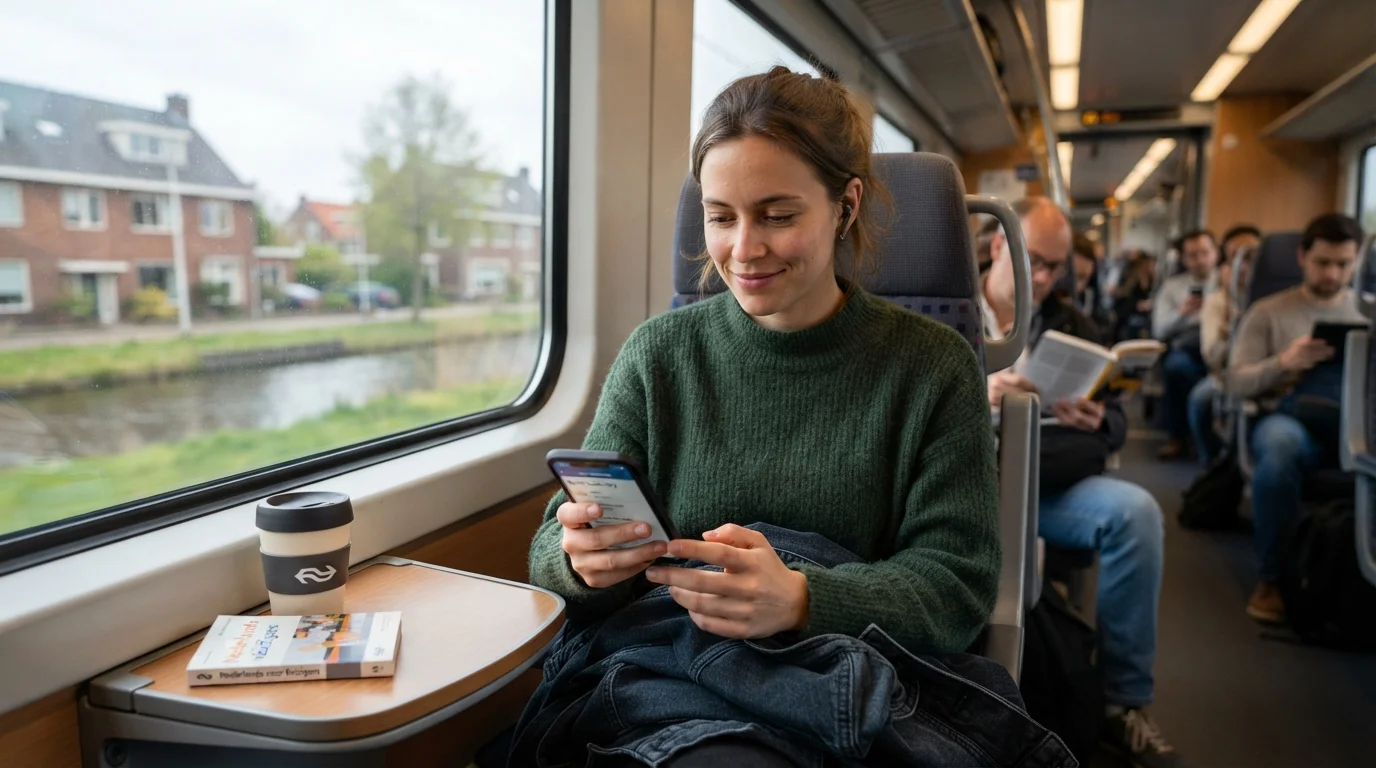
Best Offline Dutch Apps for Vocabulary on Your Commute (2026)
If you commute to work or school in the Netherlands, you are already familiar with the rhythm of Dutch public transport: stepping onto a...
Read more
For years, mobile language apps carried a persistent reputation: great for learning how to order a coffee or memorizing zoo animals, but hopelessly inadequate for holding a nuanced conversation. If your goal was to clear the B1 threshold—whether for the civic integration exam (inburgeringsexamen), the Staatsexamen NT2, or professional independence—the conventional wisdom was clear: ditch your phone and enroll in a traditional classroom.
As we navigate language learning in 2026, technology has fundamentally shifted. Mobile applications are no longer limited to simplistic multiple-choice matching games. Modern tools incorporate adaptive spaced repetition, intelligent audio dictation, dynamic syntax correction, and simulated voice conversations. But does that mean you can rely on a smartphone app to take you all the way to CEFR B1 in Dutch?
The short answer is nuanced: mobile apps can serve as the core engine of your B1 study routine, provided you understand the specific demands of the B1 level and pair your screen time with deliberate output. Here is a realistic, practical breakdown of what apps can accomplish, where their limitations lie, and how to structure your learning strategy effectively.
To evaluate whether an app can get you to B1, you must first understand the qualitative leap between A2 and B1. Under the Common European Framework of Reference for Languages (CEFR), level A2 designates a 'Basic User,' whereas B1 represents an 'Independent User.'
At A2, you can navigate routine, transactional interactions: asking for directions, shopping, handling straightforward appointments, and understanding simple notices. Grammar expectations are relatively basic, and conversational partners are expected to speak slowly and accommodate your gaps.
At B1, the expectations rise significantly:
Reaching B1 Dutch means moving beyond rote phrases. You must master inverted sentence structures, subordinate clauses with verb-final word order (omdat, hoewel, zodat), modal auxiliaries in complex tenses, and a working vocabulary of roughly 3,000 to 4,000 active words.
Can a smartphone application build these competencies? In several key areas, well-designed mobile tools actually outperform traditional weekly evening classes.
Vocabulary acquisition requires continuous, spaced exposure. Sitting in a physical classroom once a week rarely provides the repetition needed to lock thousands of Dutch lemmas into long-term memory. Mobile apps utilizing spaced repetition systems (SRS) deliver words precisely when memory decay begins.
Applying disciplined spaced repetition strategies allows expats and busy professionals to build a formidable vocabulary base during commutes or brief breaks. Furthermore, apps excel at categorizing tricky lexical features, such as drilling de versus het nouns until gender recognition becomes instinctive.
Dutch syntax is notoriously challenging for English and Romance-language speakers. Main clauses place the conjugated verb in the second position (V2), questions and adverb-first sentences require inversion, and subordinate clauses send all verbs to the end of the phrase. Interactive apps that require you to arrange sentence fragments, type full clauses, and identify syntactic errors provide the immediate, iterative feedback necessary to internalize these rules.
The primary reason adult learners plateau at A2 is not cognitive difficulty; it is inconsistency. A two-hour Sunday study session does not compensate for six days of complete disengagement. Research into adult language acquisition highlights that daily micro-learning habits create far stronger neural pathways than sporadic cramming. By offering structured daily goals—such as 15 to 30 minutes of targeted drills—apps turn Dutch practice into an automatic daily ritual.
One of the largest hurdles for expats in the Netherlands is conversational paralysis: the fear of making mistakes in public, compounded by the Dutch tendency to immediately switch to English the moment you hesitate. Modern software bridges this gap. With interactive pronunciation scoring and conversational software agents, you can speak Dutch out loud in complete privacy, honing your intonation, cadence, and muscle memory before engaging in high-stakes public conversations.
While mobile apps provide extraordinary leverage, it is critical to maintain realistic expectations. Relying solely on passive tap-and-swipe mechanics will leave you stranded well below the B1 threshold. Here is where apps encounter natural boundaries:
Many popular apps train learners to recognize the correct answer among four multiple-choice options. Recognition is an A1/A2 skill; spontaneous generation is a B1 requirement. In an actual meeting or municipal desk visit, nobody hands you four possible sentences to choose from. If an app does not force you to construct entire sentences from memory, your productive fluency will lag far behind your receptive understanding.
Studio-recorded audio exercises are clean, paced, and spoken in standard Dutch (Algemeen Beschaafd Nederlands). Real life in the Netherlands involves regional accents, rapid contractions, background ambient noise at the train station, and interrupted dialogue. Apps provide the structural blueprint, but your ears must eventually adapt to the messiness of spontaneous speech.
B1 assessment tasks frequently require continuous speaking for 1.5 to 2 minutes on a given prompt, or writing a cohesive three-paragraph email explaining a problem and proposing solutions. Apps that focus solely on isolated sentences cannot fully prepare you for narrative flow and topical cohesion without supplementary writing and monologue practice.
To make an app the foundation of your B1 journey, select a platform that prioritizes active output over passive entertainment. For example, the Dutch learning app StroopTaal is specifically built around the Dutch used in daily life, work, and integration exams across the Netherlands, covering the CEFR spectrum from A0 up to C1. Rather than isolated trivia, its curriculum guides learners through structured lesson paths with exercises in typing, dictation, word ordering, error spotting, and pronunciation feedback.
For independent learners, adopting AI-powered language tools can close the gap between mechanical drills and real-world conversation. StroopTaal addresses this intermediate plateau through features like Taalmaatje, an AI conversation partner that lets learners conduct spoken voice calls on real-world topics (such as visiting a Dutch clinic or preparing for an interview) and review the transcripts afterward. For productive writing, the app's Sentence Check tool analyzes text submitted by the user and provides immediate grammatical explanations, allowing self-directed learners to compose full sentences and understand their mistakes in depth.
If your goal is formal qualification, you are likely preparing for either the revised Civic Integration Exam (Inburgeringsexamen) or the Staatsexamen NT2 Programma I (aimed at vocational education and workplace qualification at the B1 level). According to official guidelines on integration in the Netherlands, candidates must demonstrate competency across Reading, Listening, Writing, and Speaking, alongside Knowledge of Dutch Society (KNM).
Can an app prepare you for these exams? Yes, provided the app offers dedicated, component-specific testing environments. For instance, StroopTaal provides focused exam preparation modules for both the A2/B1 inburgering exams and the Staatsexamen NT2 B1 (Programma I) and B2 (Programma II). Learners can practice reading, listening, writing, speaking, and KNM sections independently with timed conditions, receiving automated AI grading on their writing and speaking along with a readiness score for each individual skill.
However, keep in mind that app-based exam preparation functions as targeted component practice, not an officially accredited mock examination. Use apps to master test mechanics, refine your time management, and identify weak skills, while complementing your studies with official specimen papers from DUO.
If you want to reach B1 Dutch efficiently while anchoring your study around a smartphone, follow this structured four-part framework:
Whenever an exercise presents an opportunity to type rather than tap a word bank, choose typing. When an app provides audio, use dictation or shadow the speaker out loud before pressing submit. Treat every prompt as an active vocal and syntactic workout rather than a passive quiz.
Establish a non-negotiable daily micro-routine. Spend 10 minutes working through your structured lesson path, 5 minutes clearing your spaced repetition review queue, and 5 minutes practicing spoken production or dictation. Consistent engagement across seven days yields significantly better retention than an intense weekend cramming session.
An app should serve as your launching pad into authentic content. Once your app curriculum brings you past A2, begin consuming native Dutch material scaled to intermediate learners: listen to Dutch podcasts with synchronized transcripts, watch NOS Jeugdjournaal with Dutch subtitles enabled, and read regional news portals. When you encounter unfamiliar words in the wild, look them up and add them directly into your digital review flashcards.
Do not wait until you feel "ready" to use Dutch in your daily environment; B1 is achieved through practice, not before it. Use the Dutch you drill in your app at the market, reply to your Dutch colleagues in simple written sentences on Slack, send brief voice notes to Dutch-speaking acquaintances, and change the administrative language of your utilities and banking apps to Dutch.
Can mobile apps help you reach B1 Dutch? Absolutely. In 2026, mobile tools are powerful enough to build comprehensive grammar foundations, expand your active vocabulary into the thousands, fine-tune pronunciation, and provide structured exam practice on demand.
However, apps are instruments of learning, not magic wands. They cannot speak to your neighbors for you, nor can they magically grant fluency without active effort on your part. When you treat your language app not as a casual game, but as a portable training laboratory—pairing rigorous digital exercises with consistent real-world output—reaching CEFR B1 in the Netherlands is an achievable and realistic objective.
Rules, fees and dates change. Check the current version on the official pages before you act.
Share this article:
If you commute to work or school in the Netherlands, you are already familiar with the rhythm of Dutch public transport: stepping onto a...
Read moreRelocating to the Netherlands brings a distinct set of linguistic challenges. From deciphering official blue letters from the tax office to...
Read moreWhen you relocate to the Netherlands or prepare for the inburgering integration exams, Dutch vocabulary can quickly feel like an insurmountable...
Read more