Dutch School System Explained: Basisschool vs Middelbare School

This article was drafted by AI and edited by a person before it was published.

AI can get things wrong. For anything official, check the source it points to.

How StroopTaal uses AI

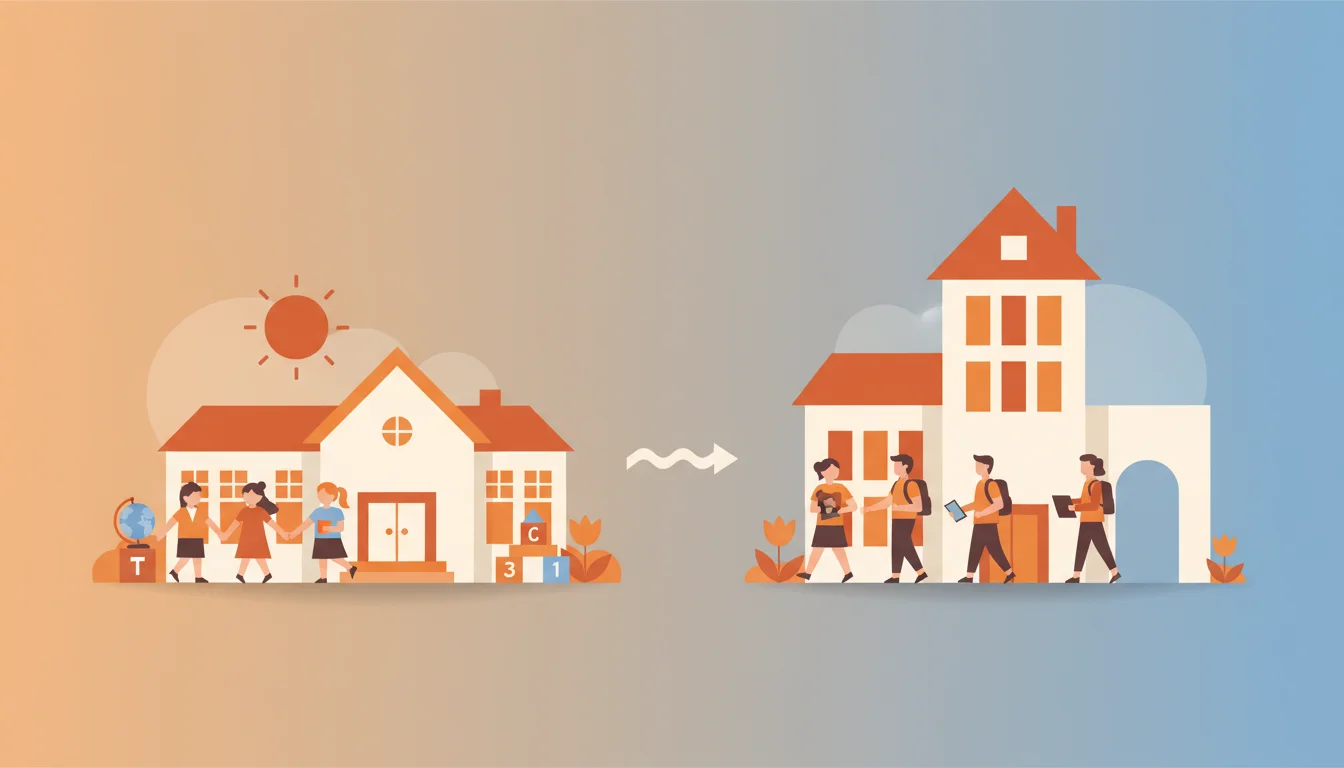
AI-generated image

Dutch School System Explained: Basisschool vs Middelbare School

Navigating the Dutch School System: Your Complete Guide

Moving to the Netherlands with your family is an exciting adventure, but it comes with a long to-do list. Right at the top, alongside finding a house and mastering the art of cycling in the rain, is understanding the Dutch school system. You’ve probably heard terms like basisschool, middelbare school, VMBO, and the infamous Cito-toets. It can feel like a complex puzzle, but don't worry. This guide will break down the entire system, from the first day of kindergarten to secondary school graduation, giving you the confidence to make the best choices for your children.

Understanding the educational journey your child will take is crucial for a smooth transition. It’s not just about academics; it’s about social integration, language acquisition, and setting them up for future success in the Netherlands. Let’s dive into the world of Dutch education.

Dutch School System Explained: An Overview of the Netherlands School System

The Dutch school system is a comprehensive, publicly funded educational framework that guides children from age 4 through primary school (basisschool) and age-streamed secondary school (middelbare school). Under Dutch law, education is compulsory from the age of five until sixteen, or until a student achieves a basic diploma (startkwalificatie). The Dutch system stands out globally because it streams pupils into distinct academic and vocational pathways relatively early, at age twelve, while maintaining government funding and rigorous standards across both public and faith-based institutions.

If you are exploring how higher education connects with this framework, understanding these secondary tracks is essential before looking ahead to universities; see our guide on HBO vs WO in the Netherlands: Dutch University System Guide for the next stage in higher education. Navigating a Dutch school setting also involves adapting to term dates and cultural rhythms, which we cover in our guide on how to prepare for the Dutch academic year.

The Foundation: Basisschool (Primary Education)

The journey through the Dutch school system begins at the basisschool, which translates to 'basic school' or primary/elementary school. Children in the Netherlands can start school from the day they turn four, and education is compulsory (leerplicht) from their fifth birthday until they are 18 or have obtained a basic qualification.

Structure and Groups (Groepen)

The basisschool is an eight-year journey, divided into 'groups' (groepen) rather than grades. This is a key piece of terminology to learn.

  • Groep 1 & 2 (Ages 4-6): This is the kindergarten phase, often called the kleuterklassen. The focus here is heavily on learning through play, social skills development, fine and gross motor skills, and an initial introduction to Dutch language and numbers. It’s a gentle and nurturing start to their educational life.
  • Groep 3-8 (Ages 6-12): From groep 3, the formal academic learning begins. The curriculum, known as kerndoelen (core objectives), is set by the government and includes:
    • Dutch language
    • Mathematics (rekenen)
    • English (usually starting in groep 7 or 8)
    • Social and Environmental Studies (wereldoriëntatie), covering history, geography, and nature.
    • Creative expression (art, music, drama)
    • Physical education (gym)

Dutch schools emphasize self-reliance and critical thinking from a young age. You'll find that children are encouraged to work independently and in groups, fostering a sense of responsibility and collaboration.

The Final Year: Groep 8 and the School Recommendation

Groep 8 is a pivotal year. It marks the end of primary education and determines the path for secondary school. This decision is based on two key factors:

  1. The School’s Recommendation (Schooladvies): Throughout their time at the basisschool, teachers track a student's progress, work ethic, and overall development. Based on this comprehensive view, the school provides a formal recommendation for the level of secondary education they believe is most suitable for the child. This recommendation is considered the most important factor.
  2. The Final Test (Doorstroomtoets): In February of groep 8, all students take a standardized aptitude test. While the most well-known version was the 'Cito-toets', it has now been replaced by a system of government-approved tests called doorstroomtoetsen. This test provides a second data point. If a student scores higher on the test than their initial schooladvies, the school must reconsider the recommendation (though they can choose to stick with the original advice if they can justify it). If the test score is lower, the original, higher recommendation stands.

This process can seem daunting, but it’s designed to place students in an environment where they can thrive, rather than struggle. For more detailed official information, you can always consult the Dutch government's website on compulsory education.

The Next Step: Middelbare School (Secondary Education)

After receiving their schooladvies, students enroll in a middelbare school (secondary school). Unlike in many countries where all students attend the same type of high school, the Netherlands has a tracked system from the beginning. The first year is often a 'bridge year' (brugklas) where students from different primary schools come together and adjust to the new environment. Sometimes, students with advice that straddles two levels (e.g., HAVO/VWO) will be in a combined brugklas to determine the best fit.

What is Middelbare School in English? Is Middelbare School High School?

In English, middelbare school translates directly as 'secondary school' or 'high school'. Yes, a middelbare school is the Dutch high school equivalent, welcoming students from roughly age 12 until age 16, 17, or 18 depending on their chosen track. When searching for 'high school in Dutch', middelbare school (or formally voortgezet onderwijs) is the precise term used across the Netherlands. Unlike single-track comprehensive high schools in the US or UK, a Dutch high school houses different educational streams under one roof or across dedicated campuses.

The Three Main Tracks

Secondary education is divided into three main streams, each preparing students for a different level of further education or the job market.

1. VMBO (Voorbereidend Middelbaar Beroepsonderwijs)

  • Duration: 4 years
  • Focus: Vocational preparatory education. It combines general education with vocational training in specific sectors like technology, care & welfare, economics, or agriculture.
  • Leads to: MBO (middelbaar beroepsonderwijs), which is secondary vocational education, preparing students for specific trades and professions.

2. HAVO (Hoger Algemeen Voortgezet Onderwijs)

  • Duration: 5 years
  • Focus: Higher general continued education. It’s a more theoretical track than VMBO and prepares students for higher professional education.
  • Leads to: HBO (hoger beroepsonderwijs), which are universities of applied sciences. These programs are practical and career-oriented.

3. VWO (Voorbereidend Wetenschappelijk Onderwijs)

  • Duration: 6 years
  • Focus: Pre-university education. This is the most academically rigorous track, designed to prepare students for theoretical research and study at a university level.
  • Sub-types: VWO has two sub-types: Atheneum and Gymnasium. The only difference is that Gymnasium includes Latin and Ancient Greek as compulsory subjects.
  • Leads to: WO (wetenschappelijk onderwijs), which are research universities (like Leiden University or Delft University of Technology).

It's important to note that the system has some flexibility. It is possible for students to move between tracks (e.g., from HAVO to VWO) if they perform well, a process known as opstromen.

Verschil Basisschool en Middelbare School: Key Differences

The primary verschil tussen basisschool en middelbare school (difference between primary school and secondary school) lies in classroom structure, student independence, and academic specialization. While basisschool keeps pupils with one primary teacher in one classroom across eight foundational groepen, middelbare school splits students into distinct academic streams (VMBO, HAVO, or VWO) where they switch classrooms and subject-specialist teachers every hour.

  • Age & Duration: Basisschool serves children aged 4 to 12 over 8 years, whereas middelbare school serves youth aged 12 to 16-18 over 4 to 6 years.
  • Curriculum & Grouping: Basisschool provides broad general knowledge to mixed-ability groups, while middelbare school groups pupils strictly according to academic ability and career orientation.
  • Autonomy & Homework: In basisschool, homework is minimal until groep 7 and 8. In middelbare school, independent study, digital planning portals (such as Magister or Somtoday), and cycling longer distances between towns become standard daily routines.

Key Differences and Cultural Nuances

The Dutch education system has some unique characteristics that might differ from what you're used to.

  • Parent Involvement: Parents are expected to be involved. You'll have regular 10-minutengesprekken (10-minute talks) with the teacher to discuss your child's progress. These meetings are direct and to the point, much like the typical Dutch 'overleg' meeting style you might encounter at work. Being able to communicate effectively in Dutch can make a huge difference in these conversations.
  • Independence: From a young age, children are encouraged to be independent. This is most famously seen in the hordes of children cycling to school on their own, rain or shine!
  • No Hot Lunches: Most schools do not provide hot meals. Children bring their own packed lunch from home, which traditionally consists of sandwiches (boterhammen) and a piece of fruit.
  • School Choice: The Netherlands has a system of school choice. While most children attend their local public school (openbaar), there are also 'special' schools (bijzonder) based on religious (e.g., Catholic, Protestant) or pedagogical (e.g., Montessori, Waldorf) principles. These are also government-funded and follow the national curriculum.

Practical Guide for Expat Parents

Navigating this system as a newcomer can be a challenge, but with the right approach, it’s entirely manageable.

Choosing a School

The first big decision is whether to choose a local Dutch school or an international school. International schools offer familiar curricula (like the International Baccalaureate) and are taught in English, which can be an easier transition. However, they are expensive and can limit your child's integration into Dutch society.

Local Dutch schools are free and offer the best path to full immersion in the language and culture. Many schools have special programs or classes (nieuwkomersklassen or taalklassen) for non-Dutch speaking children to help them catch up quickly. Don't underestimate a child's ability to become fluent in a new language!

Tips for a Smooth Transition

  1. Start Language Learning Early: If you're considering a local school, giving your child (and yourself!) a head start in Dutch is invaluable. Using an app like StroopTaal can make this process fun and effective. Our AI-powered personalized learning plans and vocabulary builders with spaced repetition can help you quickly pick up the essential words you'll hear at the school gate and at parent-teacher meetings.
  2. Visit Schools and Ask Questions: Attend open days (open dagen) and schedule meetings. Ask about their experience with international students, their language support programs, and the general atmosphere.
  3. Get Involved in the Community: Connecting with other parents, both Dutch and international, can provide a fantastic support network. Participating in school events is a great way to practice your Dutch and understand the culture better. It's another aspect of Dutch life where social skills are key, similar to how one might learn to navigate the nuances of 'de borrel' for professional and social networking.
  4. Practice Dutch at Home: Even if you speak another language at home, incorporating Dutch into daily routines can make a huge difference. StroopTaal's real-life Dutch conversation practice with AI can be a fantastic tool for you to build confidence for everything from parent-teacher meetings to arranging playdates.

Conclusion: Embracing the Dutch Educational Path

The Dutch school system, with its emphasis on creating well-rounded, independent, and happy individuals, has much to offer. While the structure of basisschool, the different tracks of middelbare school, and the importance of the schooladvies may seem complex at first, it is a well-thought-out system designed to cater to different learning styles and career paths.

By understanding the key stages and cultural context, you can confidently support your child on their educational journey in the Netherlands. It’s a path that will not only provide them with a quality education but also immerse them in the Dutch language and way of life.

Ready to build the language skills you need to confidently navigate parent-teacher meetings and help your kids with their homework? Download the StroopTaal app today and start your personalized Dutch learning journey!

Frequently Asked Questions

At what age do children start school in the Netherlands?
Children can start 'basisschool' (primary school) from their 4th birthday. School is compulsory, a concept known as 'leerplicht', from their 5th birthday until they turn 18 or achieve a basic qualification.
What is the 'doorstroomtoets' (formerly Cito-toets)?
The 'doorstroomtoets' is a standardized aptitude test taken by all students in their final year of primary school (groep 8). The result, along with the teacher's recommendation ('schooladvies'), helps determine the most suitable track for them in secondary school (VMBO, HAVO, or VWO).
Can my child attend a Dutch school without speaking Dutch?
Yes, many children do. Most Dutch schools are well-equipped to handle non-Dutch speaking students and often have special immersion classes ('taalklassen') to help them learn the language quickly and integrate into the regular classroom.
What is middelbare school in English?
In English, middelbare school means secondary school or high school. It educates children between the ages of 12 and 16 to 18 across VMBO, HAVO, and VWO tracks.
Is middelbare school high school?
Yes, middelbare school is the Dutch equivalent of high school. It follows primary school (basisschool) and prepares students for vocational training or higher education.
What is the verschil basisschool en middelbare school?
The main difference is that basisschool covers ages 4 to 12 with general subjects under one teacher, while middelbare school divides students aged 12 to 18 into specialized educational tracks with different teachers for each subject.
How does the Dutch school system work?
The Dutch school system consists of eight years of primary education (basisschool, groep 1 to 8) followed by three main secondary tracks: VMBO (vocational), HAVO (applied sciences prep), and VWO (university prep).
What is high school in Dutch?
High school in Dutch is called 'middelbare school' or formally 'voortgezet onderwijs' (VO).
At what age do children start basisschool in the Netherlands?
Children can start basisschool on their fourth birthday, and full-time attendance becomes legally compulsory from the first school day of the month after they turn five.
What are the secondary tracks in a Dutch high school?
A Dutch high school offers three main streams: VMBO (4 years, vocational pathway), HAVO (5 years, higher general pathway), and VWO (6 years, pre-university pathway including Atheneum and Gymnasium).