
The Dutch Alphabet: Master Vowels and Sounds
The Dutch Alphabet: Your Key to Clear Pronunciation If you want to sound confident in Dutch, you can't skip the alphabet. While the Dutch alphabet...
Read more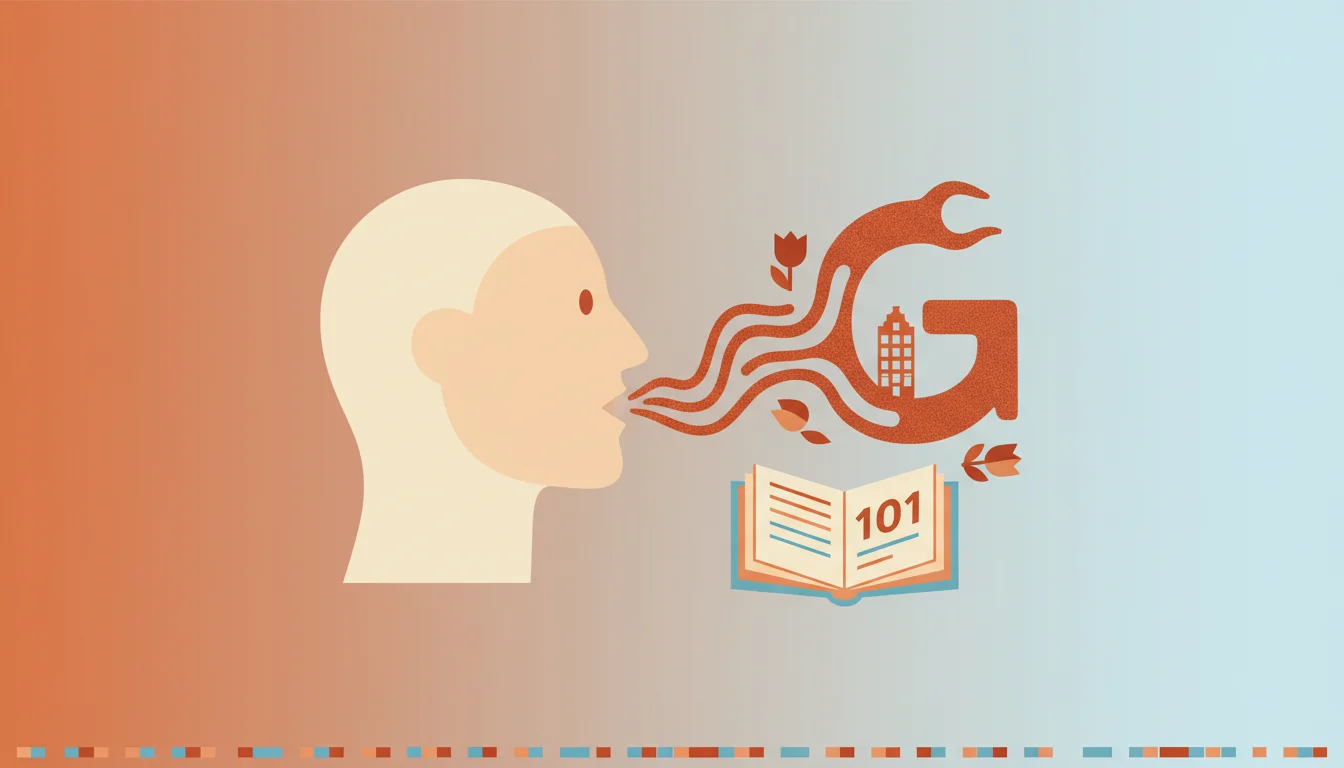
If you have ever listened to a conversation in the Netherlands, you have undoubtedly heard it: that distinct, rasping sound that seems to come from the back of the throat. It is the infamous Dutch "G"—the sound that separates tourists from locals, and arguably one of the biggest hurdles for new learners.
For many expats and students preparing for their inburgering (civic integration) exams, the Dutch G is intimidating. It is often jokingly described as the sound of someone clearing their throat or gargling mouthwash. But fear not! While it feels unnatural to English speakers at first, mastering the G is entirely possible with the right technique and a bit of confidence.
In this guide, we will break down the mechanics of the sound, the regional differences you need to know, and practical tips to help you speak with greater confidence.
The Dutch G sound is a distinctive voiceless velar or uvular fricative consonant that gives spoken Dutch its recognizable rhythm. Often referred to simply as the Dutch G or the Netherlands G, this sound occurs whenever the letter G or the combination CH appears in Dutch vocabulary. Understanding how the Dutch G works is essential for clear communication, whether you are ordering coffee using our Dutch for baristas guide or practicing for everyday conversations.
Before you strain your vocal cords, there is an important secret that many Dutch courses gloss over: there is more than one way to pronounce the G.
This is the sound most people associate with Dutch. It is prevalent in the North and West of the Netherlands (including Amsterdam, Rotterdam, The Hague, and Utrecht). It is a rasping, guttural sound made by directing air through a narrow passage at the back of the throat, near the uvula.
Travel south to provinces like North Brabant and Limburg (or cross the border into Belgium), and the sound changes completely. The "Soft G" is much gentler and is produced slightly farther forward in the mouth. It sounds similar to the "ch" in the German word ich.
The zachte G dialect is a regional variation of the G sound in Dutch spoken in southern provinces such as North Brabant and Limburg, as well as across Flanders. Unlike the rasping guttural G of the north, the zachte G sound is produced farther forward near the palate, making it much smoother for non-native speakers to pronounce comfortably.
Pro Tip: If you find the Hard G physically difficult or painful to produce, it is perfectly acceptable to adopt a Soft G. You will still be understood throughout the Netherlands.
To master the standard Northern "Hard G," you need to forget how English works for a moment. In English, the letter G is usually hard (as in go) or soft (as in giraffe). The Dutch G is neither.
Here is a step-by-step method to find the sound:
The guttural G is the classic throat-vibrating sound predominant across northern and western regions of the Netherlands. To produce a proper guttural G, relax the back of your tongue and push steady air through the narrow gap near your throat without closing it completely. Listening to audio clips during your commute using our guide to learning Dutch on the go can help tune your ear to the subtle vibrations of standard Dutch speech.
You cannot avoid the G; it is everywhere. It appears in common greetings and essential vocabulary. Start practicing with these high-frequency words:
Mastering the G in Dutch pronunciation requires knowing that both the letter G and the spelling CH produce the exact same fricative sound. Whether a word begins with G like goed or features CH like schoon, standard G in Dutch rules apply. Paying attention to these subtle pronunciation patterns is especially helpful when mastering grammar, such as learning adjective ending rules in Dutch.
One of the biggest challenges in learning Dutch pronunciation is that we often cannot hear our own mistakes. You might think you are saying Scheveningen correctly, but to a local, it might sound completely different.
This is where technology can bridge the gap. While listening to podcasts helps, you also need active correction. This is a core feature we built into StroopTaal. Our app includes pronunciation training with instant feedback, allowing you to speak into your phone and see exactly how close you are to a native accent. It removes the embarrassment of practicing in public before you are ready.
Once you are feeling brave, try these classic Dutch tongue twisters designed to test your G mastery. Warning: Keep a glass of water nearby!
Many learners get shy and turn the G into a soft H (saying "Hood morning" instead of "Goedemorgen"). While polite Dutch people might understand you from context, it creates bad habits. Commit to the friction of the sound!
This happens when you close your throat too tightly. Gaan (to go) should not sound like Kaan.
You do not need to hurt your throat. The sound requires airflow, not brute force. If your throat is sore after five minutes of practice, you are pressing too hard. Relax your jaw.
Mastering the G isn't just about sounding authentic; it's about confidence. When you know you can pronounce the words clearly, you are more likely to speak up in shops, at work, or at social gatherings.
If you are preparing for the inburgering exam, pronunciation is a key component of the speaking test. Examiners look for clarity. Using tools like StroopTaal's interactive dialogue games can simulate these real-life scenarios, helping you practice your G's in context—whether you are simulating ordering a coffee or making polite requests.
The Dutch G is unique, distinct, and undeniably tricky. But it is also an important part of the language's rhythm. Don't be afraid to sound silly at first. Dutch people appreciate the effort you put into learning their language, and they will be impressed when you greet them with a confident "Goedemiddag!"
The key takeaway is simple: start gently, focus on steady airflow rather than force, and practice regularly with feedback. Ready to build your confidence? Download StroopTaal today to start your personalized learning plan and get instant feedback on your pronunciation. Succes!
Share this article:
The Dutch Alphabet: Your Key to Clear Pronunciation If you want to sound confident in Dutch, you can't skip the alphabet. While the Dutch alphabet...
Read moreGefeliciteerd! You have arrived in the Netherlands. Whether you are staring at a canal in Amsterdam, unpacking boxes in Rotterdam, or navigating the...
Read moreThe Million-Euro Question: "Wanneer ben ik vloeiend?" If you are an expat living in the Netherlands or planning to move to the Low Countries, there...
Read more