
Dutch for Baristas: The Ultimate Cafe Dutch Guide
Introduction: Brewing Connections in the Dutch Coffee Scene The Netherlands is a nation fueled by coffee. Whether it's a quick morning espresso...
Read more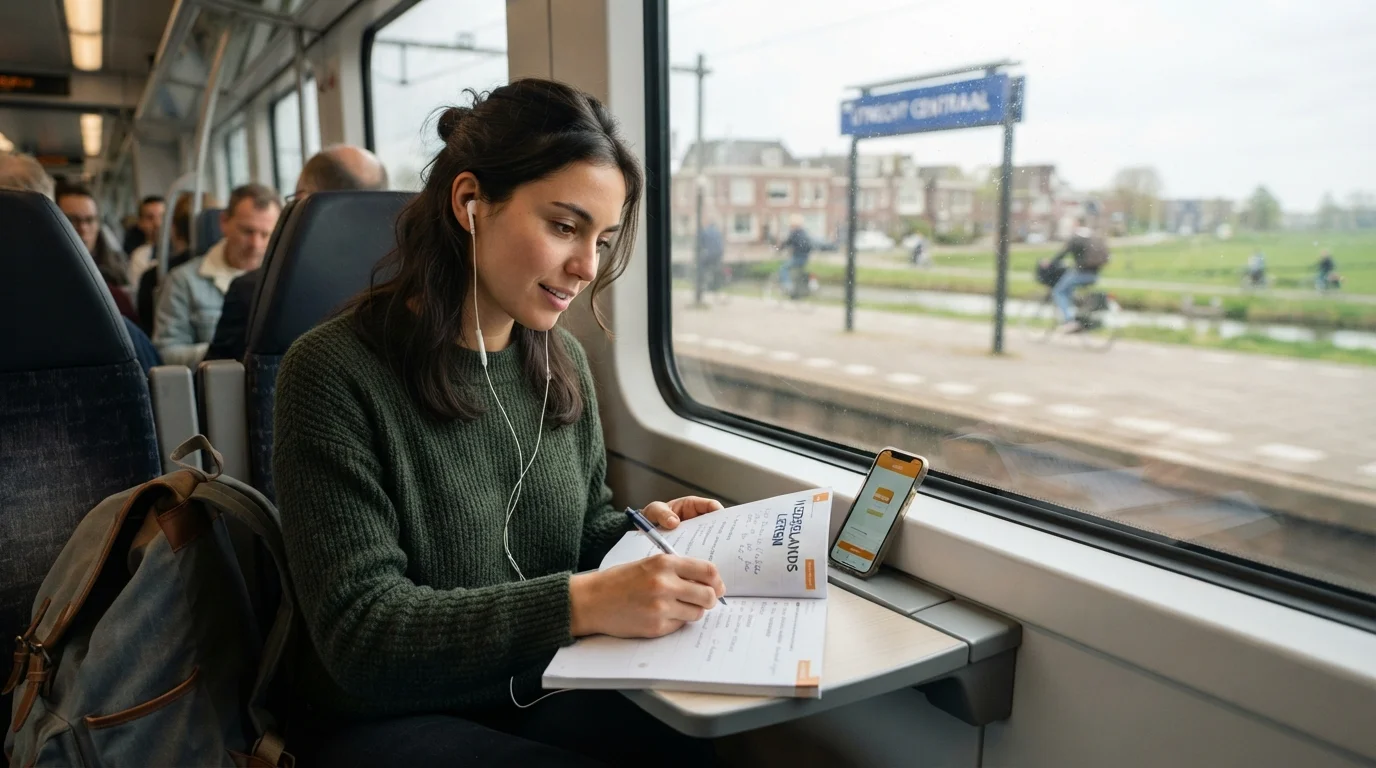
Commuting in the Netherlands is a unique, sensory experience. Whether you are riding the iconic yellow-and-blue trains operated by the NS (Nederlandse Spoorwegen), navigating the bustling tram networks of Amsterdam or Rotterdam, or cycling through the crisp morning air, you are constantly surrounded by the Dutch language. Yet, for many expats, international students, and busy professionals, this travel time is often spent mindlessly scrolling through social media or staring out the window.
What if you could transform this daily "dead time" into a powerful engine for language learning? Learning Dutch during your commute is one of the most efficient ways to build consistency, establish a daily study habit, and accelerate your path to integration. In this guide, we will explore practical, actionable strategies to "Dutch" your commute, regardless of whether you travel by train, bus, tram, or bicycle.
The biggest challenge most language learners face is not a lack of resources, but a lack of time. Between work, family, social commitments, and household chores, finding a dedicated hour to sit down with a grammar textbook can feel nearly impossible. This is where your commute becomes your greatest asset.
According to the principles of habit stacking—a concept popularized by productivity experts—it is much easier to build a new habit when you anchor it to an existing routine. Your commute is already a fixed, non-negotiable part of your day. By deciding that "commute time equals Dutch time," you remove the friction of deciding when to study. Even a modest 20-minute commute twice a day adds up to over three hours of highly focused learning per week, or over 150 hours a year!
Furthermore, micro-learning—breaking your study into short, highly focused bursts—is incredibly effective for cognitive retention. Your brain is highly receptive to absorbing vocabulary and practicing pronunciation in short intervals, preventing cognitive fatigue and keeping your learning journey engaging.
If you are part of the legendary Dutch cycling culture, your commute is highly active. While you cannot look at a screen or type on a keyboard while riding a bicycle (which is both dangerous and illegal in the Netherlands), you can still make massive strides in your Dutch comprehension through auditory learning.
Podcasts are an exceptional tool for cycling commuters. For beginners and intermediate learners, podcasts like Zeg het in het Nederlands or Een beetje Nederlands offer clear, slow-paced spoken Dutch about local culture, history, and daily life. As your comprehension improves, you can transition to mainstream Dutch podcasts, news broadcasts, or audiobooks.
Shadowing is an effective language-learning technique where you listen to a native speaker and repeat what they say in real-time, matching their rhythm, intonation, and pronunciation as closely as possible. Since you are on a bicycle, you have the privacy of the open air to speak out loud without feeling self-conscious. This active vocalization trains your mouth muscles to produce unfamiliar Dutch sounds naturally.
When cycling, your safety and the safety of those around you must always come first. Never use noise-canceling headphones that block out ambient traffic sounds. Instead, use bone-conduction headphones or keep one ear completely free so you remain fully aware of approaching trams, emergency vehicles, and fellow cyclists.
If you commute via public transit, you have the luxury of having your hands free and your eyes available. This opens up a vast array of interactive learning opportunities. Rather than passively consuming content, you can actively engage with the language.
Quiet train rides are the perfect setting to tackle those analytical grammar rules that require focus. For instance, you can spend a morning commute mastering Dutch adjective ending rules to finally understand when to add that elusive "-e" to your adjectives. Similarly, you can use your evening journey to practice complex sentence structures, such as understanding the difference between omdat and doordat to express cause and effect like a native speaker.
To make the most of your transit time, you need a tool designed for bite-sized, high-impact learning. This is where StroopTaal becomes your ultimate travel companion. Instead of generic flashcards, StroopTaal offers an AI-powered personalized learning plan that adapts to your exact level, from absolute beginner (A0) to advanced (C1). During a single train ride, you can play quick article mastery games to conquer "de" and "het" words, or build your vocabulary with spaced-repetition reviews that bring words back just as they start to fade.
For intermediate and advanced learners, reading the news is an excellent way to acquire vocabulary and understand current affairs in the Netherlands. Download apps like NOS, NU.nl, or read the physical free newspapers often left on train seats. Try to read one short article per journey, highlighting unfamiliar words and looking them up later.
To help you get started, here are three structured "commuter workouts" tailored to different journey lengths. Choose the one that matches your daily travel time.
One of the greatest benefits of commuting in the Netherlands is that you are surrounded by native speakers. Public transport is a living, breathing language laboratory. Without being intrusive, you can use your surroundings to boost your colloquial Dutch skills.
Listen to the train conductor's announcements. Can you catch the reason for the delay? ("Dames en heren, wegens een wisselstoring..."). Listen to the casual conversations of teenagers, business professionals, and families sitting near you. Pay attention to the filler words they use, their intonation, and how they greet each other. This exposure to authentic, unscripted Dutch is invaluable for developing a natural-sounding accent and understanding real-world slang.
Learning Dutch does not require you to sacrifice your evenings or weekends. By reclaiming your commute, you can make steady, measurable progress toward fluency while simply going about your daily life. The key is consistency; a short, daily habit of 15 to 20 minutes is far more effective than a grueling three-hour study session once a week.
Are you ready to transform your daily travel time into a rewarding language-learning adventure? Start by choosing one commuting habit today—whether it is listening to a Dutch podcast on your bike or practicing grammar on the train. To make your journey even more efficient, download the StroopTaal app and let our AI-powered platform design the perfect personalized learning path for your daily commute. Your journey to Dutch fluency starts at the next station!
Share this article:
Introduction: Brewing Connections in the Dutch Coffee Scene The Netherlands is a nation fueled by coffee. Whether it's a quick morning espresso...
Read moreIntroduction: The Mystery of the Dutch "-e" Picture this: You are standing in a cozy bakery in Amsterdam, ready to order a delicious Dutch treat. You...
Read moreHave you ever heard a Dutch speaker say "Moge de beste winnen" or "Koste wat kost" and wondered why the verbs look slightly out of place? If you...
Read more