How to Form the Perfect Tense in Dutch: A Step-by-Step Guide
So, you have mastered the basics. You can say "Ik eet een appel" (I eat an apple) and "Ik fiets naar mijn werk" (I cycle to work). But what happens...
Read more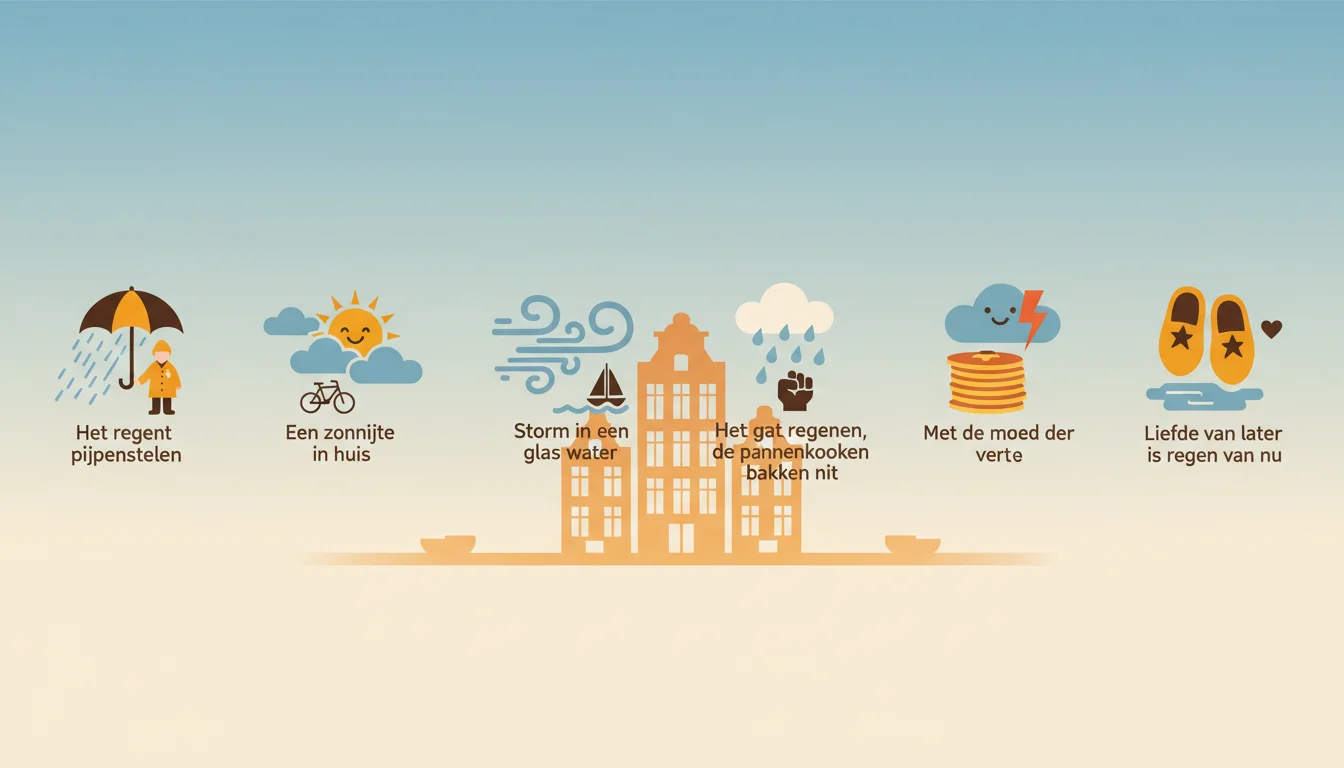
If you are currently living in the Netherlands, you know the drill. It is February. The days are short, the sky is a permanent shade of slate gray, and the rain seems to have developed a personality of its own. For expats and those learning Dutch, this time of year can feel challenging. However, for the Dutch, it is just another Tuesday.
Weather is the number one topic of small talk in the Netherlands. It is the ultimate icebreaker (pun intended). If you want to integrate into Dutch society, pass your inburgering exam, or simply chat with your neighbors, you need to master the art of complaining about the weather. But to truly sound like a local, you need more than just "Het regent" (It is raining).
Dutch is rich with colorful idioms derived from centuries of living with water, wind, and clouds. Mastering these expressions won't just improve your vocabulary; it will give you insight into the Dutch mindset. Here are 7 essential Dutch idioms about weather to help you survive a rainy February.
Literal translation: It is raining pipe stems.
English equivalent: It is raining cats and dogs.
This is the quintessential phrase for a Dutch February. When the rain is coming down in straight, vertical sheets—resembling the long, thin stems of old-fashioned clay tobacco pipes—you use this phrase. It implies a heavy, relentless downpour that makes cycling a heroic feat.
Usage tip: Look out the window with a sigh and say to your colleague: "Ik ga nog niet naar huis, het regent pijpenstelen!" (I'm not going home yet, it's raining pipe stems!)
Literal translation: You aren't made of sugar, are you?
Meaning: A little rain won't dissolve you; toughen up.
This is perhaps the most culturally significant phrase on this list. It encapsulates the Dutch pragmatic attitude toward bad weather. You will hear parents say this to children who refuse to bike to school in the rain, or friends saying it to each other when suggesting a walk despite the drizzle. It represents the Dutch resilience—life goes on, regardless of the weather.
If you are struggling to motivate yourself to go outside, remember: you are not made of sugar. However, if you want to practice your retort to this phrase, you can use the StroopTaal app's AI conversation partner to role-play a scenario where you politely decline a rainy bike ride!
Literal translation: After rain comes sunshine.
Meaning: Every cloud has a silver lining; bad times are followed by good times.
While this is literally true about the weather (eventually), it is almost always used metaphorically. It is a phrase of comfort and optimism. If you are struggling with a difficult grammar concept or feeling homesick during the dark winter months, this is the idiom to keep in mind.
Example: "I know studying for the inburgering exam is hard right now, but keep going. Na regen komt zonneschijn."
Literal translation: From the rain into the drip (gutter).
English equivalent: Out of the frying pan and into the fire.
Imagine standing under an awning to escape a rain shower, only to realize a broken gutter is pouring water directly onto your head. That is the visual here. You use this when a solution to a problem actually results in a worse situation. It is a great phrase to use when complaining—another favorite Dutch pastime!
Literal translation: A storm in a glass of water.
English equivalent: A tempest in a teapot / Making a mountain out of a molehill.
Dutch culture values nuchterheid (being down-to-earth). Drama and exaggeration are generally frowned upon. If someone is making a huge fuss about a minor issue, you can dismiss it as "een storm in een glas water."
Usage tip: This is an excellent idiom to use in a business context or during a discussion to show you have a calm, level-headed perspective.
Literal translation: To hear it thundering in Cologne.
Meaning: To be completely flabbergasted; to not know what is happening.
This idiom dates back to times when news traveled slowly. If you heard thunder coming from the direction of Cologne (Germany), it was distant and confusing. Today, it means you are stunned or visibly confused by news. If someone tells you something shocking, or explains a very complex Dutch grammar rule that makes no sense, you can say: "Ik hoor het in Keulen donderen."
Speaking of complex grammar, if the difference between de and het makes you feel this way, try the article mastery games on StroopTaal. It’s better to practice there than to be thunderstruck in a real conversation!
Literal translation: High trees catch a lot of wind.
Meaning: People in prominent positions attract a lot of criticism.
This is a bit more philosophical but very common. In the egalitarian Dutch culture (often referred to as the "maaiveld" culture, where you shouldn't stick your head above the mowing field), standing out can be risky. Leaders, celebrities, or anyone taking a bold stance will face criticism. It is a weather metaphor applied to social hierarchy.
You might wonder, "Why focus on idioms when I am still learning basic vocabulary?" The answer lies in connection. Literal language allows you to transact; idioms allow you to connect. When you drop a perfectly timed "Je bent toch niet van suiker?" while getting on your bike in the rain, you signal to the Dutch people around you that you understand their culture, not just their dictionary.
February in the Netherlands might be wet and windy, but it is also the perfect classroom. Every rain shower is an opportunity to practice your new vocabulary. So, zip up your raincoat, get on your bike, and face the elements. After all, you aren't made of sugar!
Ready to take your Dutch to the next level? Download StroopTaal today and start your streak! From A0 to C1, we help you speak Dutch with confidence, rain or shine.
If you are an expat looking to settle here long-term, you might also be interested in understanding Dutch work contracts to secure your future in the Netherlands, or checking weather survival guides for expats.
Share this article:
So, you have mastered the basics. You can say "Ik eet een appel" (I eat an apple) and "Ik fiets naar mijn werk" (I cycle to work). But what happens...
Read moreLittle Words, Big Impact: Understanding "Verkleinwoorden" If you have spent any time in the Netherlands, you have probably noticed a peculiar habit...
Read moreThe Ultimate Guide to Avoiding One of the Most Common Dutch Mistakes Imagine this scenario: You are at a networking event in Amsterdam. You spot...
Read more