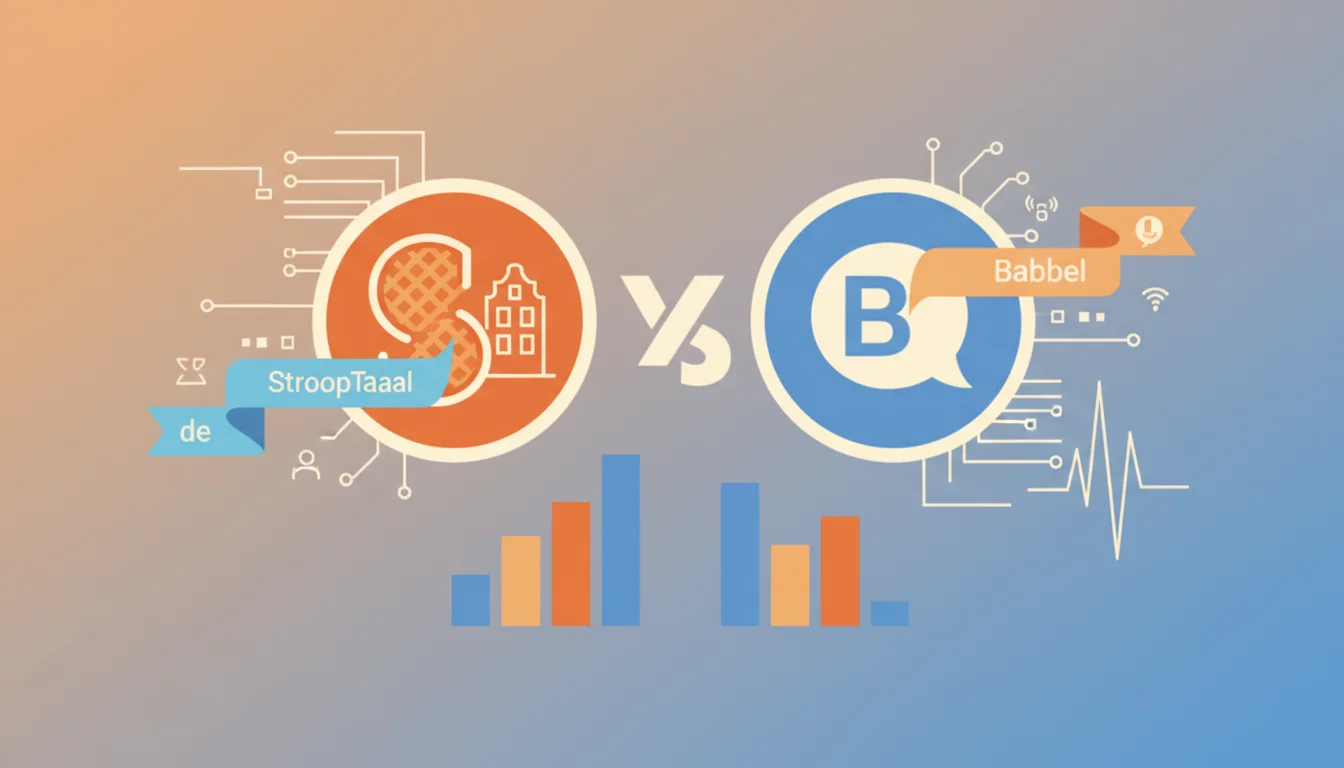
StroopTaal Review: Best App for De/Het Memorization?
The Dutch Definite Article Dilemma: Conquering 'De' and 'Het' If you've spent more than five minutes learning Dutch, you've met them: the two tiny...
Read more
If you are an expat living in the Netherlands, a prospective student, or simply a language enthusiast, you already know that learning Dutch comes with a unique set of challenges. While the vocabulary might share familiar Germanic roots with English and German, Dutch grammar is notorious for throwing learners off balance. From unpredictable word order rules to the seemingly arbitrary assignment of de and het, mastering the mechanics of the Dutch language requires patience, practice, and the right tools.
Welcome to 2026. The days of relying solely on dusty textbooks and rigid, one-size-fits-all language courses are behind us. The landscape of language acquisition has been completely transformed by Artificial Intelligence. Today, learners have access to hyper-personalized, adaptive, and conversational AI tools that make understanding complex grammar rules intuitive and engaging. If you want to understand how AI tutors are revolutionizing Dutch language learning, you need to look at the incredible software available on your smartphone right now.
In this comprehensive guide, we will explore the top 5 AI language apps for learning Dutch grammar in 2026. Whether you are starting from scratch at A0, preparing for your civic integration exams, or pushing towards professional C1 fluency, these applications will help you conquer Dutch grammar faster and more efficiently than ever before.
Before diving into the apps, it is important to understand exactly what makes Dutch grammar so tricky for non-native speakers. A good AI app needs to specifically address these common stumbling blocks:
Traditional apps often fail to explain these nuances, leaving learners to guess the patterns. The AI-powered apps of 2026, however, can analyze your mistakes in real-time, explain the exact rule you broke, and generate custom exercises to help you master it.
We start with our own app, StroopTaal, built specifically from the ground up for Dutch language learners. While many global apps treat Dutch as an afterthought, StroopTaal's lessons, words and situations follow life in the Netherlands, with grammar as part of the lessons.
What makes StroopTaal revolutionary for grammar is its AI-powered personalized learning plans. The app continuously assesses your strengths and weaknesses from A0 to C1 levels. If the AI notices you are constantly forgetting to put the verb at the end of a subordinate clause, it will dynamically adjust your daily lessons to include more practice on that specific rule, providing instant, conversational feedback.
Key Grammar Features:
If you are an expat working in the Netherlands or preparing for your exams, StroopTaal's combination of spaced repetition, daily streaks, and cultural lessons makes it a broad, all-round tool.
Babbel has long been a favorite for learners who prefer a structured, traditional approach to grammar, and their 2026 AI updates have only solidified their position in the top tier. Babbel treats grammar not as an afterthought, but as the foundation of language learning.
Key Grammar Features:
Pros & Cons: Babbel is fantastic for learners who want to understand the "why" behind the language. However, it can sometimes feel a bit rigid, lacking the open-ended conversational freedom found in newer, purely AI-driven platforms.
While not a traditional language learning app, ChatGPT (especially with its advanced 2026 Voice Mode and custom GPTs) has become an indispensable tool for Dutch learners. It acts as a 24/7 personal tutor that can explain complex Dutch grammar rules in infinite ways until you understand them.
Key Grammar Features:
To get the most out of this tool, it is highly recommended to learn about the role of ChatGPT in learning Dutch and how to engineer the perfect prompts for grammar practice. The only downside is that it lacks a structured curriculum, meaning you have to direct your own learning.
Duolingo has always been the king of gamification, but its premium tier, Duolingo Max, introduces generative AI to solve the app's oldest problem: a lack of grammar explanations. In the past, you would get a sentence wrong and have no idea why. In 2026, Duolingo Max uses AI to bridge that gap.
Key Grammar Features:
Pros & Cons: Duolingo Max is incredibly motivating and great for building a daily habit. However, its Dutch course still heavily favors translation exercises, and the vocabulary can sometimes be notoriously quirky (you will know how to say "The apple speaks Dutch" perfectly, but might struggle to rent an apartment).
Busuu takes a hybrid approach, blending AI technology with a massive community of native speakers. For Dutch grammar, this combination is incredibly powerful. The app offers structured lessons that guide you through B2 level, making it a solid choice for serious learners.
Key Grammar Features:
Pros & Cons: Busuu offers excellent, structured grammar lessons and the community aspect is invaluable. However, the AI conversational features are not as advanced or open-ended as StroopTaal or ChatGPT.
For many expats, learning Dutch isn't just a hobby; it's a legal requirement. If you are preparing for the Inburgeringsexamen (Civic Integration Exam), your grasp of grammar will be tested across reading, writing, listening, and speaking. According to the Immigration and Naturalisation Service (IND), the current requirement for most integration candidates is the B1 level.
At the B1 level, you are expected to have a solid command of complex sentences, correct word order, and appropriate use of tenses. This is where AI apps shine. Instead of blindly doing practice exams, apps like StroopTaal let you practice each part of the exam on its own, with a timer and AI feedback on your writing and speaking. By using AI to practice the speaking part of the exam, you can walk into the testing center with more confidence.
Even with the best AI apps in the world, your success depends on how you use them. Here are some actionable tips to accelerate your Dutch grammar mastery in 2026:
The landscape of learning Dutch has never been more exciting. In 2026, AI language apps have completely removed the friction from learning complex Dutch grammar. From the highly personalized, culture-rich environment of StroopTaal to the structured lessons of Babbel and the conversational power of ChatGPT, there is a tool for every learning style.
If you want to stop struggling with word order, finally master de and het, and speak Dutch with confidence, it is time to upgrade your learning toolkit. Download one of these AI-powered apps today, commit to a daily streak, and watch as the seemingly impossible puzzle of Dutch grammar finally clicks into place. Succes met leren! (Good luck with learning!)
Share this article:
The Dutch Definite Article Dilemma: Conquering 'De' and 'Het' If you've spent more than five minutes learning Dutch, you've met them: the two tiny...
Read moreIntroduction: The Inburgering Challenge Moving to the Netherlands is an exciting adventure filled with beautiful canals, endless cycling paths, and...
Read moreThe Ultimate Showdown: Mastering "De" and "Het" If you are an expat living in the Netherlands or someone currently preparing for your integration...
Read more