
Top Dutch Podcasts for Intermediate Learners
Tired of Textbooks? Tune In to These Top Dutch Podcasts for Intermediate Learners You’ve reached the intermediate plateau. You can read Dutch news...
Read more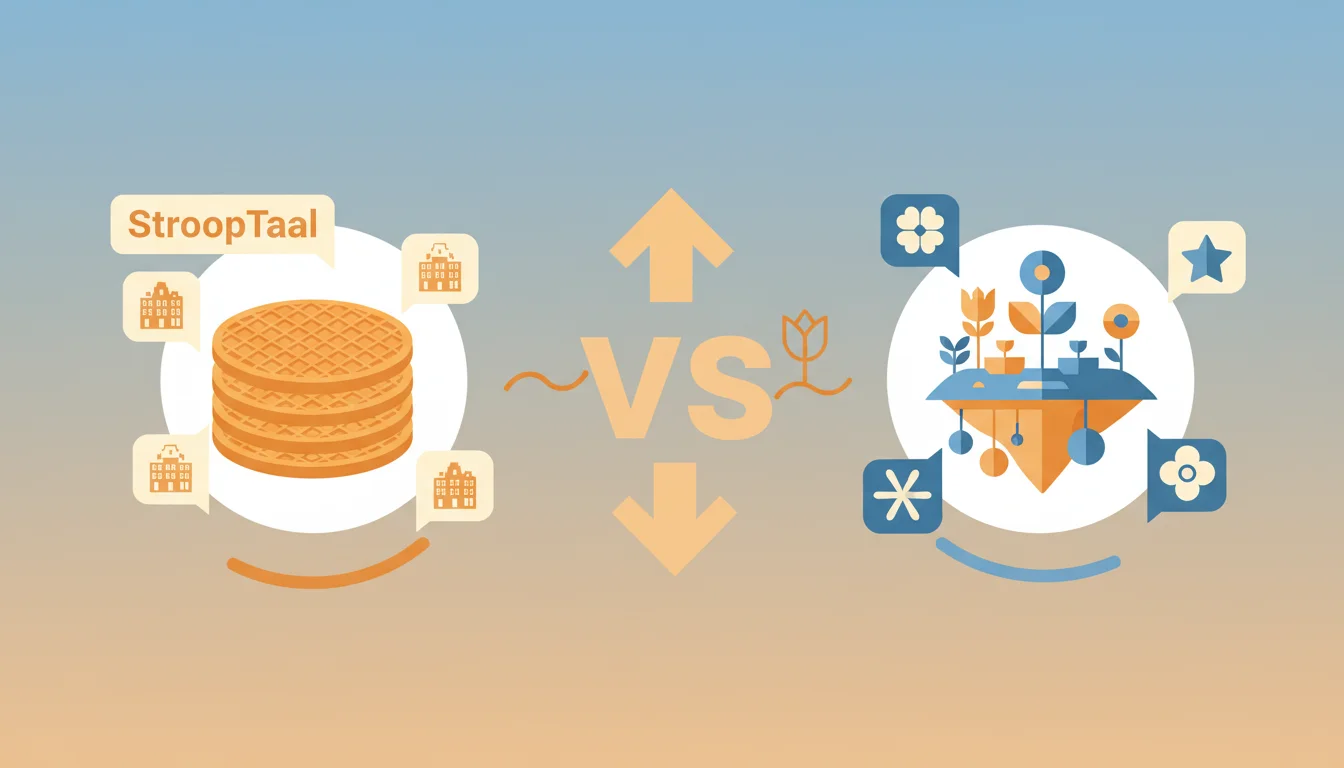
So, you’ve decided to learn Dutch. Leuk! You’re picturing yourself confidently ordering a koffie verkeerd in Amsterdam or chatting with new colleagues in Rotterdam. But then reality hits: the vocabulary. A seemingly endless sea of words, from the deceptively simple fiets (bicycle) to the tongue-twisting waarschijnlijk (probably), not to mention the dreaded de and het articles. It’s enough to make anyone feel overwhelmed.
In your search for a digital lifeline, you’ve likely stumbled upon two names: Memrise, the well-known flashcard giant, and StroopTaal, the AI-powered specialist for Dutch learners. Both promise to help you build your vocabulary, but they take vastly different paths to get you there. Which one is truly the best tool for mastering Dutch words?
This in-depth comparison will dissect both apps, looking beyond the surface-level features. We'll explore their learning methodologies, content quality, ability to provide context, and motivational tools to help you decide which platform will turn your vocabulary woes into conversational wins.
Before we dive deep, let's get a general feel for our two competitors.
Memrise has been a staple in the language learning community for years. Its core strength lies in its massive library of user-generated courses. Think of it as the Wikipedia of flashcards. For almost any topic imaginable, from 'Top 1000 Dutch Verbs' to 'Vocabulary for Watching Dutch Football,' someone has probably created a course for it. It uses spaced repetition and mnemonic devices (called 'mems') to help you cram words into your memory.
StroopTaal is a newer, more focused player designed exclusively for learning Dutch. It’s not just a flashcard app; it's a comprehensive learning ecosystem. StroopTaal uses Artificial Intelligence to create a personalized learning plan for you, covering everything from vocabulary and grammar to pronunciation and real-life conversation practice. Its content is organized for learners at all levels, from complete beginners (A0) to advanced speakers (C1).
At the heart of any vocabulary app is its method for making you remember things. Both StroopTaal and Memrise use a form of Spaced Repetition System (SRS).
The concept of SRS is simple but powerful: the app shows you a new word, and then re-introduces it at increasing intervals — just before you’re about to forget it. This is scientifically proven to be far more effective than cramming. However, the *implementation* of SRS is where the two apps diverge significantly.
Memrise uses a classic SRS algorithm. You learn a word, mark it as known, and it will appear again in a few hours, then a day, then a few days, and so on. It's effective and has helped millions of users. The platform also encourages users to create or use 'mems'—quirky images or phrases—to create a stronger mental hook for each word. While helpful, the quality of these mems can be inconsistent as they are user-submitted.
StroopTaal takes SRS to the next level. It doesn't just follow a fixed schedule; it keeps track of every answer you give. Did you get the word gezellig wrong? Did you misremember the article for huis? The app notices. It will adjust the review schedule for each specific word based on your unique learning patterns, ensuring you spend more time on words you struggle with and less on those you've already mastered. It’s a dynamic and highly efficient system. To learn more about the science, you can read about how spaced repetition system (SRS) works in our dedicated post.
This personalized adaptation means your study sessions are always optimized for maximum retention, cutting down on wasted time and frustration.
When you're learning a language, the quality and accuracy of your learning materials are paramount. A single mistake learned early can become a fossilized error that's incredibly hard to correct later.
Memrise's biggest strength—its vast library of user-generated content—is also its most significant weakness. While you can find hyper-specific vocabulary lists, you're also at the mercy of the creator's knowledge. You might encounter:
Sifting through courses to find a high-quality, comprehensive, and error-free one can be a time-consuming task in itself.
StroopTaal eliminates this guesswork. All content, from individual vocabulary words to complex grammar explanations, is drafted with AI, checked automatically and reviewed in batches, and part of it is also checked by native Dutch speakers. The curriculum is structured according to the Common European Framework of Reference for Languages (CEFR), guiding you logically from A0 to C1.
This is particularly vital for learners with specific goals. If you're an expat in the Netherlands, you need to pass the civic integration exam (inburgeringsexamen). This exam requires a specific set of knowledge about Dutch society and language. You can learn more about the essential vocabulary for the inburgeringsexamen and how a structured app can help. StroopTaal's lessons follow life in the Netherlands, with context and culture lessons that you simply won't find in a random flashcard deck. For more information on the exam itself, the Dutch Immigration and Naturalisation Service (IND) is the official source.
Memorizing a list of words is one thing. Using them correctly in a sentence is a completely different ball game. This is where the gap between a simple vocabulary builder and a true language learning tool becomes a chasm.
Memrise primarily teaches words in isolation. You see 'brood,' you learn it means 'bread.' But how do you use it? Is it de brood or het brood? How do you say 'I would like some bread'? The app doesn't inherently provide this framework.
StroopTaal is built on the principle of contextual learning. You don’t just learn a word; you learn it as part of a system.
This holistic approach ensures that the vocabulary you learn is immediately usable. You’re not just building a mental dictionary; you’re building the ability to communicate.
Learning a language is a marathon, not a sprint. Both apps understand the importance of motivation and use gamification to keep you coming back.
Memrise uses a garden metaphor: you 'plant' words, and then 'water' them by reviewing them. It’s a satisfying visual representation of your progress. You also earn points and climb leaderboards, which can be motivating for competitive learners.
StroopTaal also incorporates points, leaderboards, and a daily streak to encourage consistency. However, its core gamification is more deeply integrated into the learning process itself. The interactive dialogue games and pronunciation challenges feel less like drills and more like playing a game where the prize is genuine communication skill. This intrinsic motivation—the joy of successfully navigating a conversation—is a powerful driver. Understanding how gamification can boost motivation is key to choosing an app that will keep you engaged long-term.
So, StroopTaal or Memrise? The answer depends entirely on your goals and learning style.
Choose Memrise if:
Choose StroopTaal if:
While Memrise can be a useful tool for rote memorization, especially as a supplement, it treats vocabulary as a collection of isolated items. It helps you build a list of words.
StroopTaal, on the other hand, treats vocabulary as the living, breathing building block of communication. It doesn't just give you the bricks; it shows you how to build the house. By integrating vocabulary into a comprehensive ecosystem of AI-driven grammar lessons, conversation practice, and cultural insights, StroopTaal guides you from simple memorization to true mastery.
If your goal is not just to know Dutch words, but to use them with confidence and accuracy, then a specialized, holistic tool is your best investment. Ready to build a Dutch vocabulary that sticks?
Download the StroopTaal app today and experience the difference an AI-powered, personalized learning plan can make.
Share this article:
Tired of Textbooks? Tune In to These Top Dutch Podcasts for Intermediate Learners You’ve reached the intermediate plateau. You can read Dutch news...
Read moreThe Dutch Learning Dilemma: From 'Leuk!' to 'Ugh, Again?' Remember the day you decided to learn Dutch? The excitement was palpable. You imagined...
Read moreThe Dutch Definite Article Dilemma: Conquering 'De' and 'Het' If you've spent more than five minutes learning Dutch, you've met them: the two tiny...
Read more