Mastering the Dutch Subjunctive: Phrases with 'Moge' and 'Wens'
Have you ever heard a Dutch speaker say "Moge de beste winnen" or "Koste wat kost" and wondered why the verbs look slightly out of place? If you...
Read more
Moving from an elementary A2 level to an intermediate B1 level in Dutch is an exciting milestone. At A2, your writing consists mostly of short, simple sentences: 'Ik ga naar de winkel. Ik koop brood. Het weer is mooi.' While correct, this style of writing feels choppy and robotic. To sound natural, express complex thoughts, and pass the Dutch integration exams (Inburgeringsexamen) at the B1 level, you need connective tissue. You need transition words.
In Dutch, these are known as signaalwoorden (signal words) or verbindingswoorden (connecting words). They act as roadmaps for your reader, signaling whether you are adding information, contrasting points, explaining a cause, or drawing a conclusion. Crucially, in Dutch, these words also dictate your sentence structure and word order—one of the most challenging aspects of the language.
In this comprehensive guide, we will break down 15 essential Dutch transition words every B1 learner must master. We will categorize them by function, explain their impact on word order, and provide practical examples to elevate your B1 writing practice immediately.
Before we dive into the list, we must address the grammatical elephant in the room. In English, transition words rarely change the structure of the sentence that follows. In Dutch, however, the type of transition word you use completely dictates your word order. If you get this wrong, your writing will immediately look non-native, regardless of how advanced your vocabulary is.
Transition words generally fall into three grammatical categories:
As you study the 15 words below, pay close attention to where the verbs land!
Use these words to build on an existing point, add new arguments, or list facts in a structured manner.
Bovendien is a conjunctive adverb used to add an extra, often stronger, argument to your text. It triggers inversion when it starts a sentence.
Literally translating to "next to that," daarnaast is incredibly common in both written and spoken Dutch. It is perfect for introducing a parallel point and triggers inversion.
When writing an essay or an email listing multiple points, use tenslotte to introduce your final argument. It triggers inversion when starting a clause.
Showing contrast is a key requirement of B1 writing. These words help you present counterarguments or alternative perspectives smoothly.
Echter is the formal cousin of maar (but). It is highly favored in formal emails and B1 writing exams. It can trigger inversion if placed at the beginning of a sentence, but it is often placed after the verb.
Hoewel is a subordinating conjunction. This means it kicks all verbs to the very end of its clause. Mastering this structure is a major milestone for intermediate learners.
Use daarentegen to highlight a sharp contrast between two subjects. It is typically placed after the subject or verb of the second clause.
To write logically, you must explain *why* things happen and what the consequences are. These transition words are essential for structured arguments.
Daarom is a conjunctive adverb that explains the result of a previously stated cause. Because it is an adverb, placing it at the start of a sentence triggers inversion.
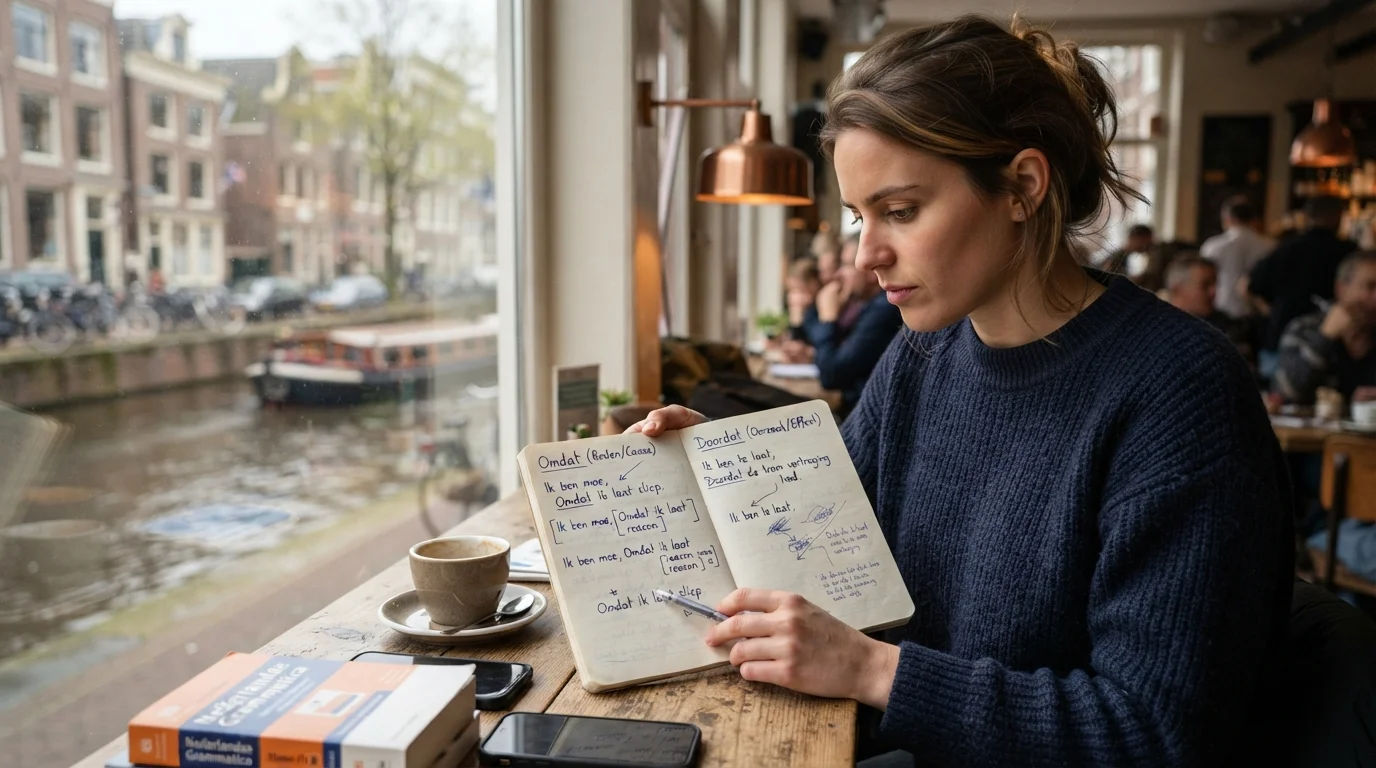
Unlike omdat (which explains a personal reason or motivation), doordat explains an involuntary cause or physical mechanism. It is a subordinating conjunction, sending all verbs to the end. Be sure to study how this fits into broader word order rules for separable verbs if your verb happens to be separable.
Perfect for concluding a paragraph or a short essay. Kortom summarizes your main point and triggers inversion when starting a sentence.
Similar to kortom, al met al is used to weigh various factors and present a balanced conclusion. It triggers inversion.
These words allow you to set conditions, provide concrete examples, or describe parallel timelines.
Tenzij is a subordinating conjunction used to state a condition that could change the outcome. It sends all verbs to the end of the clause.
This is a formal, highly useful B1/B2 subordinating conjunction. It states a strict condition under which something will happen. Verbs go to the end.
No argumentative text is complete without examples. Bijvoorbeeld can be placed at the start of a sentence (often triggering inversion) or tucked neatly inside the sentence after the verb.
Namelijk is a unique Dutch word that explains or justifies a previous statement. It is a post-positional adverb, meaning it is *never* placed at the start of a sentence. It usually appears right after the finite verb.
Terwijl serves a dual purpose: it can describe two events happening at the same time, or contrast two opposing ideas. It is a subordinating conjunction (verbs to the end). When writing complex sentences with terwijl, it is also highly useful to practice mastering the Dutch word 'er' to keep your clauses natural and grammatically sound.
Knowing these words intellectually is only half the battle; using them naturally under exam pressure is where the real challenge lies. Here are three actionable tips to make these words part of your active vocabulary:
If you want to transition from rigid, textbook sentences to fluid, natural Dutch, consistent practice is key. This is where the StroopTaal app can help you take flight. StroopTaal features interactive grammar lessons covering levels A0 to C1, helping you master complex word order rules step-by-step.
With StroopTaal's real-life Dutch conversation practice with AI, you can try out these transition words in simulated conversations and receive instant feedback on your word order. Additionally, the app offers dedicated exam preparation tools and daily streak gamification to keep you motivated. Whether you are preparing for your Inburgeringsexamen or simply wanting to sound more professional at work, StroopTaal personalizes your learning journey to target your exact writing and speaking weak spots.
Mastering these 15 essential Dutch transition words will instantly elevate your writing from basic to cohesive, nuanced, and professional. They are the keys to unlocking the B1 level and passing your integration exams with confidence. Start incorporating them into your daily writing practice, pay close attention to the word order rules they trigger, and watch your fluency soar.
Ready to put these words into practice? Download the StroopTaal app today and start building personalized learning plans designed to make you a confident Dutch writer and speaker!
Share this article:
Have you ever heard a Dutch speaker say "Moge de beste winnen" or "Koste wat kost" and wondered why the verbs look slightly out of place? If you...
Read moreMastering Dutch Cause and Effect: Omdat vs. Doordat If you have been learning Dutch for a while, you have likely run into the classic grammatical...
Read moreIntroduction: The Past Tense Puzzle in Dutch For many expats, language learners, and those preparing for the Dutch integration exams...
Read more