How to Use LinkedIn to Find Jobs in the Dutch Tech Sector
Introduction: The Thriving Dutch Tech Ecosystem The Netherlands has rapidly transformed into one of Europe's most vibrant and innovative...
Read more
This article was drafted by AI and edited by a person before it was published.
AI can get things wrong. For anything official, check the source it points to.
AI-generated image
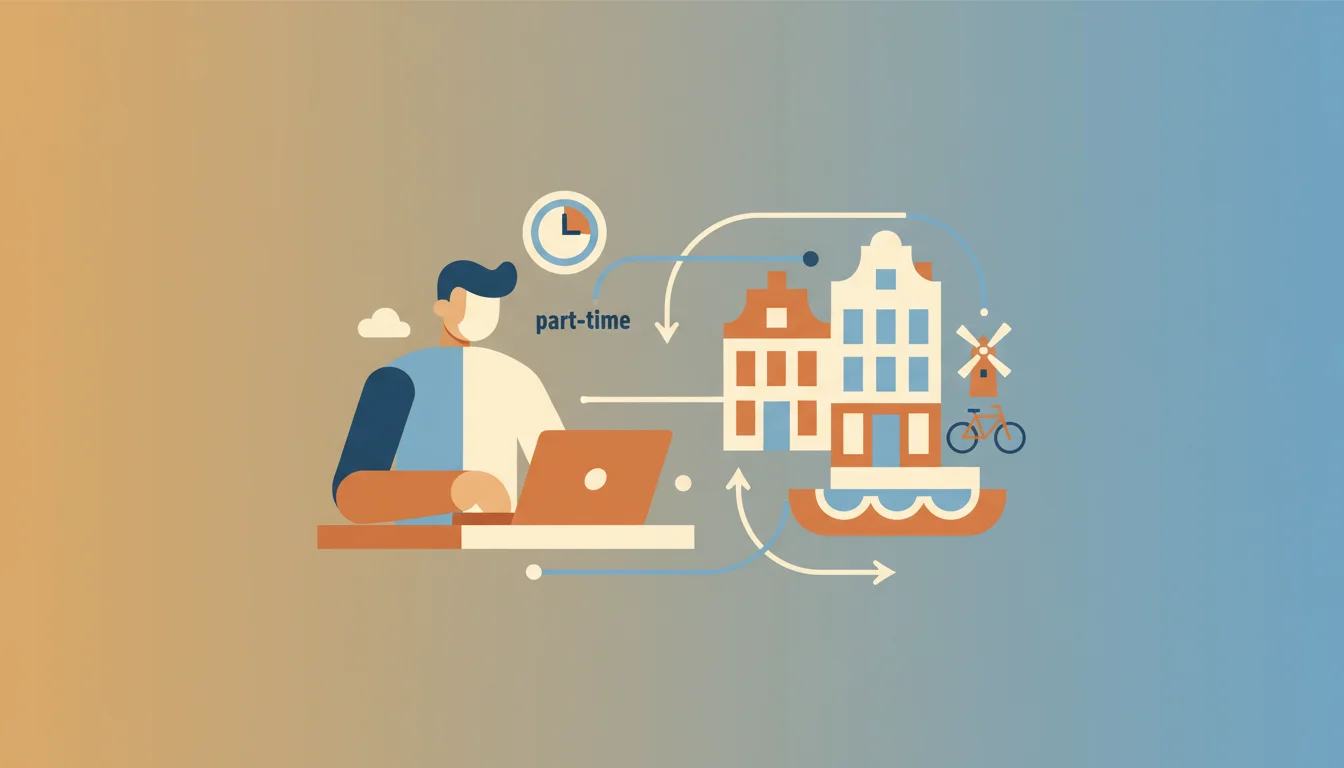
Welcome to the land of windmills, tulips, and the four-day workweek. If you have recently moved to the Netherlands or are considering making the leap, you will quickly notice a unique phenomenon: a massive portion of the workforce does not work a standard 40-hour week. In fact, the Netherlands is the undisputed part-time working champion of Europe.
For many expats, the concept of intentionally asking to work fewer hours—and seeing that request normalized, encouraged, and legally protected—is nothing short of culture shock. In many Western countries, working part-time is often associated with student jobs, retail, or a lack of ambition. In the Netherlands, however, it is the gold standard for achieving a healthy, sustainable work-life balance.
Whether you are navigating the job market, preparing for your inburgering (civic integration) exams, or simply trying to understand your Dutch colleagues' schedules, this comprehensive guide will explain everything you need to know about working part-time in the Netherlands.
To truly understand the Dutch workplace, you have to look at the statistics. According to Statistics Netherlands (CBS), over half of the Dutch workforce works part-time (defined as less than 36 hours a week). But why is this so deeply ingrained in the culture?
The roots of this culture date back to the 1980s. During a period of high unemployment, the Dutch government, employers, and labor unions signed the historic Wassenaar Agreement. To combat joblessness, they agreed to trade wage increases for shorter working hours, effectively redistributing available work among more people. Around the same time, more women were entering the workforce. Instead of transitioning to full-time roles, many took on part-time positions to balance work with traditional family responsibilities.
Today, part-time work is no longer just a female-dominated trend. The concept of the Papadag (Daddy day) has become a cultural staple. It is incredibly common for Dutch fathers to work four days a week, dedicating one specific weekday entirely to childcare and household duties. This egalitarian approach to parenting is supported by employers across almost all industries, from tech startups to corporate banking.
When we talk about part-time work (parttime werken) in the Netherlands, we are usually not talking about 15-hour weeks at a coffee shop. Most Dutch professionals work "substantial part-time" roles.
The Dutch government actively protects your right to work less. Under the Flexible Working Act, employees who have been with a company for at least 26 weeks have the legal right to request a change in their working hours. Employers can only refuse this request if they can prove it would cause severe disruption to the business—a high burden of proof that is rarely met.
Before you make any requests, however, it is vital that you are fully aware of your employment terms. We highly recommend understanding your Dutch work contract, as the differences between a fixed (vast) and temporary (tijdelijk) contract can influence how and when you should negotiate your hours.
While the Dutch system sounds idyllic, expats should weigh the pros and cons before dropping to a four-day workweek.
Working part-time requires excellent time management and clear communication. The Dutch are famous for their directness and efficiency, which makes part-time schedules function smoothly.
In the Netherlands, when you are off the clock, you are truly off the clock. It is culturally unacceptable to expect a colleague to answer emails or Slack messages on their designated day off. You will frequently see out-of-office replies stating: "Ik werk niet op woensdag" (I do not work on Wednesdays). To succeed, you must be comfortable enforcing these boundaries.
Adapting to this level of directness can be tricky for internationals. For a deeper dive into how to communicate effectively with your Dutch colleagues, check out our guide on navigating Dutch business etiquette.
One challenge of working part-time is missing out on spontaneous office socializing, particularly if your day off falls on a Friday. Friday afternoons are sacred in the Dutch corporate world because of the Vrijmibo (Vrijdagmiddagborrel)—the Friday afternoon drinks. If you work Monday through Thursday, try to occasionally join social events on other days, or make an effort to drop by the office on a Friday just for the networking aspect. Mastering the Dutch borrel is crucial for your career progression and building relationships with your team.
Before you request a reduction in hours, it is essential to understand the financial mechanics of the Dutch system.
The Netherlands has a progressive tax system, meaning the more you earn, the higher the percentage of tax you pay on the top portion of your income. Because of general tax credits (algemene heffingskorting) and labor tax credits (arbeidskorting), reducing your working hours by 20% does not necessarily mean your net take-home pay will drop by exactly 20%. In many cases, the net impact is less severe than the gross impact, making part-time work financially viable for many.
By law, all employees in the Netherlands receive a holiday allowance of 8% of their gross annual salary, usually paid out in May. If you transition to a part-time contract, your base salary decreases, which means your 8% holiday allowance will also decrease proportionally.
Depending on your household income, working fewer hours might lower your combined income enough to qualify you for government benefits (toeslagen), such as healthcare allowance (zorgtoeslag) or childcare allowance (kinderopvangtoeslag). Always run the numbers through the Belastingdienst (Tax Authority) calculation tools before making a decision.
If you are currently working full-time and want to transition to a part-time schedule, the process is straightforward, provided you follow the legal guidelines.
Even if you work in a highly international company where English is the primary language, speaking some Dutch will dramatically improve your workplace experience. It helps you catch the nuances in meetings, participate in lunch table conversations, and build rapport with local colleagues.
If you are nervous about office small talk, the StroopTaal app offers real-life Dutch conversation practice with AI, allowing you to simulate coffee machine chats, negotiation scenarios, and borrel conversations before you try them out in real life. Combined with our cultural lessons and grammar exercises, this can help you feel more confident in your Dutch workplace.
Working part-time in the Netherlands is much more than a scheduling quirk; it is a profound reflection of a society that values well-being, family, and personal time as much as economic productivity. As an expat, adopting this mindset can drastically improve your quality of life, giving you the time and energy to truly enjoy your new home.
Whether you use your extra day off to explore the canals, spend time with your family, or study for your inburgering exams, embracing the Dutch work-life balance is one of the best decisions you can make. Ready to make the most of your free time? Download the StroopTaal app today and start mastering the Dutch language with our gamified, AI-powered lessons!
Share this article:
Introduction: The Thriving Dutch Tech Ecosystem The Netherlands has rapidly transformed into one of Europe's most vibrant and innovative...
Read moreIntroduction: Stepping into the Dutch Boardroom Imagine this: You have just landed a fantastic job in the Netherlands. You arrive at your first team...
Read moreIntroduction to the ZZP Life in the Netherlands The Netherlands is widely celebrated for its robust economy, excellent work-life balance, and...
Read more