Top 20 Dutch Phrasal Verbs Every Expat Should Know in 2026
Crack the Code of Dutch Separable Verbs If you have been living in the Netherlands for any amount of time, you have likely encountered the infamous...
Read more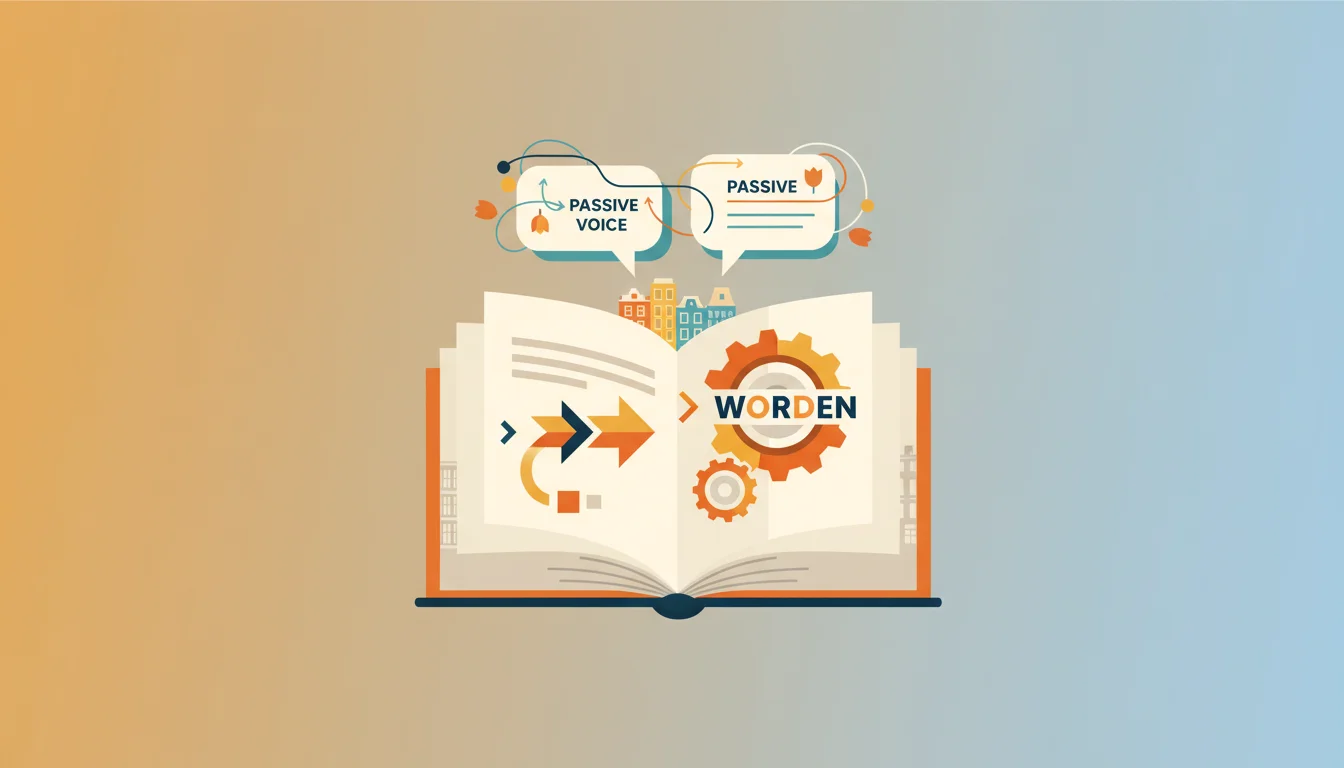
If you have been learning Dutch for a while, you have likely encountered sentences that seem to run backwards. You might see a sentence where the subject isn't doing anything at all, but rather, something is being done to it. Welcome to the world of the Passive Voice (de lijdende vorm).
For many expats living in the Netherlands and students preparing for the inburgering exam, the passive voice is a notorious hurdle. It changes the rhythm of the sentence and introduces a new auxiliary verb that becomes your best friend: worden.
In this guide, we will break down exactly how to use worden, how to structure your sentences correctly, and why mastering this grammar point is essential for sounding like a local.
Before diving into Dutch grammar rules, let’s clarify the concept. In an active sentence, the subject performs the action. In a passive sentence, the action happens to the subject.
Notice what happened there? In the passive version, "the man" disappeared (though we can add him back later), and the focus shifted entirely to the car and the action of washing. The Dutch use the passive voice frequently, especially in formal writing, news reports, and when the person performing the action is unknown or irrelevant.
To construct the passive voice in the present tense (onvoltooid tegenwoordige tijd), you need the auxiliary verb worden (to become/to get) combined with a past participle (voltooid deelwoord).
First, you must know how to conjugate worden in the present tense:
The formula for a basic passive sentence is:
Subject + Conjugated form of "worden" + ... + Past Participle
Dutch grammar is famous for its strict word order, often visualized as a "sandwich." In the passive voice, this structure is critical. The conjugated form of worden acts as the first slice of bread, and the past participle acts as the second slice at the very end of the sentence. Everything else—time, manner, place—gets stuffed in the middle.
Let's make it more complex. Suppose the bread is baked in the bakery every morning.
Notice how gebakken (the past participle) is pushed to the very end. This is the golden rule of Dutch syntax. If you put the participle too early, the sentence will sound unnatural to native speakers.
Sometimes you want to use the passive voice but still mention who is doing the action. In English, we use the word "by." In Dutch, we use the preposition door.
While grammatically correct, Dutch speakers often drop the "door" part if the actor is obvious or unimportant. This makes sentences cleaner and more direct.
The passive voice isn't limited to the present. To describe a process that happened in the past (Imperfectum), you simply change worden to its past tense forms: werd (singular) or werden (plural).
The word order rules remain exactly the same. The participle gebouwd stays at the end of the sentence. Just like when you are telling time in Dutch, precision with these structures is key to being understood.
One of the biggest mistakes learners make involves confusing the process with the result. This often leads to confusion between using worden and zijn.
When you are focusing on the action taking place, always stick with worden. This is a common area of confusion, similar to how students struggle with using niet vs geen correctly in different contexts.
Understanding the theory is step one, but internalizing the word order requires practice. You need to train your brain to wait until the end of the sentence to drop the participle.
Dutch news articles (like those on NOS or Nu.nl) are goldmines for the passive voice. Journalists love using it to sound objective. Try to highlight every instance of wordt or werd + a participle you find.
Grammar drills can be dry, but they are necessary. However, applying grammar in context is better. This is where StroopTaal can accelerate your learning. With AI-powered personalized learning plans, you can specifically target grammar weak points like the passive voice.
More importantly, you can use StroopTaal’s real-life Dutch conversation practice to try these sentences out. The AI acts as a patient conversation partner, allowing you to construct passive sentences without the fear of judgment. If you mess up the word order (putting that participle too early!), the instant feedback feature will gently correct you, helping you build the right habits faster.
Take a simple children's book or a list of active sentences and try to rewrite them all in the passive voice. This mental gymnastics strengthens your understanding of subject-object relationships.
If you are preparing for the inburgering exam (especially the writing and speaking sections), demonstrating that you can use the passive voice correctly is a great way to show a higher proficiency level (A2/B1 and above). It adds variety to your sentence structures, preventing you from speaking in simple, repetitive active sentences. You might also want to practice making polite requests to further elevate your formal language skills.
Mastering the passive voice and the use of worden unlocks a new level of fluency. It allows you to speak more formally, describe processes, and understand the nuance between an action in progress and a completed result. Remember the sandwich rule: keep worden near the subject and throw that participle to the very end!
Ready to stop struggling with Dutch grammar? Download StroopTaal today to practice the passive voice with interactive dialogue games and get instant feedback on your pronunciation and syntax. Start your streak today and master the Dutch language!
Share this article:
Crack the Code of Dutch Separable Verbs If you have been living in the Netherlands for any amount of time, you have likely encountered the infamous...
Read moreSo, you have mastered the basics. You can say "Ik eet een appel" (I eat an apple) and "Ik fiets naar mijn werk" (I cycle to work). But what happens...
Read moreEmbrace the Gray Skies Like a Local If you are currently living in the Netherlands, you know the drill. It is February. The days are short, the sky...
Read more