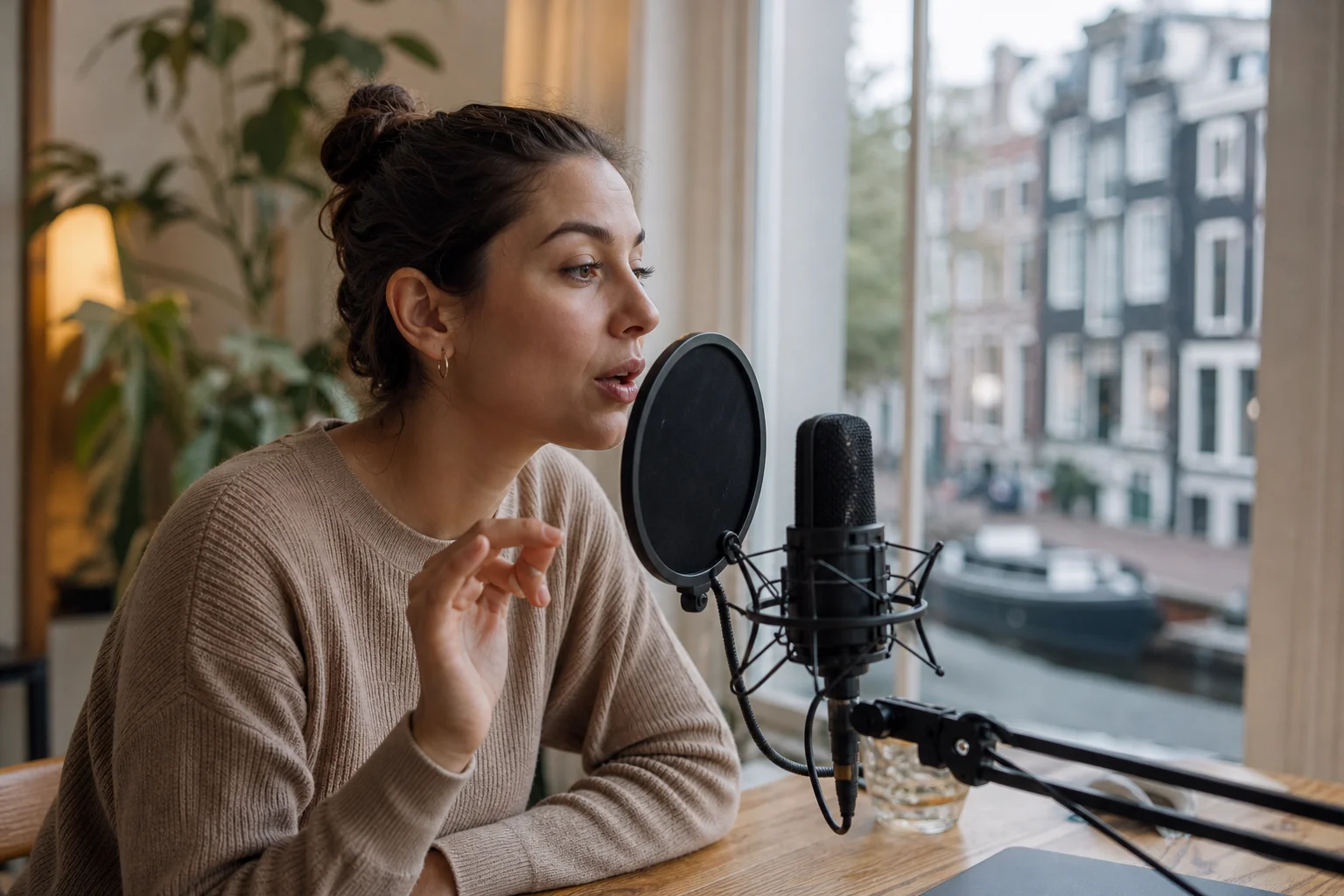
Mastering Dutch Vowels: How AI Audio Analysis Perfects Your Accent
Why Dutch Vowels Feel Like an Obstacle Course Ask anyone learning Dutch in the Netherlands what keeps them up at night, and they will rarely say word...
Read more
If you have spent even a few days studying Dutch, you have undoubtedly run into the perpetual dilemma that haunts language learners across the Netherlands: is this word ‘de’ or ‘het’?
It sounds deceptively simple on paper. Dutch only has two definite articles, unlike German with three or French and Italian with multiple gendered and plural variations. Yet, native Dutch speakers assign gender automatically without pausing to think, while adult learners find themselves constantly playing a 50/50 guessing game. Unfortunately, flipping a mental coin fails half the time, and choosing the wrong article triggers a domino effect that disrupts adjectives, pronouns, and the natural flow of your speech.
While mastering grammatical gender takes intentional practice, you do not have to rely on blind luck. By understanding the underlying structural patterns of Dutch nouns and utilizing dedicated article drills in StroopTaal, you can systematically move past hesitation. Here is how Dutch grammatical gender works, why getting it right matters so much, and how to train your brain to know instinctively when a noun takes het.
To stop guessing, it helps to understand the odds. In modern Dutch, nouns are divided into two main categories: common gender (which take the article de) and neuter gender (which take the article het). Historical feminine and masculine distinctions merged into common gender centuries ago, leaving learners with a simpler, yet still asymmetric, landscape.
Roughly 75% of all Dutch nouns use de, while only about 25% take het. That means de is the default standard in Dutch. If you were forced to guess a completely unknown word in the wild, statistically de would give you a three-in-four chance of being correct. However, surviving on statistics alone will quickly lead to clumsy mistakes, because many of the most frequent, everyday words in Dutch are neuter nouns: het huis (the house), het werk (the work), het kind (the child), and het jaar (the year).
Fortunately, the Dutch language is not entirely arbitrary. A significant portion of nouns follow clear linguistic rules that guarantee whether they take de or het. For an exhaustive comparison of how different learning tools tackle these mechanics, see our breakdown of memorizing de and het across Dutch learning apps.
Whenever you encounter a word that falls into one of these categories, you can use het with certainty:
Just as some categories belong strictly to het, several indicators immediately tell you that a noun belongs to de:
Many adult learners wonder: does it actually matter if I say de huis instead of het huis? Will Dutch speakers still understand me?
In casual conversation, people will usually grasp your intended meaning. However, articles in Dutch are not isolated words; they serve as grammatical anchors for the entire sentence. Making a mistake on the article creates an immediate chain reaction across multiple parts of speech:
The inflection of adjectives changes depending on whether the noun is a de-word or a het-word. When an adjective precedes a noun with an indefinite article (een), it only takes an -e ending if the noun is a de-word. If it is a singular neuter (het) noun, the adjective takes no ending:
If you don’t know whether the noun is de or het, you will inevitably misapply your adjective endings.
Selecting the right word for “this” or “that” depends completely on noun gender:
If you are living in the Netherlands and preparing for your civic integration exams (inburgering) or the Staatsexamen NT2, grammatical precision in your writing and speaking directly influences your assessment. In the writing sections, repeated confusion between deze/dit, uninflected adjectives, and incorrect relative pronouns (die vs dat) marks down grammatical accuracy. Practicing foundational comprehension beforehand with tools like a free A2 reading practice test helps expose your eye to correct article usage in context.
According to official regulations published on inburgeren.nl (checked on 9 November 2026), each exam component under the Wet inburgering 2021—Lezen, Luisteren, Schrijven, Spreken, and KNM—costs €50 per part, totaling €250. Retaking an exam part because of weak written control means paying that per-part fee again. Solidifying your articles early removes a common source of errors in your productive exam answers.
Most learners acquire vocabulary passively: they read a text, see het kantoor, understand the meaning from context, and move on. The brain registers the word “office,” but it discards the article as redundant noise because the meaning is clear without it.
When it comes time to write or speak, the learner remembers kantoor, but because the article was never actively stored alongside the noun, they are forced to guess. To eliminate guessing, you must treat the article not as a separate grammatical accessory, but as an inseparable prefix of the noun itself. It is never just kantoor; the word is het kantoor.
This is where deliberate, targeted drills make all the difference. Instead of encountering articles randomly across long reading passages, focused drills strip away context and force your brain to retrieve gender instantly.
StroopTaal includes dedicated features designed specifically to build this automatic recall through active retrieval and spaced exposure. If you are comparing study methods, our guide on finding the best app to learn Dutch as an expat explains how focused drilling contrasts with broader curriculum apps.
Here is how to use the article tools inside the StroopTaal app to build rock-solid gender recognition:
Inside StroopTaal’s Words tab, you will find a specialized game designed specifically for learning which article goes with a noun. Instead of wading through full sentences when your primary objective is mastering grammatical gender, this drill presents nouns directly, challenging you to choose between de and het quickly.
Because you immediately see whether your selection is correct or incorrect, the feedback loop is instantaneous. When you get a word wrong, the app highlights the error right away, which helps correct faulty intuition before it becomes an entrenched bad habit.
Recognizing an article once in a drill does not mean it is permanently memorized. In StroopTaal, words and past mistakes return in short, targeted reviews. These reviews are spaced out so that they reappear just as your memory begins to fade.
When you mistake a het-word for de during a lesson or review, the spaced repetition system logs that error and reintroduces the word into your upcoming practice sessions. By returning to tricky neuter nouns at calculated intervals, your brain transitions from conscious hesitation to automatic recognition.
One of the best ways to internalize articles is to practice with words you encounter in your daily environment. With StroopTaal Premium, you can photograph physical letters from the gemeente, street signs, official forms, or restaurant menus, and extract the vocabulary directly into your app. You can save any word you discover and immediately turn it into flashcard practice or review it in the Words tab.
StroopTaal is available on iPhone and iPad (iOS 18 or later) as well as Android phones and tablets (Android 8.0 or later). For users with an Apple Watch, StroopTaal also offers a dedicated watch app specifically for quick word practice. These micro-sessions are ideal for running through five or ten article flashcards while waiting for the train or standing in line at the grocery store, keeping Dutch gender patterns top of mind throughout the day.
Building automatic gender recall does not require hours of grammar study each day. A consistent, structured 10-to-15-minute daily habit produces far more reliable results. Here is an actionable routine you can implement starting today:
Inside the app, configure your daily study goal to between 5 and 30 minutes, and choose a daily reminder time that fits into your schedule. Maintaining a streak helps keep your momentum going, and StroopTaal provides three streak freezes per month on the free tier to keep an unexpected busy day from wiping out your progress.
Begin your session in the Words tab with the article game. Spend three to five minutes sorting nouns into de and het. Treat every mistake as valuable data: pay close attention to any noun ending or category pattern you overlooked.
Next, move to your daily reviews. Because StroopTaal brings back past mistakes alongside new vocabulary, this step forces you to confront the words you previously slipped up on. Type out the answers and pay attention to dictation exercises to verify that your spelling and article alignment remain intact.
Knowing an article in a silent multiple-choice quiz is one skill; producing it spontaneously in conversation is another. If you have Premium, schedule a brief call with Taalmaatje, StroopTaal’s AI conversation partner. Choose an everyday scenario—such as discussing your weekend, visiting the pharmacy, or asking questions about an apartment—and deliberately speak out loud.
Taalmaatje is software, not a human, and it lets you practice without any social anxiety. After the call, you can read the full transcript back to inspect your sentences. If you wrote sentences during your lesson exercises, Premium’s Sentence Check will correct your text and clearly explain the grammatical rules behind any mistakes.
While diminutive endings and infinitives cover many neuter words, a group of core, high-frequency nouns must simply be memorized through repetition. These words appear constantly in daily Dutch life, integration exams, and workplace communication:
| Dutch Noun | English Meaning | Common Sentence Context |
|---|---|---|
| Het werk | The work / job | Ik ben nu op het werk. |
| Het huis | The house | Dit is een groot huis. |
| Het idee | The idea | Dat vind ik een goed idee. |
| Het weer | The weather | Het weer in Nederland verandert snel. |
| Het kantoor | The office | Ons kantoor ligt in het centrum. |
| Het probleem | The problem | Dat is geen enkel probleem. |
| Het geld | The money | Heb je genoeg geld meegenomen? |
| Het gesprek | The conversation / interview | Het gesprek met de gemeente duurde kort. |
When you encounter words like these during your lessons, tap to save them immediately to your custom vocabulary list in the Words tab so they re-enter your daily review cycle.
Assigning the correct Dutch article is not an innate talent possessed only by native speakers; it is a mechanical skill built through focused exposure and repetitive retrieval. Relying on vague intuition or guessing will leave you feeling uncertain every time you speak or write.
By learning the core morphological rules, paying attention to noun suffixes, and running regular drills in StroopTaal’s Words tab, you can systematically replace guesswork with confidence. Download StroopTaal on your iPhone, iPad, or Android device, set your daily reminder, and start training your ear and memory to make het feel completely natural.
Rules, fees and dates change. Check the current version on the official pages before you act.
Share this article:
Why Dutch Vowels Feel Like an Obstacle Course Ask anyone learning Dutch in the Netherlands what keeps them up at night, and they will rarely say word...
Read moreReading Dutch fluently is often the tipping point for expats and language learners living in the Netherlands. At first, you might get by relying on...
Read moreExpanding your Dutch vocabulary is often the single biggest hurdle between surviving on English in the Randstad and feeling genuinely at home in the...
Read more