
Dutch Word Order Demystified: Where Does the Verb Go?
Is Dutch Word Order Driving You Crazy? If you have ever tried to construct a complex sentence in Dutch, you have likely felt a bit like Yoda. "I have...
Read more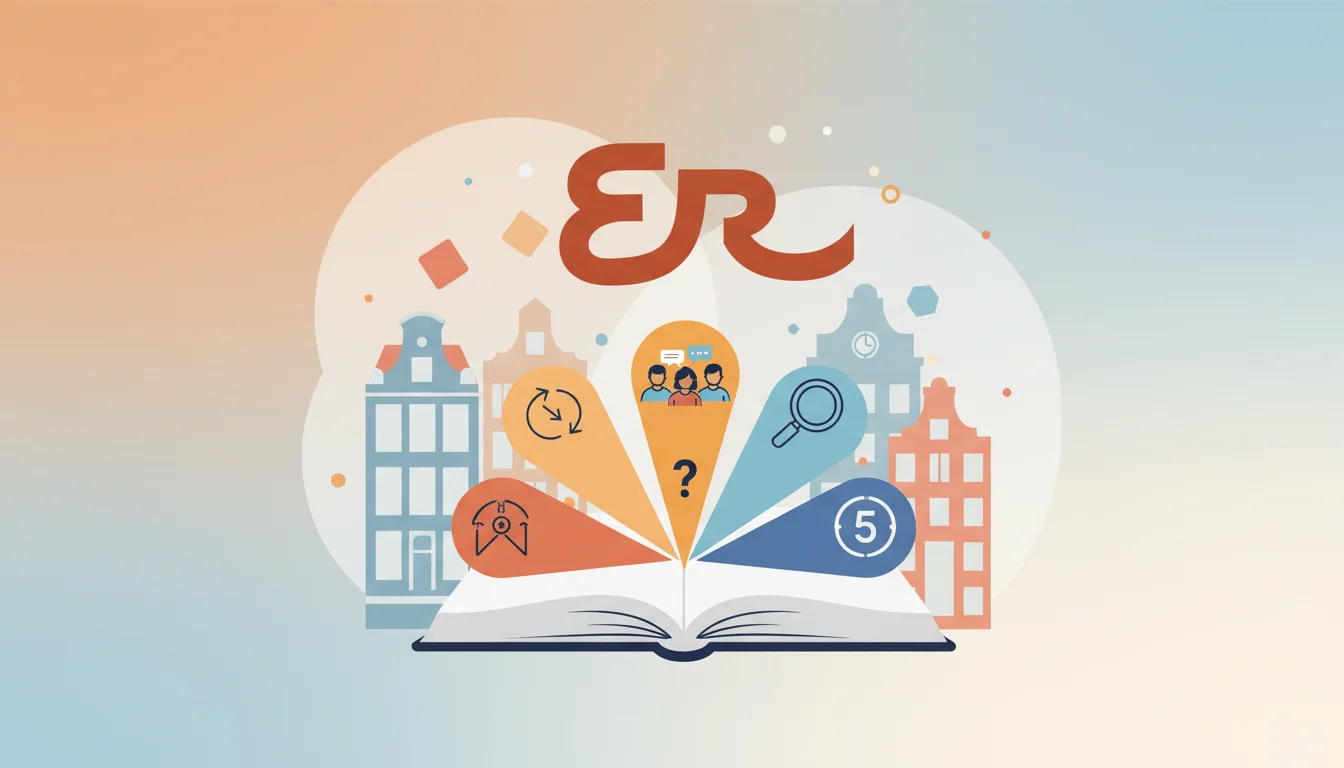
If you have been living in the Netherlands for a while, or if you have just started your journey into the Dutch language, you have undoubtedly encountered a tiny, two-letter word that seems to appear everywhere: er.
It is one of the most common words in the Dutch language, yet it is notoriously difficult for English speakers to master. Why? Because er is a shapeshifter. It doesn't translate to just one word in English. Sometimes it means "there," sometimes it means "of them," sometimes it replaces "it," and sometimes—frustratingly—it seems to mean nothing at all.
Many expats preparing for their Inburgering exam or simply trying to order a coffee without stumbling find themselves guessing where to put this elusive word. But fear not! While er is versatile, it follows logic. By breaking it down into five distinct functions, you can start using it with confidence.
Here are the 5 simple rules for using "er" in Dutch.
This is the easiest form of er to understand because it translates directly to the English word "there." You use this when referring to a location that has already been mentioned or is implied by context.
In Dutch, if someone asks if you are at a specific place, you usually cannot simply say "Yes, I am." You must include the location. If you don't want to repeat the name of the place, you use er.
Pro Tip: If you use a specific location name (like "in Amsterdam"), you don't use er. It's one or the other.
In English, we introduce a subject using "There is" or "There are." Dutch does the exact same thing using Er is (singular) or Er zijn (plural). This is used to state that something exists, usually with an indefinite subject (a man, some people, no milk).
Notice in the last example that Dutch often uses specific verbs of position (staan, liggen, zitten) instead of just "to be." Even then, er acts as the placeholder subject.
This is the usage that often trips up English speakers the most. In English, if someone asks, "How many cookies do you have?" you can simply answer, "I have two."
In Dutch, you cannot say "Ik heb twee." It feels incomplete to a Dutch ear. You must say, "I have two of them." That "of them" is translated by er.
Whenever you mention a number (een, twee, drie) or a quantity word (veel, weinig, genoeg) without repeating the noun, you must use er.
Mastering this small nuance is a great way to sound more native. If you are using StroopTaal, try practicing this in a conversation with the AI about shopping at a market. The app's AI will give you instant feedback if you drop the er when buying apples or ordering drinks!
Dutch grammar has a strict rule: you generally cannot combine a preposition (op, in, over, aan) directly with the pronoun "het" (it). Instead, the two words merge and transform.
The Formula: Preposition + Het → Er + Preposition
Furthermore, when they combine, "er" comes first, and they are often written as one word.
This construction is incredibly common. You will see words like erbij, erin, eraf, and erover constantly. While it looks intimidating, it is simply a way of pointing to an object mentioned earlier.
Finally, we have the passive use. This is often used to describe the general atmosphere or an action taking place where the specific person doing the action isn't important.
In English, we might say "There is dancing" or "People are laughing." In Dutch, we use er + passive verb.
This form is very common in news reports and formal announcements, making it essential for reading comprehension at the B1 and B2 levels. If you are writing formal reports, you might also need to understand the passive voice and word order to sound professional.
Understanding the rules is step one, but using them naturally in conversation is step two. Because er changes the sentence structure and rhythm, you need to train your brain to hear and say it automatically.
Here are a few ways to practice:
The word er is a small giant in the Dutch language. It acts as a pointer to place, a placeholder for subjects, a counter for quantities, and a partner for prepositions. While it may feel like a hurdle now, mastering these 5 rules is a major milestone in moving from "Expat Dutch" to fluent Dutch.
Don't be afraid to make mistakes—everyone does! The more you use it, the more natural it will feel. If you are still struggling with other tricky small words, you might also want to check out our guide on mastering nog and al.
Ready to master "er" and finally feel confident speaking Dutch? Download StroopTaal today for personalized lessons, pronunciation feedback, and daily conversation practice with Premium.
Share this article:
Is Dutch Word Order Driving You Crazy? If you have ever tried to construct a complex sentence in Dutch, you have likely felt a bit like Yoda. "I have...
Read moreThe Great Dutch Dilemma: De or Het? If you have ever stared at a Dutch word, frozen in panic, wondering whether to use de or het in front of it, you...
Read moreThe Notorious Guttural G If you have ever told a friend you are learning Dutch, they probably responded with a joke about clearing your throat. It is...
Read more