Studying Abroad in the Netherlands: The Definitive Guide
Studying abroad in the Netherlands means enrolling in a world-class higher education system—either a research university (WO) or a university of...
Read more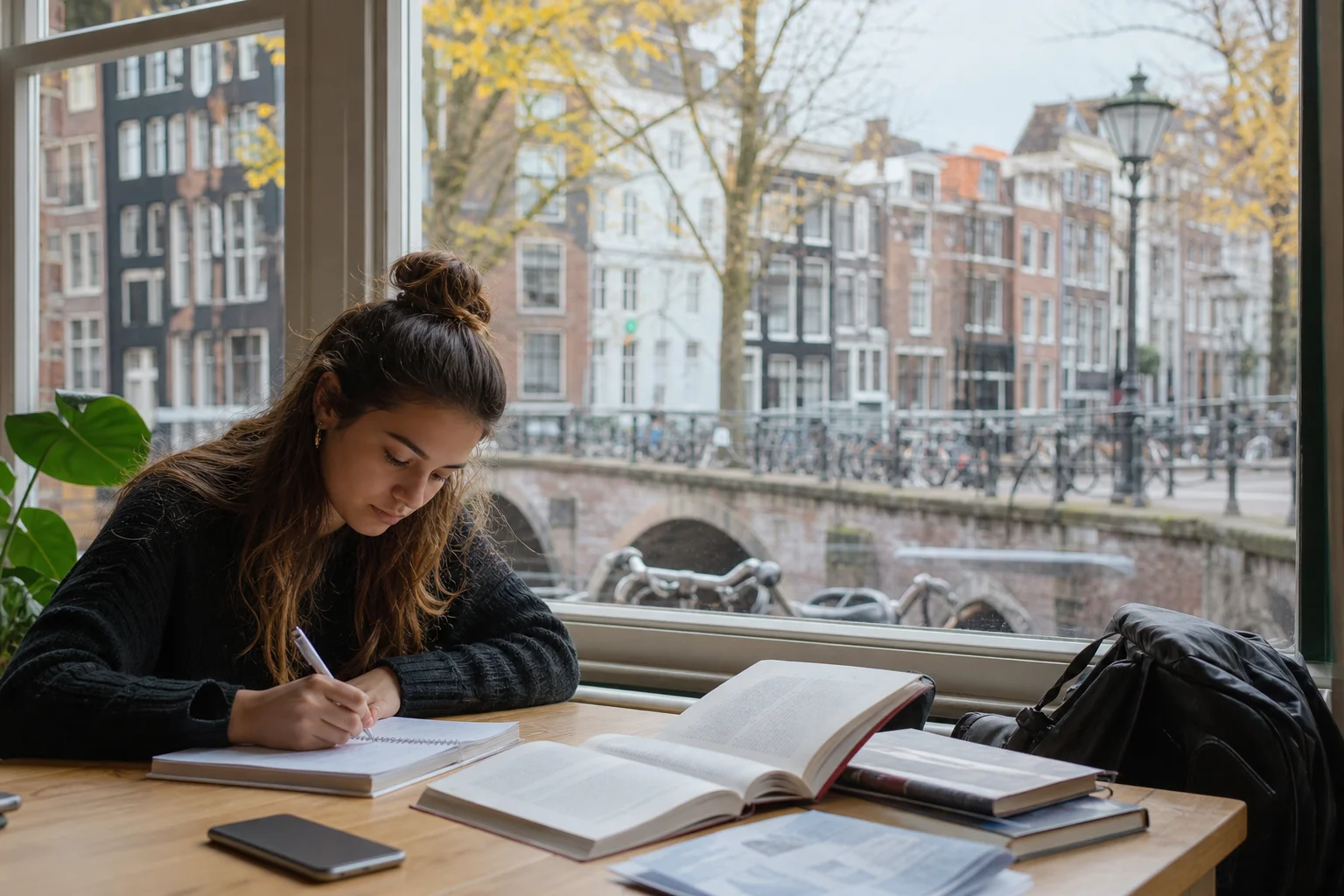
To study in Amsterdam, you must secure admission through Studielink or an accredited institution, line up housing well before arrival, apply for a residence permit via the IND (if you are non-EU/EEA), register with Gemeente Amsterdam for your BSN, and budget for tuition and living expenses. Thriving as a student in the Dutch capital also means finding productive study spaces across the city and learning conversational Dutch so you do not remain stuck in an international bubble.
Amsterdam is home to world-renowned research universities, universities of applied sciences (hogescholen), and specialized academies. However, relocating to and studying in the Netherlands involves strict bureaucratic procedures and an exceptionally competitive housing market. This guide covers every step of the journey: academic admissions, visas, municipal registration, budgeting, the best study spots, and how to master Dutch for daily life.
Before submitting any paperwork, determine which type of education matches your academic background and career goals. Dutch higher education operates on a binary system:
While Amsterdam has one of the highest concentrations of English-taught degree programs in continental Europe, many professional degrees (such as medicine, law, psychology, and primary education) require proficiency in Dutch. If you plan to enroll in a Dutch-language program, universities typically require proof of language proficiency at CEFR B2 level, usually achieved by preparing for the Staatsexamen NT2 (Programma II). According to DUO, the Staatsexamen NT2 costs €50 per component (€200 for the complete four-part examination).
Higher education admissions in the Netherlands are centralized through the national platform Studielink. Here is how the application cycle works:
While requirements vary by faculty, you will generally need:
Studying legally in Amsterdam requires adhering to Dutch immigration and municipal laws overseen by the national government and the Immigration and Naturalisation Service (IND).
If you hold a passport from outside the EU/EEA or Switzerland, you must obtain a student residence permit (verblijfsvergunning voor studie). Key points to keep in mind:
Anyone staying in the Netherlands for longer than four months is legally obligated to register with their local municipality (gemeente) within five business days of arriving. When you register with Gemeente Amsterdam at an appointed service desk, you receive your Burgerservicenummer (BSN). Your BSN is your citizen service number, required to open a Dutch bank account, take out health insurance, sign an employment contract, and interact with tax authorities.
To register, you must present a valid passport, an apostilled birth certificate (depending on your country of origin), and proof of address (a signed tenancy agreement or approval statement from your landlord).
The single greatest obstacle facing prospective students in Amsterdam is housing. The Dutch capital experiences an acute housing shortage, and universities in the Netherlands do not own traditional residential campuses. They have access to only a limited allocation of short-stay student rooms.
Amsterdam is an expensive European capital. A realistic monthly student budget typically ranges between €1,200 and €1,800, excluding non-EU tuition fees.
Tuition fees in the Netherlands depend on your nationality and the degree level:
EU/EEA students may work without restriction in the Netherlands. For non-EU/EEA students holding an IND student residence permit, strict employment regulations apply: you may work a maximum of 16 hours per week during the academic semester, or full-time during June, July, and August only. Your Dutch employer must obtain a work permit (TWV - Tewerkstellingsvergunning) on your behalf before you begin working.
Finding quiet, well-equipped places to read and prepare assignments outside your student room is essential for productivity. Amsterdam offers exceptional public and university study facilities:
Located near Amsterdam Centraal Station, OBA Oosterdok is one of the largest public libraries in Europe. It spans multiple floors with floor-to-ceiling windows overlooking the city waterfront. It offers dedicated quiet study floors, high-speed Wi-Fi, and power outlets. While browsing and general seating are open to the public, designated study desks during exam seasons may require an inexpensive OBA membership or desk reservation.
If you prefer a relaxed atmosphere with coffee and background ambient noise, look for laptop-friendly venues outside the canal ring. Neighborhoods like De Pijp, Amsterdam-Oost, and Oud-West feature cafes that welcome remote workers and students on weekdays, though many enforce "no laptop" rules during busy weekend brunch hours.
Because nearly everyone in Amsterdam speaks fluent English, it is easy to spend years in the city without learning Dutch. However, relying entirely on English comes with significant drawbacks: it isolates you from local student associations, limits your access to the broader Dutch job market after graduation, and complicates everyday tasks with government agencies, tax letters, and medical appointments.
Learning Dutch alongside your university coursework does not require hours of formal grammar classes every night. Consistent, bite-sized daily practice makes a noticeable difference. StroopTaal is an AI-powered Dutch learning app designed specifically for life, work, and integration in the Netherlands. With a structured lesson path running from absolute beginner (A0) to advanced proficiency (C1), StroopTaal teaches the real Dutch spoken on the streets of Amsterdam.
Between university lectures, you can use StroopTaal on your phone (available for iOS 18+ and Android 8.0+) to complete quick 5-to-15 minute interactive lessons featuring gap fills, dictation, and real-life listening scenes. StroopTaal includes Taalmaatje, an AI conversation partner that lets you make spoken calls out loud to practice real-life interactions—such as scheduling a doctor's visit or interviewing for a student job—with immediate feedback on your pronunciation and grammar. Pairing your campus life with active tools helps you gain confidence when practising speaking Dutch in daily situations, from ordering at a market stall on the Albert Cuyp to chatting with your Dutch flatmates.
To ensure a seamless transition to university life in the Netherlands, follow this operational checklist:
Studying in Amsterdam offers a high quality of education, a vibrant international student body, and an open, culturally rich lifestyle. Success depends on early planning: treat your housing search with the highest urgency, adhere strictly to visa and municipal registration timelines, and budget carefully for living costs. By combining your academic pursuits with active efforts to learn the local language, you can make the most of your student years in the Dutch capital.
Rules, fees and dates change. Check the current version on the official pages before you act.
Share this article:
Studying abroad in the Netherlands means enrolling in a world-class higher education system—either a research university (WO) or a university of...
Read moreWhen you start learning Dutch, one of the first decisions you face is how to spend your study time. Should you pop in your earbuds and repeat phrases...
Read moreWhy Dutch Vowels Feel Like an Obstacle Course Ask anyone learning Dutch in the Netherlands what keeps them up at night, and they will rarely say word...
Read more