Mastering 'Zou' vs 'Moest' in Dutch Conditional Sentences
Introduction: The Conditional Conundrum in Dutch Imagine you are chatting with a Dutch colleague during a koffiepauze (coffee break). You want to...
Read more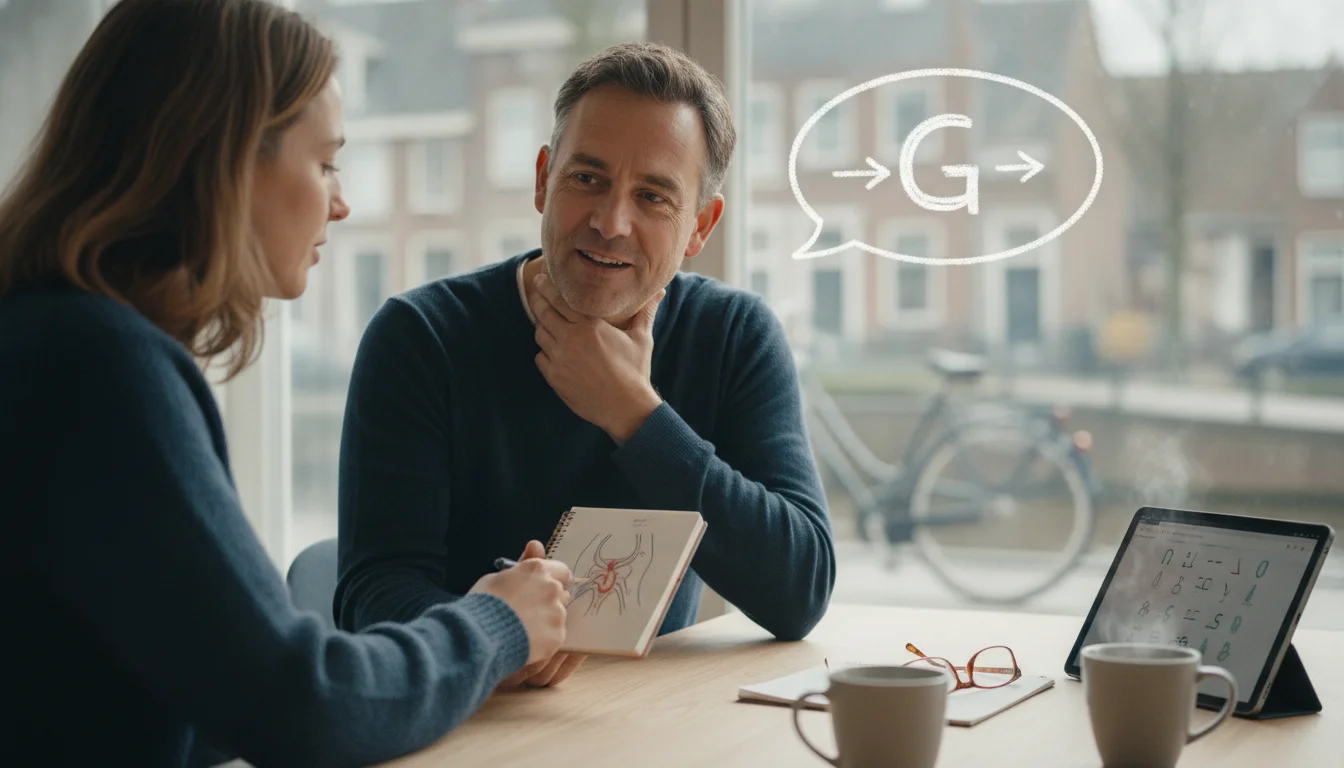
For many expats, international students, and highly skilled migrants arriving in the Netherlands, the Dutch language presents a formidable linguistic wall. You might have mastered basic vocabulary, figured out the word order, and even memorized how to count to ten. But then, you meet the ultimate gatekeeper: the notorious Dutch G sound.
Often described by foreigners as sounding like 'clearing your throat,' 'coughing up a hairball,' or even 'choking on a stroopwafel,' this unique sound can feel physically impossible to produce if your native language doesn't share it. However, mastering the Dutch 'G' is one of the most rewarding milestones of your language-learning journey. Not only does it boost your confidence when ordering a warm beverage on a rainy afternoon, but it also signals to native speakers that you are genuinely putting in the effort to integrate.
Whether you are navigating your expat guide for your Dutch tech job search or simply trying to greet your neighbors with a warm 'Goedemorgen', this step-by-step guide will demystify the Dutch 'G' and show you exactly how to make it without hurting your throat.
To pronounce the Dutch 'G' correctly, it helps to understand what is physically happening inside your mouth. In linguistics, the sounds represented by the letters G and CH in Dutch are known as fricatives. Specifically, they are usually classified as voiceless velar fricatives or uvular fricatives.
According to Wikipedia's overview of Dutch phonology, the exact place of articulation depends heavily on where you are in the country and the vowels surrounding the sound. Here is a breakdown of the two main types of 'G' you will encounter in the Netherlands:
In standard Dutch (Algemeen Nederlands), both versions are widely understood, though the Northern 'Hard G' is often taught as the standard in language courses. In this guide, we will focus primarily on mastering the classic, scraping 'Hard G', while also showing you how to soften it if you prefer.
If your native language is English, your brain is wired to pronounce 'G' as a hard stop (like in 'gate' or 'good') or a soft 'J' sound (like in 'giant'). To make the Dutch 'G', you have to reprogram your tongue and throat muscles. Follow these four steps to find the correct physical position:
Say the English word 'kick' or 'cat' slowly. Pay close attention to what the back of your tongue is doing when you make the 'K' sound. You should feel the very back of your tongue rise up and press firmly against the soft, fleshy roof of your mouth (the soft palate) to block the airflow entirely, before releasing it with a puff of air.
Now, try to make that same 'K' sound, but do not let your tongue touch the roof of your mouth completely. Leave a tiny, microscopic gap between the back of your tongue and your soft palate. Instead of stopping the air completely, force your breath through this narrow gap. You should hear a continuous, hissing, scraping sound. This friction is the essence of the Dutch 'G'.
Place your hand on your throat (specifically your larynx or Adam's apple). If you say 'Zzzz' or 'Vvvv', you should feel your vocal cords vibrating. If you say 'Ssss' or 'Ffff', there should be no vibration. The Dutch 'G' (and especially 'CH') is largely voiceless. Make sure your vocal cords are quiet; the sound should come purely from the air rushing past the back of your tongue.
If you are still struggling, try whispering the word 'loch' (as in Loch Ness) or the name of the composer 'Bach'. The 'ch' sound at the end of these words is phonetically identical to the Dutch 'G'. Once you can make that whispering sound at the end of a word, try moving it to the beginning of a word, like 'geel' (yellow) or 'gaan' (to go).
If the scraping 'Hard G' feels too unnatural, uncomfortable, or even painful, here is a secret: you don't have to use it. Thousands of Dutch people speak with a 'Soft G' (Zachte G) every single day, and it is considered highly charming and completely correct.
To make the Soft G, imagine you are sighing heavily, or making an 'H' sound, but with slightly more tension in the middle of your mouth. Your tongue should lie flatter, and the air should flow over it smoothly without the deep, throat-clearing scrape. If you plan to live or work in Eindhoven, Tilburg, or Maastricht, adopting the Soft G will actually help you blend in much better with the locals!
Now that you know the mechanics, it is time to put them into practice. We have grouped these practice words into three levels of difficulty. Read them aloud, focusing on maintaining steady airflow without fully blocking your throat.
Once you feel confident, try tackling these advanced words and phrases. They require rapid switching between different mouth shapes:
While physical explanations and reading guides are incredibly helpful, language acquisition is fundamentally an auditory and physical habit. You cannot learn to swim by reading a book, and you cannot master the Dutch 'G' without speaking and receiving feedback.
This is where modern technology can completely transform your learning curve. In the past, expats had to rely on expensive private tutors or brave the embarrassment of practicing on busy cashiers. Today, the StroopTaal app offers a highly sophisticated, stress-free alternative.
With StroopTaal's advanced pronunciation training with instant feedback, you can speak directly into your phone and receive real-time, pinpoint analysis of your accent. The AI-powered feedback tells you what to improve, helping you fine-tune the friction of your 'G' sound without any social anxiety. Furthermore, StroopTaal features immersive interactive dialogue games that simulate real-world Dutch scenarios. This allows you to practice tricky sounds in context, ensuring that when you finally step into a local bakery, your 'Goedemorgen, een volkorenbrood alstublieft' flows naturally and confidently.
Once you have nailed your pronunciation, you can easily shift your focus to other fascinating linguistic nuances, such as mastering how to use 'wel' in Dutch to add nuance and emphasis to your conversations.
To help you progress faster, keep an eye out for these common pitfalls that many English and Romance-language speakers fall into when learning Dutch:
Pronouncing the Dutch 'G' is not a matter of genetic luck; it is a physical skill that relies on muscle memory. Just like hitting the gym, the muscles in your tongue and soft palate will get stronger and more flexible the more you use them. Do not be afraid to make mistakes, sound a bit silly, or try out different regional variations until you find a style that feels comfortable for you.
By incorporating consistent daily practice, paying attention to your mouth's anatomy, and leveraging smart tools like StroopTaal, you can steadily close the gap between sounding like a tourist and sounding more natural. Whether you are settling in for the long haul, learning about your employee rights and labor laws in the Netherlands, or preparing for your integration exams, mastering this one signature sound will open doors, spark friendly smiles, and make you feel truly at home in the lowlands.
Ready to take your Dutch pronunciation to the next level? Download the StroopTaal app today to start practicing with our AI-powered pronunciation trainer and unlock your personalized Dutch learning plan!
Share this article:
Introduction: The Conditional Conundrum in Dutch Imagine you are chatting with a Dutch colleague during a koffiepauze (coffee break). You want to...
Read moreMastering the Art of Comparison in Dutch Imagine you are sitting outside, enjoying a sunny afternoon on a Dutch terrace. You want to order another...
Read moreThe Mystery of the Untranslatable Dutch Word: 'Wel' If you have spent any amount of time listening to native Dutch speakers, you have undoubtedly...
Read more