Mastering the 10 Most Common Dutch Irregular Verbs
If you have started learning Dutch, you have likely noticed that the language is often praised for its logical structure. The rules for the...
Read more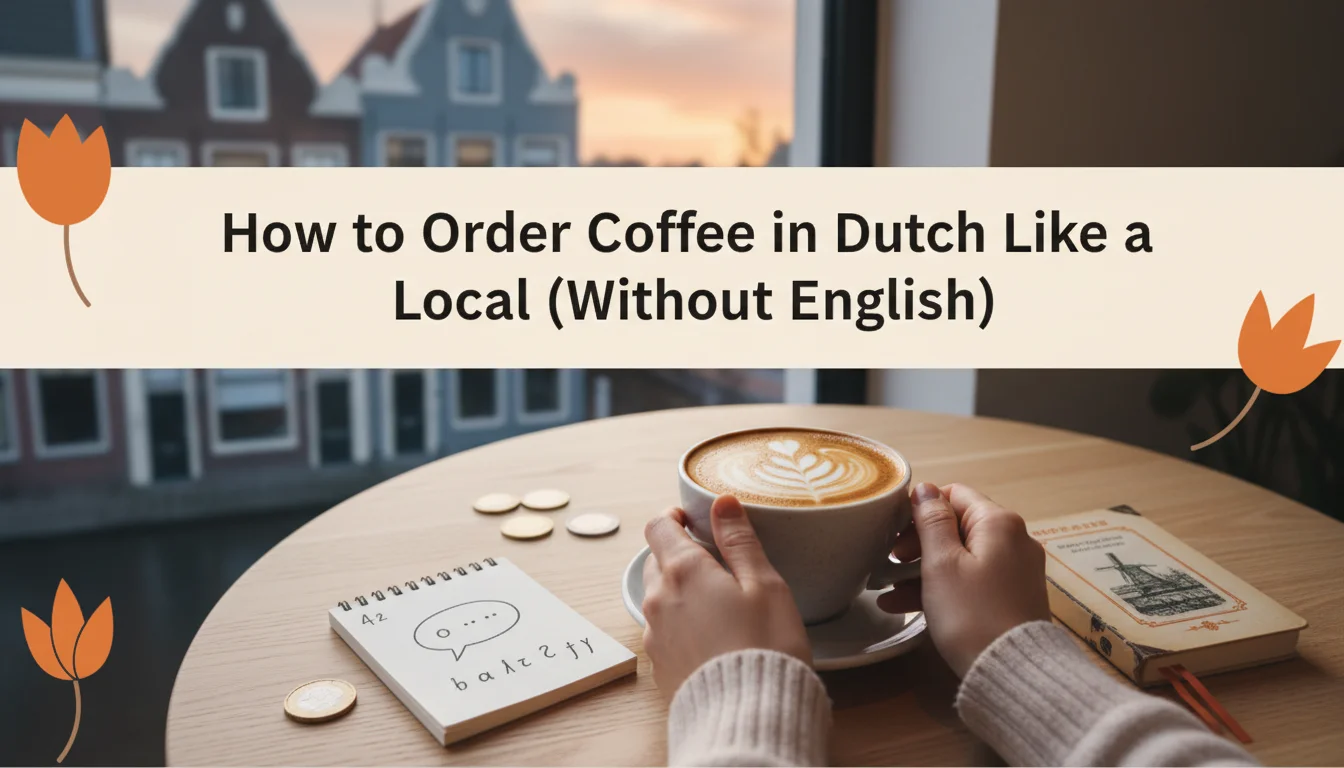
Picture this: You are sitting on a sunny terrace in Utrecht or Amsterdam. The waiter approaches, a notepad in hand. You take a deep breath, ready to order your morning caffeine fix. But then, panic sets in. You freeze, smile awkwardly, and utter the phrase that defeats every language learner's purpose: "Sorry, do you speak English?"
We have all been there. The Netherlands is famous for its high English proficiency, which is both a blessing and a curse for expats and learners. It makes settling in easy, but it can make learning Dutch surprisingly difficult. The moment a Dutch person detects a hint of hesitation, they helpfully switch to English.
But not today. Today, you are going to learn exactly how to order your coffee in Dutch, handle the payment, and navigate the menu with confidence. Let’s get you ready to order your koffie like a true local.
Before you can speak, you need to know what you are asking for. Dutch coffee culture is strong, and while you will find standard Italian varieties everywhere, there are a few local terms you should know.
The Netherlands has embraced modern coffee trends, so you aren't limited to cow's milk anymore.
The exact term for coffee in Dutch is koffie, pronounced with a hard 'k' sound and a short 'o' sound like ("KOF-ee"). If you are searching for Dutch for coffee or double-checking common online spelling mistakes like "coffe in dutch", remember that Dutch spelling always requires a 'k' and double 'f'. Knowing how to pronounce coffee in Dutch correctly builds instant credibility when ordering at local counters. For an in-depth breakdown of terminology behind the espresso bar, check out our guide on Dutch for baristas.
Dutch directness is famous, but when ordering, politeness is key. You don't just bark "Koffie!" at the waiter. Here are the sentence structures you need.
This is the most versatile phrase in your arsenal.
Use this when you want to sound intentional and polite. This is a great way to practice polite requests in a real-world setting.
Pro Tip: The word graag (please/gladly) contains that infamous Dutch "G" sound. It can be intimidating! If you are struggling with pronunciation, this is where the StroopTaal app becomes your best friend. You can use the pronunciation training feature to practice that guttural "G" until you get instant feedback, so you feel more confident when the waiter is waiting for your order.
To know how to order in Dutch at any café, bakery, or restaurant, combine the polite starter "Mag ik..." (May I have...) with your item and end with "alsjeblieft" (please). Learning how to order in Dutch across different settings relies on three simple phrase templates that work everywhere: "Mag ik...", "Ik wil graag..." (I would like...), and "Voor mij..." (For me...). When ordering multiple beverages or treats, remember basic pluralization rules, such as those explained in our guide to mastering Dutch plural nouns, so you can confidently ask for twee koffies or drie espresso's without breaking character.
Let’s walk through a typical interaction so you aren't caught off guard by the waiter's questions.
Waiter: "Goedemorgen! Zeg het maar." (Good morning! Say it / What can I get you?)
You: "Goedemorgen. Mag ik een cappuccino met havermelk?" (Good morning. May I have a cappuccino with oat milk?)
Waiter: "Natuurlijk. Anders nog iets?" (Of course. Anything else?)
You: "Ja, heeft u ook appeltaart?" (Yes, do you also have apple pie?)
Waiter: "Zeker. Met slagroom?" (Certainly. With whipped cream?)
You: "Ja, lekker." (Yes, tasty/sounds good.)
Waiter: "Komt eraan!" (Coming right up!)
If you are at a train station kiosk or a counter, they might ask: "Meenemen of hier opdrinken?"
To successfully learn how to order coffee in Amsterdam without baristas switching to English, state your entire drink order immediately in confident Dutch as soon as you step up to the counter. Amsterdam specialty cafés and neighborhood spots feature many international staff and fast-moving service queues, meaning baristas switch to English at the slightest sign of hesitation. By greeting the server with "Goedemorgen, mag ik een cappuccino met havermelk, alsjeblieft?" before they initiate in English, you establish Dutch as the language of the conversation. Practice your order beforehand using StroopTaal so you can deliver your line naturally even in busy central locations like the Jordaan or De Pijp.
In the Netherlands, cash is becoming increasingly rare. In fact, many coffee spots are "Pin Only" (debit card only). Here is how to handle the bill.
When you are ready to leave, catch the waiter's eye (or raise a hand slightly) and say:
The waiter will likely arrive with a handheld terminal and ask: "Pinnen?"
You simply reply: "Ja, graag."
To truly blend in, you need to understand the unspoken rules of the Dutch café.
Almost every coffee in the Netherlands comes with a single, small cookie on the saucer. This is a miniature institution of Dutch hospitality. Do you eat it first? Dip it? Save it? There are no strict rules, but it is a delightful bonus. Just don't expect a giant American-style muffin unless you order one specifically.
As soon as the temperature rises above 15 degrees Celsius, Dutch people flock to the terraces (het terras). If you see an empty table, you can usually just sit down; you don't always need to wait to be seated unless a sign says "Wachten op plaats."
Reading this guide is step one, but speaking is step two. The anxiety of speaking a new language in a busy environment is real. That is why preparation is key.
Before you head to that hip café in the Jordaan or Witte de Withstraat, try simulating the experience. StroopTaal’s interactive dialogue games allow you to roleplay ordering coffee in a risk-free environment. You can chat with our AI to practice ordering complicated drinks, asking for the bill, or even making small talk about the weather, all while building your vocabulary and confidence.
Ordering coffee is often the first milestone in learning a new language. It is a small interaction, but succeeding gives you a massive confidence boost. Remember, Dutch people appreciate it when you try. Even if your grammar isn't perfect, the effort shows you are respecting their culture. To avoid common mistakes, you might want to review some Dutch false friends before you head out.
So next time, leave the English at the door. Walk in, smile, and say: "Eén koffie verkeerd, alsjeblieft!" With these phrases, you have everything you need to order confidently and keep the conversation in Dutch.
Ready to take your Dutch beyond the coffee shop? Download StroopTaal today and start your personalized learning journey towards fluency!
Share this article:
If you have started learning Dutch, you have likely noticed that the language is often praised for its logical structure. The rules for the...
Read moreThe Great Dutch Dilemma: To Be Formal or Informal? Imagine walking into a bakery in Amsterdam. You smile at the baker and confidently ask for a loaf...
Read moreThe Dutch Alphabet: Your Key to Clear Pronunciation If you want to sound confident in Dutch, you can't skip the alphabet. While the Dutch alphabet...
Read more