
Why Daily Micro-Learning is Key to Conversational Dutch
If you have lived in the Netherlands for any amount of time, you are likely familiar with the expat paradox: you genuinely want to speak Dutch, but...
Read more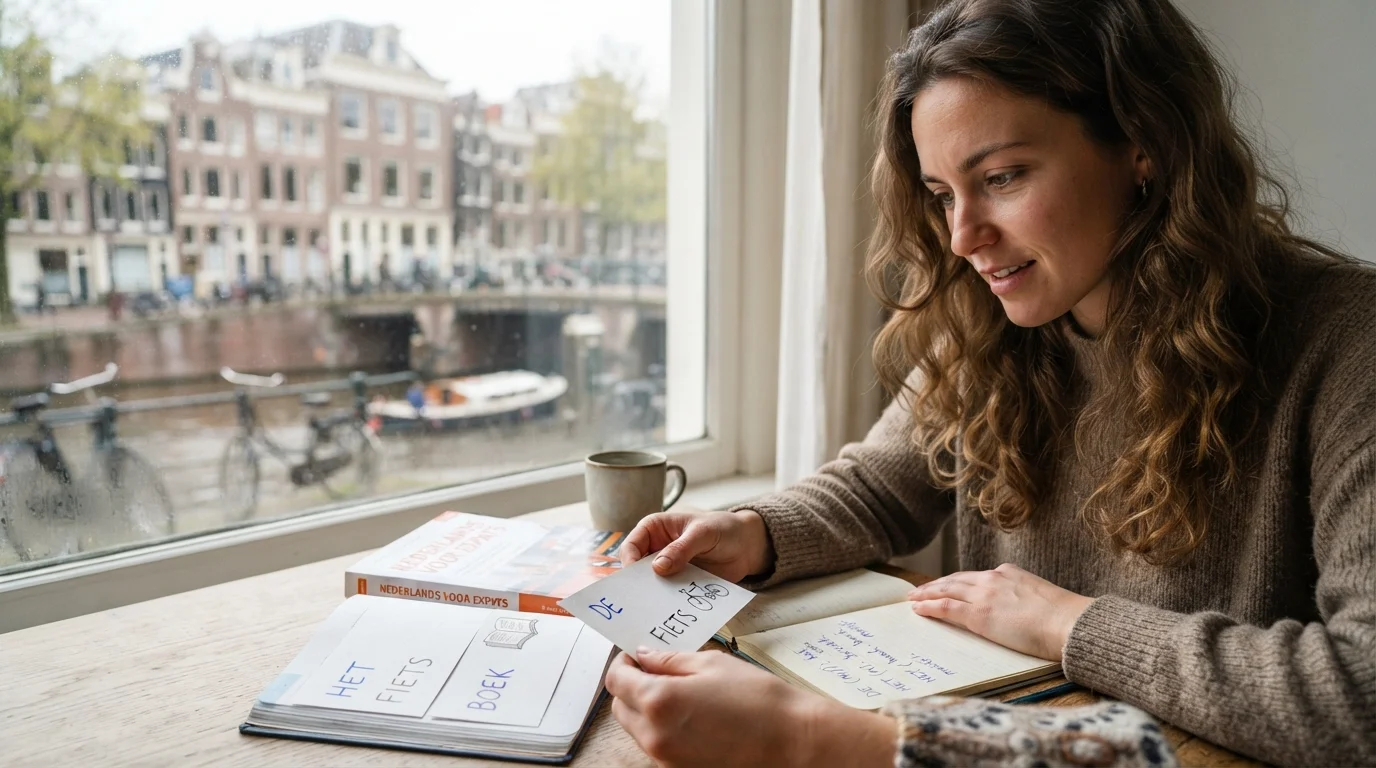
If you have ever stood at a bakery counter in Amsterdam wondering whether to ask for het brood or de brood, you are not alone. For almost every expat living in the Netherlands, mastering Dutch noun genders feels like an endless guessing game. With roughly 75% of nouns taking de and 25% taking het, the odds might seem in your favor, but guessing will quickly unravel your adjective endings, relative pronouns, and overall conversational confidence.
Fortunately, you do not have to rely on blind luck or brute-force memorization. By combining cognitive science—specifically Spaced Repetition Systems (SRS)—with strategic pattern recognition, you can cement Dutch noun genders into your long-term memory. In this comprehensive guide, we will break down why traditional study methods fail, reveal the hidden rules behind Dutch genders, and show you how to build an effortless daily retention routine.
In many languages, grammatical gender is clearly telegraphed by noun endings (like -o and -a in Spanish or Italian). Dutch, however, has evolved over centuries from a three-gender system (masculine, feminine, neuter) into a common/neuter system. Masculine and feminine nouns merged into the common gender governed by de, while neuter nouns kept het. According to official linguistic overviews of Dutch grammar, this historical merger leaves few obvious spelling markers on the surface of root nouns.
Why does getting the article right matter so much in daily life?
Rote memorization—staring at a static list of 500 nouns—rarely works because our brains are not wired to retain disconnected facts. In fact, many learners discover that traditional flashcard apps fail for Dutch grammatical gender because they treat words as isolated definitions rather than structural building blocks.
Before plugging hundreds of nouns into a spaced repetition schedule, you should eliminate the low-hanging fruit. While no single rule covers every word, about 30–40% of Dutch vocabulary follows predictable morphological patterns.
You can automatically assign het to the following categories without second-guessing:
Conversely, you can reliably use de for:
Recognizing these patterns gives you an immediate head start when building a foundational Dutch vocabulary.
What about the thousands of monomorphemic root nouns (like stoel, tafel, boek, raam, vloer) that follow no obvious rule? This is where Spaced Repetition becomes indispensable.
Rooted in Hermann Ebbinghaus’s research on the Forgetting Curve, spaced repetition introduces intervals of review that expand exponentially as a memory strengthens. Instead of reviewing a card 10 times in one afternoon, an SRS algorithm prompts you to recall the noun gender right before your brain is about to discard it—say, on Day 1, Day 3, Day 8, Day 21, and Day 60.
The SRS Memory Curve for Nouns
Initial Review (10 min) → First Recall (24 hrs) → Reinforcement (4 days) → Permanent Retrieval (2+ weeks)
By forcing active retrieval rather than passive recognition, your brain establishes robust neural pathways. However, to maximize SRS for Dutch noun genders, you must structure your reviews strategically.
When you add a new Dutch word to your study queue, never write just the noun. If your flashcard says tafel = table, your brain stores the concept of a table and neglects the grammatical article. Treat the article as an inseparable syllable of the word: it is not tafel, it is de tafel; not raam, but het raam.
To make the mental association even stickier, add an adjective into the prompt: het grote raam or de rode appel. This cements both the noun gender and the matching inflectional ending simultaneously.
Visual and sensory associations dramatically decrease the time needed to commit an abstract grammatical rule to memory:
A frequent trap with standard flashcard decks is assuming you know a word because you recognize its English definition. You might see het vliegveld and think, "Airport! Easy!"—completely ignoring whether it was de or het.
Structure your spaced repetition sessions with dedicated article quizzes. Challenge yourself specifically: “___ station (de/het)?” If you pick the wrong article, mark the card as failed, even if you knew what the word meant in English.
Flashcards alone can only take you so far. Real fluency happens when you recall articles spontaneously in spoken dialogue. This is where modern language tools outshine legacy decks.
For example, the StroopTaal app combines structured spaced repetition with interactive article mastery games and conversational AI simulations. Instead of tapping through static cards, you practice applying de and het inside real-life Dutch scenarios—such as ordering groceries, renting an apartment, or chatting with colleagues—receiving instant pronunciation and grammatical feedback when an adjective or article slips up. Exploring specialized apps designed to master de and het gives you an edge in building reflexive habits rather than slow, deliberate mental calculations.
| Common Mistake | Why It Happens | How to Correct It |
|---|---|---|
| Defaulting to “De” for everything | Because 75% of nouns use de, learners guess it by default. | Focus dedicated study blocks exclusively on high-frequency het nouns until they feel distinct. |
| Forgetting diminutive overrides | Assuming the base word's gender carries over (e.g., saying de biertje because of het bier). | Memorize the cardinal rule: Every single diminutive ends in -je and takes het. |
| Over-inflecting adjectives with het | Applying the standard -e ending to neuter nouns with indefinite articles (een mooie huis). | Practice triad phrases using SRS: het huis → het mooie huis → een mooi huis. |
Consistency beats intensity every single time when acquiring grammatical reflexes. Here is an easy-to-follow daily routine designed for busy expats:
Within three to four weeks of maintaining this micro-routine, you will notice a profound shift: choosing between de and het will stop feeling like an intellectual deduction and begin feeling like an intuitive reflex.
Mastering de vs. het does not require you to memorize the entire Dutch dictionary by heart. By understanding the core categorical rules, bundling articles directly with nouns, and letting spaced repetition do the heavy lifting of scheduling reviews, you can eliminate hesitation and speak Dutch with natural fluidity.
Ready to supercharge your Dutch vocabulary and conquer noun genders once and for all? Start implementing spaced repetition into your daily routine today, and watch your conversational confidence transform.
Share this article:
If you have lived in the Netherlands for any amount of time, you are likely familiar with the expat paradox: you genuinely want to speak Dutch, but...
Read moreIf you have ever spent an evening staring at Dutch vocabulary flashcards wondering why a table is de tafel but a house is het huis, you are in good...
Read moreReaching the B1 level in Dutch is widely considered the ultimate milestone for expats, international professionals, and prospective citizens. At the...
Read more