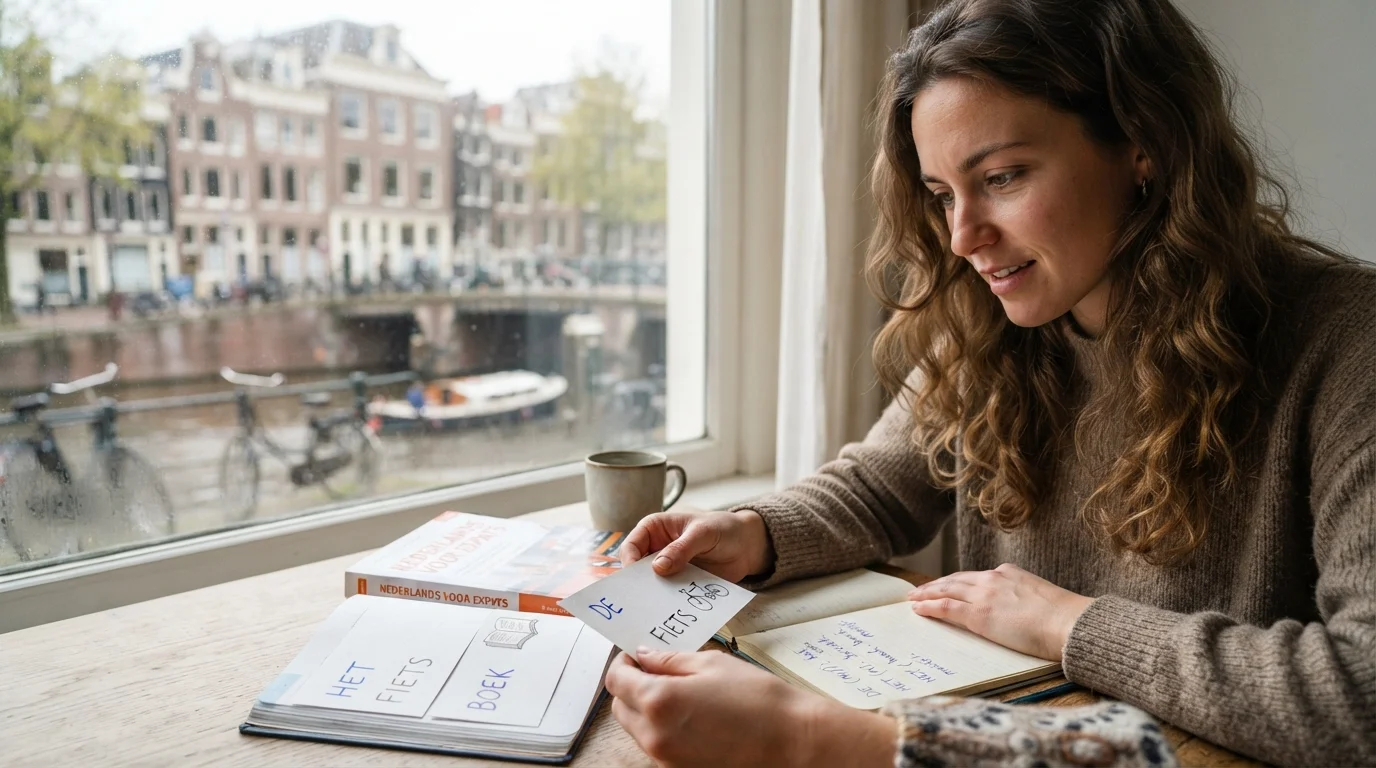
How to Memorize Dutch Noun Genders: Spaced Repetition Tips for Expats
If you have ever stood at a bakery counter in Amsterdam wondering whether to ask for het brood or de brood, you are not alone. For almost every expat...
Read more
If you have ever spent an evening staring at Dutch vocabulary flashcards wondering why a table is de tafel but a house is het huis, you are in good company. For expats, international professionals, and language enthusiasts tackling Dutch, the distinction between de and het is notoriously one of the most frustrating hurdles on the path to fluency.
Unlike languages with clear gender endings like Spanish or Italian, Dutch grammatical gender often feels arbitrary to beginners. Yet, getting your articles right is foundational: it dictates adjective endings, demonstrative pronouns (deze vs. dit), and relative pronouns (die vs. dat). In this guide, we explore why this grammatical quirk is so challenging, outline the core rules you can rely on, and review how modern grammar apps—especially specialized platforms like StroopTaal—can help you permanently master Dutch articles.
In modern Dutch, nouns are divided into two primary grammatical genders: common gender (which takes the article de) and neuter gender (which takes the article het). Historically, Dutch had a three-gender system (masculine, feminine, neuter) similar to German, but masculine and feminine gradually merged into the common gender category over centuries. For a deeper historical breakdown, linguistic resources like Wikipedia's overview of Dutch grammatical gender offer fascinating insights into this evolution.
Statistically, roughly 75% of Dutch nouns take de, while only about 25% take het. While those odds might tempt you to guess de every time, guessing creates severe downstream errors in your spoken and written Dutch:
Because these articles act as the connective tissue of Dutch syntax, mastering them early accelerates your overall comprehension and confidence.
While many nouns must simply be memorized, Dutch grammar does provide reliable patterns. Memorizing these structural rules will help you correctly identify hundreds of words without looking them up.
Most learners instinctively turn to mobile apps to learn Dutch. However, not all apps approach grammar and article acquisition with equal effectiveness. Understanding how different methodologies impact your retention is crucial when selecting the right tool.
Traditional generic flashcard apps often isolate words from their grammatical reality. If you practice a flashcard that displays "house = huis," you lose the intrinsic bond between the article and the noun. To understand why rote memorization often stalls your progress, read our detailed analysis on why traditional flashcard apps fail for Dutch grammatical gender.
When comparing the best Dutch learning apps for expats, look for systems that integrate three vital educational principles:
StroopTaal was engineered specifically to solve the unique roadblocks learners face when mastering Dutch grammar from A0 beginner stages up to C1 fluency. Rather than treating grammatical gender as an afterthought, StroopTaal makes article mastery an engaging, core component of daily study.
Instead of endless static flashcards, StroopTaal features rapid-fire Article Mastery Games. These games ask you to match nouns with the right article again and again, helping your brain move from slow analytical calculation to instinctual pattern recognition. By gamifying the repetition, you build the rapid recall required for fluid, real-time conversations.
No two learners struggle with the same vocabulary. StroopTaal utilizes an adaptive AI engine that analyzes your mistakes during dialogue sessions and grammar drills. If you consistently confuse the gender of compound nouns or abstract terms, your personalized curriculum automatically serves targeted exercises and spaced repetition reviews to address those exact gaps.
Memorizing isolated articles is only half the battle; applying them under conversational pressure is what creates true fluency. StroopTaal features AI-driven real-life Dutch conversation practice where you converse in realistic situations—such as ordering at a café, speaking with municipal offices (gemeente), or discussing workplace tasks. The app provides instant, gentle grammar corrections whenever an article or adjective ending slips up, ensuring you never fossilize bad habits.
Regardless of the tools you use, combining smart learning habits with effective software guarantees faster results. Here are four practical techniques you can apply immediately:
Whenever you write down or review a new Dutch word, treat the article as an inseparable syllable of the word itself. Do not memorize tafel; memorize de tafel. Do not record kantoor; record het kantoor. When you vocalize the word, always pronounce the article along with it.
Dutch loves long, compound words (e.g., het ziekenhuis, de koffiezetapparaat). The golden rule of compound nouns in Dutch is simple: the final noun determines the gender of the entire compound.
Grammar elements do not live in silos. Practicing full clauses that combine subject pronouns, conjugated verbs, and direct objects reinforces sentence structure comprehensively. To streamline your daily grammar routine, check out our guide on how to master Dutch verb conjugations with spaced repetition.
Visual learners benefit enormously from color association. In your digital notes or physical notebooks, highlight all de words in blue and all het words in orange or green. Over time, your mind will recall the visual hue associated with a concept whenever you prepare to speak.
Mastering de and het is not an impossible puzzle reserved for native speakers—it is a skill built through systematic rule application, contextual exposure, and smart repetition. By understanding the underlying structural patterns and utilizing dedicated interactive tools like StroopTaal, you can replace hesitation with natural confidence.
Ready to conquer Dutch grammar once and for all? Explore StroopTaal's AI-powered learning plans, article mastery games, and real-life dialogue simulations to elevate your Dutch skills today.
Share this article:
If you have ever stood at a bakery counter in Amsterdam wondering whether to ask for het brood or de brood, you are not alone. For almost every expat...
Read moreReaching the B1 level in Dutch is widely considered the ultimate milestone for expats, international professionals, and prospective citizens. At the...
Read moreWhen you start learning Dutch, it does not take long to hit the infamous "intermediate plateau." You might know isolated vocabulary words like fiets...
Read more