Demystifying Dutch Relative Clauses: Using 'Die', 'Dat', and 'Wat' Correctly
Have you ever found yourself mid-sentence in a Dutch conversation, wanting to add a crucial detail, only to freeze up? You want to say, "The book...
Read more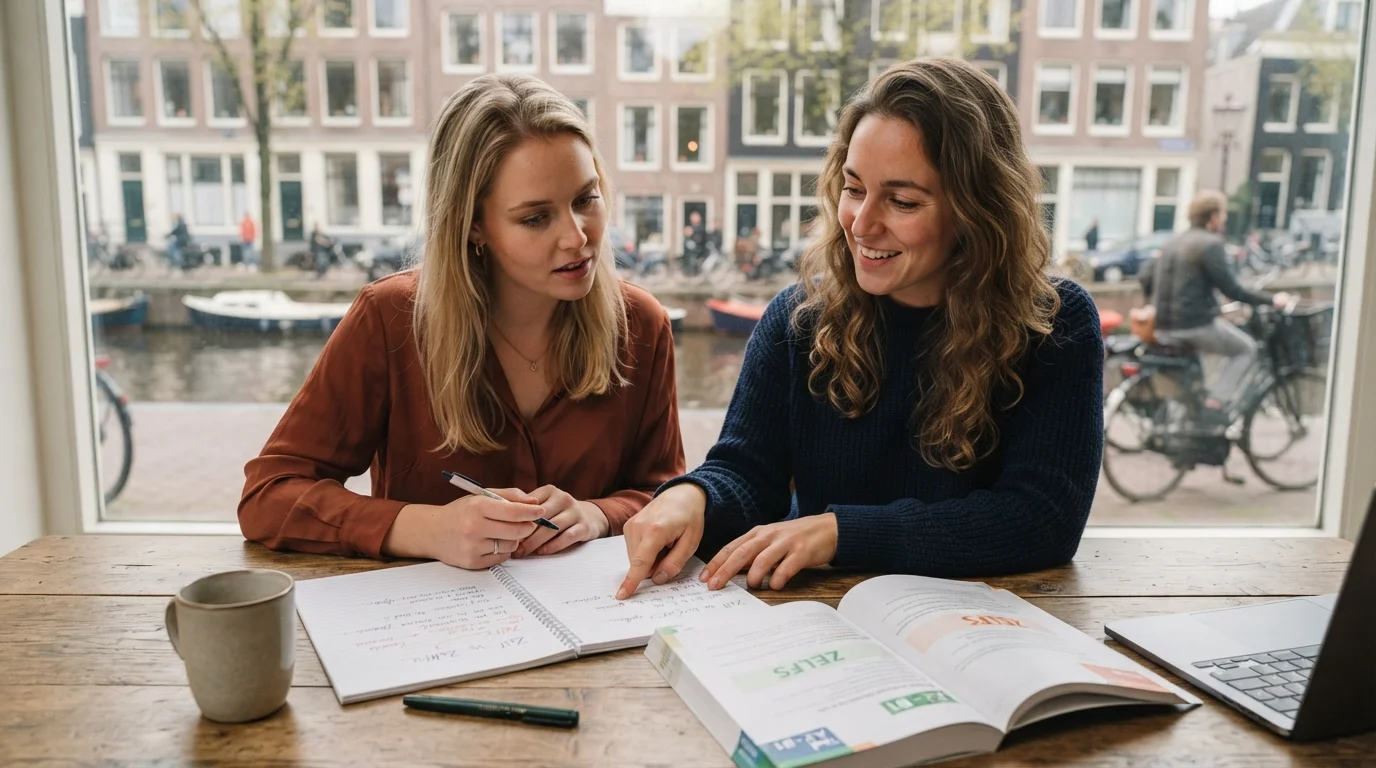
Imagine you are chatting with your Dutch neighbor over a cup of coffee. You want to tell them, "I painted the living room myself." Confidently, you say: "Ik heb de woonkamer zelfs geschilderd." Your neighbor looks at you with wide, surprised eyes. Why? Because instead of saying you did it yourself, you actually just said: "I even painted the living room" (implying that painting the living room was an extreme, shocking feat for someone like you!).
In the Dutch language, a single letter can entirely transform the meaning of your sentence. This is precisely the case with 'zelf' and 'zelfs'. These two words look nearly identical, sound very similar, yet serve completely different grammatical functions. For expats, language learners, and those preparing for their civic integration exams (inburgeringsexamen), mixing them up is one of the most common pitfalls.
In this comprehensive guide, we will break down the exact differences between 'zelf' and 'zelfs', explore their grammatical structures, look at real-life conversational examples, and provide you with actionable strategies to never mix them up again.
At its core, the word 'zelf' translates to "myself," "yourself," "himself," "herself," "itself," "ourselves," or "themselves" in English. It is an intensive pronoun used to emphasize that the subject of the sentence performed the action personally, without help from anyone else.
Just like mastering other tricky particles in the language, such as learning how to use 'er' in Dutch, understanding where to place 'zelf' is crucial for natural-sounding speech.
Let's look at how 'zelf' is used in everyday scenarios:
If you want to describe a homemade meal that tastes absolutely incredible, you might also want to brush up on the versatile word 'lekker' to compliment the cook!
Now, let's add that tiny, powerful letter 's'. The word 'zelfs' translates directly to "even" in English. It is an adverb used to express surprise, emphasis, or to highlight an extreme, unexpected situation.
Unlike 'zelf', which focuses on who did the action, 'zelfs' focuses on the unexpected nature of the action or the subject itself.
Notice how 'zelfs' introduces an element of shock or exaggeration:
To help you visualize the difference, let's look at how adding or removing the 's' completely alters the meaning of identical sentence structures. This is one of those classic areas where learners stumble, similar to the traps found in 10 Dutch false friends that can completely change your intended meaning.
Study these contrastive pairs closely:
As you can see, confusing these two words can lead to hilarious, confusing, or slightly insulting misunderstandings in professional and social settings!
Both words are highly active in Dutch vocabulary and form the basis of several common compound words and idiomatic expressions. Understanding these will instantly boost your fluency and help you sound more like a native speaker.
Memorizing rules from a screen is a great start, but the real challenge is applying them dynamically during rapid-fire Dutch conversations. When you are speaking, you do not have time to pause and think: "Do I need an intensive pronoun or an adverb of surprise here?"
This is where StroopTaal comes in. Designed specifically for expats and language learners who want to bridge the gap between textbook grammar and real-world fluency, StroopTaal offers targeted, interactive features to make these linguistic differences second nature:
By practicing just 10 to 15 minutes a day, you can build the muscle memory required to speak Dutch naturally, effortlessly distinguishing between subtle word variations.
Mastering the subtle nuances of Dutch grammar principles can feel overwhelming at first, but breaking them down into logical categories makes the journey much easier. Remember this simple rule of thumb next time you speak:
Zelf = Done by "self" | Zelfs = "Even" (with an 's' for Surprise!)
Don't let the fear of making mistakes hold you back. Every slip-up is a stepping stone to fluency. Start paying attention to these words in the podcasts you listen to, the articles you read, and the conversations you have around you.
Are you ready to take your Dutch speaking, grammar, and pronunciation to the next level? Download the StroopTaal app today and start practicing with your own personalized AI language coach!
Share this article:
Have you ever found yourself mid-sentence in a Dutch conversation, wanting to add a crucial detail, only to freeze up? You want to say, "The book...
Read moreWhy the Dutch Passive Voice Matters for Expats and Learners If you have ever tried reading an official letter from the Dutch tax office...
Read moreImagine this: You step off the train at Utrecht Centraal on a crisp autumn morning. You walk into a local bakery, and the aroma of fresh stroopwafels...
Read more